Myrtle Beach, South Carolina – An international coalition announced a $19 million research project aimed at understanding how a farmer or rancher’s grazing management decisions impact soil health on pasture and rangeland (commonly called grazing lands) and – in turn – how soil health can positively impact a producer’s land and well-being.
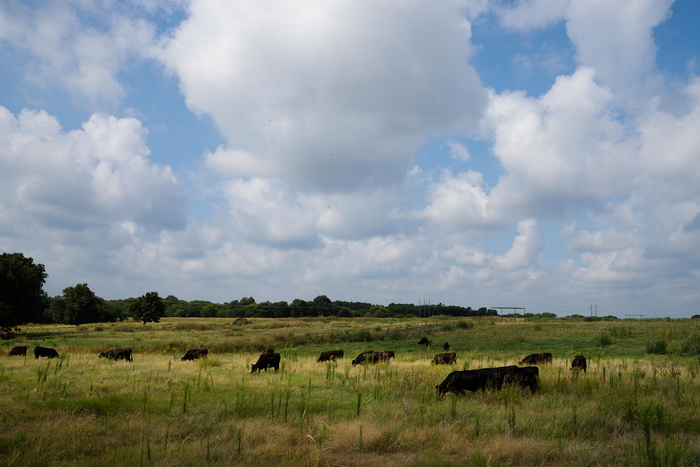
Credit: Noble Research Institute
Myrtle Beach, South Carolina – An international coalition announced a $19 million research project aimed at understanding how a farmer or rancher’s grazing management decisions impact soil health on pasture and rangeland (commonly called grazing lands) and – in turn – how soil health can positively impact a producer’s land and well-being.
Entitled Metrics, Management, and Monitoring: An Investigation of Pasture and Rangeland Soil Health and its Drivers, the project was announced today at the National Grazing Lands Coalition triennial meeting. The Foundation for Food & Agriculture Research awarded Noble Research Institute a $9.5 million grant to lead this critical research that is improving soil health on grazing lands. Noble Research Institute is providing $7.5 million to this project with additional financial contributions by Greenacres Foundation, The Jones Family Foundation and ButcherBox.
Pasture and rangeland soils contain about 20 percent of the world’s soil organic carbon stock but have largely deteriorated in many regions due to poor management, fragmentation or conversion to cropland. As soil health decreases, the land loses its viability to grow healthy plants, maintain flood- and drought-resilience or filter water.
For decades, farmers and ranchers who have implemented soil health principles have improved the overall health of their land and have experienced more profitable operations, however, these observations have – to this point – been largely anecdotal. This research is quantifying these observations and examining how management decisions on grazing lands are connected to the overall health of the ecosystem, including the social and economic well-being of the farmer, rancher and land manager.
“Enhancing soil resilience and productivity necessitates a major investment in research that provides farmers and ranchers with the best tools and information to make informed decisions benefitting their operations, said FFAR Executive Director Dr. Sally Rockey. “FFAR is proud to fund this audacious research that supports thriving farms and ranches while improving overall environmental health for the betterment of society.”
The project brings together researchers from 11 nonprofit organizations, for-profit businesses, private research institutes and public universities in the United States and the United Kingdom. Led by Noble Research Institute, Michigan State University, Colorado State University and the University of Wyoming, collaborators include Oregon State University, National Grazing Lands Coalition, USDA-ARS (Maryland, Colorado and Wyoming), Savory Institute, Snaplands LLC, The Nature Conservancy and the UK’s Quanterra Systems.
The project will provide farmers and ranchers tools that simply and accurately measure outcomes of soil health in grazing land environments to guide management decisions and quantify the impact of intentional management. Measuring soil health requires techniques that are often site-specific and costly for ranchers.
“Our focus is to develop strategies to increase the value of measurement, reduce the labor and cost of measurement, and increase our understanding of soil health beyond a single site to the ranch as a whole,” said Rhines president and CEO of Noble Research Institute. “This information – in conjunction with working directly with land managers – will help us better understand the drivers that inform producers to adopt and implement soil health-focused management practices.”
The study is unique in that it will focus on the soil health of grazing lands. Most soil health initiatives explore cropland, failing to address the hundreds of millions of acres of degrading pasture and rangeland. These acres are best suited for livestock production and are incapable of sustained production of crops for human food.
Pasture and rangelands are among the largest ecosystems on the planet, covering 70 percent of the world agricultural area. There are 655 million acres of pasture and rangeland in the United States. This is 41 percent of the land usage in the continental United States, making it the single largest use of land in the nation – more than row crops, cities and timberlands.
“Improving the ecological management of these hundreds of millions of acres, farmers and ranchers can be catalysts for sequestering carbon, better managing fresh water, reducing typical greenhouse gas emissions and building soil health, which all benefit society at large,” said Dr. Jason Rowntree, professor of Sustainable Agriculture at Michigan State University and project co-lead. “In addition, applying these core agricultural principles also helps producers be more sustainable and profitable, ensuring they can leave a legacy of healthy land and brighter futures for their children. It’s a win-win.”
The project is exploring why some producers adopt soil health building principles, such as adaptive grazing management, while others do not. It is also examining social and economic sustainability (commonly called producer well-being), which have rarely been studied in agriculture, or in particular, livestock agriculture. Anecdotally, producers report that their profitability and/or quality of life improve when they adaptively manage their assets, including the soil, plants and grazing animals, according to Rowntree.