


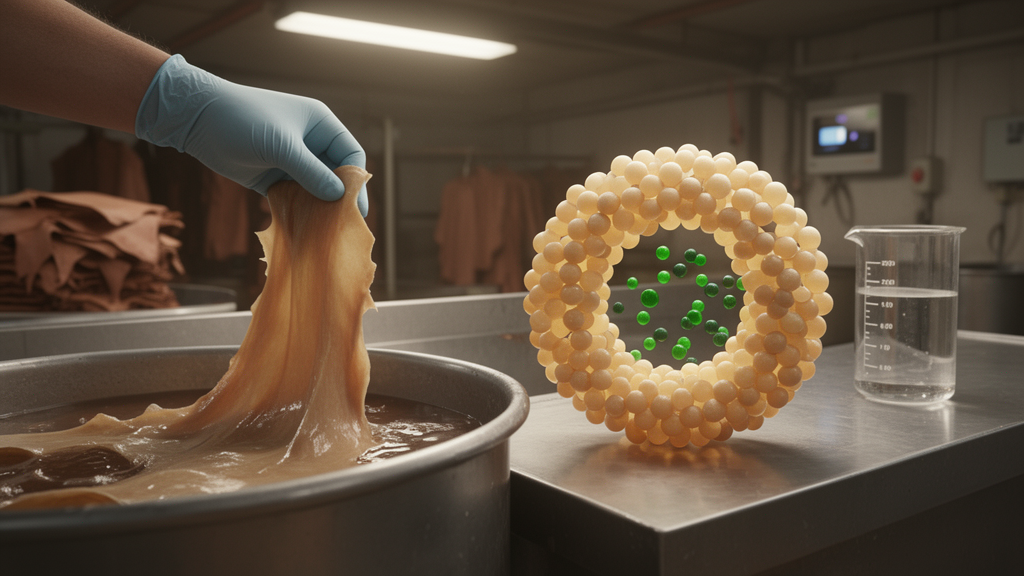
Chemists in China have shown that a simple sugar molecule can pull a stubborn chlorophenol pollutant out of pickled cattle hide, the raw material that sits at the heart of leather manufacturing. In a study published in Collagen and Leather, researchers led by Qinyang Li, Yanni Cao, Liming Zhao, Yuling Tang and Jianfei Zhou report that β-cyclodextrin, a nontoxic cyclic oligosaccharide, removed 2,4,5-trichlorophenol from spiked pickled hide samples so completely that the residual levels fell below the strictest international ecotextile limit of 0.05 mg·kg−1. The work addresses a problem that has long shadowed the leather trade: even though chlorophenols are officially banned in leather production, residues of 2,4,5-trichlorophenol keep turning up in raw hide, wet-blue and finished leather, threatening import and export channels.
The significance of the finding lies in where the contamination comes from. The authors note that residual 2,4,5-trichlorophenol, an important synthetic intermediate in leather-based chemicals, may enter the material through environmental accumulation, contaminated raw materials or exposure along the supply chain. Earlier studies have detected several chlorophenols, including this compound, in animal fur, possibly owing to its environmental distribution. The chemical can bioaccumulate, and frequent exposure to excessive amounts has been linked to headaches, abdominal pain, vomiting and central nervous system impairment, with additional risks of teratogenicity and carcinogenicity. Regulatory limits in most countries, including those within the European Union, cap 2,4,5-trichlorophenol in leather products at 0.05 mg·kg−1 for infant products and 0.5 mg·kg−1 for regular products. Finding a way to strip the residue before tanning therefore matters for the ecological quality of finished leather.
β-Cyclodextrin is an unusual candidate for pollution control. It consists of seven D-glucose units linked by α-1,4-glycosidic bonds, arranged into a hollow truncated cone. The interior of the cone is lined with methylene groups and glycosidic oxygen atoms, giving it a hydrophobic cavity, while the outer surface bristles with hydroxyl groups that make it water-friendly. That architecture lets the molecule encapsulate weakly polar guests such as 2,4,5-trichlorophenol through van der Waals forces, hydrophobic interactions and hydrogen bonding, forming host-guest inclusion complexes. Cyclodextrins have already been used to target organic pollutants in other settings: glycine-modified β-cyclodextrin has enhanced pyrene removal, β-cyclodextrin solutions desorbed polycyclic aromatic hydrocarbons and n-alkanes from sediments with maximum efficiencies of 63.0% and 61.7%, and β-cyclodextrin-based adsorbents and frameworks have captured methylene blue and perfluoroalkanesulfonates rapidly and repeatedly.
The team first asked which cyclodextrin fits the job. They compared five candidates: α-CD, β-CD, γ-CD, hydroxypropyl-β-CD and methyl-β-CD. In batch elution tests on pickled hide spiked with 116.39 mg·kg−1 of 2,4,5-trichlorophenol, pure water alone managed a removal rate of 23.94%, while β-cyclodextrin achieved 81.01%, the highest among the sugars tested. Molecular docking simulations showed that all five cyclodextrins could encapsulate the pollutant, but with distinct spatial orientations: the molecule sits roughly perpendicular to the cavity axis in α-CD, adopts a partially tilted conformation in β-CD and its derivatives, and lies nearly parallel to the cavity in γ-CD. The researchers attribute β-CD’s advantage to a precise size match between its cavity, with an inner diameter of 6.0–6.5 Å, and the 6.2 Å molecular diameter of 2,4,5-trichlorophenol, which allows a semi-tilted encapsulation that maximizes the van der Waals contact interface.
Two additional techniques supported that mechanistic picture. In fluorescence experiments using alizarin red S as a competitive probe, β-CD showed the strongest quenching among the five cyclodextrins, with a minimum relative fluorescence intensity of 64.95%, compared with 87.01% for α-CD, 73.67% for γ-CD, 77.22% for HP-β-CD and 77.76% for M-β-CD. Substitution, it turns out, is not always helpful: incomplete hydroxypropyl and methyl substitution disrupts the symmetry of the cavity, introducing steric hindrance that may hinder effective embedding of the chlorophenol. Quartz crystal microbalance with dissipation monitoring then tracked the encapsulation in real time. When a 0.05 g·L−1 solution of 2,4,5-trichlorophenol was introduced after cyclodextrin adsorption onto the sensor, the β-CD and γ-CD systems showed sharp frequency drops to −260 ± 15 Hz and −250 ± 12 Hz within 4 minutes, while the α-CD, HP-β-CD and M-β-CD systems fell only to about −26 ± 3 Hz. The responses were consistent across 3, 5 and 7 MHz sensors, indicating the results were not artifacts of the measurement frequency.
With β-CD selected, the researchers optimized the elution recipe. Sodium chloride served as the background electrolyte, not for chemistry’s sake but to maintain osmotic pressure equilibrium and prevent swelling of the hide and hydrolysis of its proteins during treatment. Removal efficiency rose as NaCl climbed from 6% to a maximum of 81.01% at 8%, then fell at 9%. The decline at high salt was traced to physical changes in the hide itself: stereomicroscopy showed thickness shrinking from 3.3 mm to 2.8 mm as NaCl increased, and mercury intrusion porosimetry on freeze-dried samples showed porosity dropping from 63.13% to 56.01%. High salt compresses the interfibrillar spaces within collagen fiber bundles, which likely slows the permeation of β-CD through the hide and reduces its contact with the pollutant.
Time, dosage and temperature each had their own optimum. Removal climbed with reaction time and plateaued at 81.01% by 120 minutes, consistent with a nonequilibrium, rate-controlled desorption process that stabilizes once complexation reaches equilibrium. β-CD dosage showed a peak at 5 g·L−1, reaching 80.90%, after which efficiency declined. Transmission electron microscopy offered an explanation: β-CD molecules form large columnar aggregates ranging from 50 nm to 500 nm, and in mixed solutions with the chlorophenol, rod-like structures about 400 nm wide and 1000 nm long appeared, suggesting that excess cyclodextrin self-assembles and sediments, reducing the encapsulation available for the pollutant. Temperature mattered too: removal was 72.82% at 288.15 K, peaked at 81.93% at 298.15 K, and remained a satisfactory 77.91% at 300.15 K, the maximum production temperature, meaning the process can work without additional heating.
The most consequential result came from repeated elution cycles. Pickled hide samples were spiked at three contamination levels: 116.39, 75.57 and 40.55 mg·kg−1. After the first elution, residual contents dropped to 25.73, 19.27 and 14.06 mg·kg−1, corresponding to removal of 77.89%, 74.50% and 65.32% of the original contaminant. After five cycles, 2,4,5-trichlorophenol was completely removed from all three samples, meeting the 0.05 mg·kg−1 limit specified in international ecological textile standards. Because the treatment slots into the existing pickling stage, the authors argue it requires no change to the production system and avoids extra consumption of salt and water or the generation of additional highly saline wastewater.
Removing a pollutant is only useful if the hide survives the wash. Scanning electron microscopy of pickled hide before and after β-CD treatment showed slight surface hydrolysis but unchanged morphology and fiber weave structure. Hydroxyproline, a characteristic amino acid of collagen, increased only slightly in the eluate, indicating limited collagen degradation. Subsequent chrome tanning experiments revealed comparable chromium uptake between treated and untreated hide, and measurements of tensile strength, elongation at break and tear strength showed only minor differences. The authors conclude that β-CD treatment caused no significant damage to the hide’s physicochemical properties, supporting its use as a green eluting agent. The study’s scope is worth noting: the experiments used artificially spiked cattle hide at defined contamination levels, with initial contents set based on feedback from real leather production factories, and all experiments were performed in triplicate. Whether the same efficiency holds across the full variability of commercially supplied hides and production lines remains a question for future work, but the demonstration that a food-grade sugar cavity can outperform plain water by a wide margin, and do so without harming the material it cleans, marks a concrete step toward ecological leather production.
Subject of Research: Removal of 2,4,5-trichlorophenol from pickled hide using β-cyclodextrin elution
Article Title: Investigating the elution mechanism and efficiency of 2,4,5-trichlorophenol removal from pickled hide using β-cyclodextrin
Article References: Li, Q., Cao, Y., Zhao, L., Tang, Y., & Zhou, J. (2026). Investigating the elution mechanism and efficiency of 2,4,5-trichlorophenol removal from pickled hide using β-cyclodextrin. Collagen and Leather, 8(1), Article 22. https://doi.org/10.1186/s42825-026-00240-1
Image Credits: AI Generated
DOI: 10.1186/s42825-026-00240-1
Keywords: β-cyclodextrin, 2,4,5-trichlorophenol, pickled hide, leather industry, chlorophenol removal, host-guest inclusion, cyclodextrin, ecotextile standard, collagen, green chemistry, QCM-D, molecular docking
News Source: Denise Maddox. (October 30, 2026). β-Cyclodextrin Strips Chlorophenol Residues from Pickled Hide. Scienmag.



