Entomophthora muscae is a widespread, pathogenic fungus that survives by infecting common houseflies with deadly spores. Now, research shows that the fungus has a unique tactic to ensure for its survival. The fungus ‘bewitches’ male houseflies and drives them to necrophilia with the fungal-infected corpses of dead females.
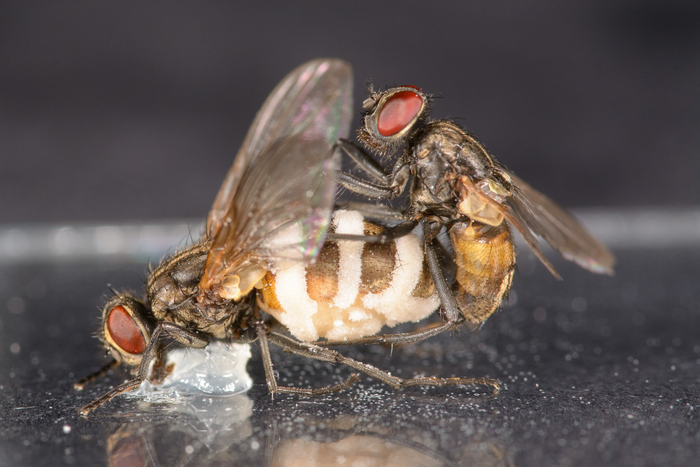
Credit: Filippo Castelucci
Entomophthora muscae is a widespread, pathogenic fungus that survives by infecting common houseflies with deadly spores. Now, research shows that the fungus has a unique tactic to ensure for its survival. The fungus ‘bewitches’ male houseflies and drives them to necrophilia with the fungal-infected corpses of dead females.
After having infected a female fly with its spores, the fungus spreads until its host has slowly been consumed alive from within. After roughly six days, the fungus takes over the behavior of the female fly and forces it to the highest point, whether upon vegetation or a wall, where the fly then dies. When the fungus has killed the zombie female, it begins to release chemical signals known as sesquiterpenes.
“The chemical signals act as pheromones that bewitch male flies and cause an incredible urge for them to mate with lifeless female carcasses,” explains Henrik H. De Fine Licht, an associate professor at the University of Copenhagen’s Department of Environment and Plant Sciences and one of the study’s authors.
As male flies copulate with dead females, the fungal spores are showered onto the males, who then suffer the same gruesome fate. In this way, Entomophthora muscae spreads its spores to new victims and ensures for its survival.
This is the conclusion of a new study conducted by researchers at the University of Copenhagen and Swedish University of Agriculture Sciences in Alnarp.
“Our observations suggest that this is a very deliberate strategy for the fungus. It is a true master of manipulation – and this is incredibly fascinating,” says Henrik H. De Fine Licht.
Fly corpses become more attractive as the hours pass
Tracking fly behavior also let the researchers demonstrate that dead female flies become more attractive as time passes.
Specifically, 73 percent of the male flies in the study mated with female fly carcasses that had died from the fungal infection between 25-30 earlier. Only 15 percent of the males mated with female corpses that had been dead for 3-8 hours.
“We see that the longer a female fly has been dead, the more alluring it becomes to males. This is because the number of fungal spores increases with time, which enhances the seductive fragrances,” explains Henrik H. De Fine Licht.
Besides the insight into nature’s fascinating mechanisms, the study provides new knowledge that may lead to effective fly repellents in the future. Henrik H. De Fine Licht adds:
“Flies are quite unhygienic and can sicken humans and animals by spreading coli bacteria and any diseases that they are carrying. So, there is an incentive to limit housefly populations, in areas where food is being produced for example. This is where the Entomophthora muscae fungus may prove useful. It might be possible for us to use these same fungal fragrances as a biological pest control that attracts healthy males to a fly trap instead of a corpse,” he concludes.
[FACT BOXES]
The research explained
- The researchers used an array of methods. These included the chemical analysis of fragrances emitted by the fungus and amplified in dead female flies, as well as by studying the fungus’ genetics via RNA sequencing.
- They also studied the sexual habits of male flies through behavioral experiments that exposed them to dead female flies which were at various stages of fungal infection, as well as females that had died from other causes. Here, researcher observations demonstrated that male flies preferred mating with fungus-infected females that had been dead for quite some time.
More about the zombie fly fungus
- Entomophthora muscae is a fungus that survives by taking control of and infecting its host, namely flies.
- The fungus secretes special enzymes that break a fly’s body down over the course of about seven days. The fungus can eject its infected spores at up to 10 meters a second, which is among the fastest of nature’s movements.
Journal
The ISME Journal
DOI
10.1038/s41396-022-01284-x
Article Title
Pathogenic fungus uses volatiles to entice male flies into fatal matings with infected female cadavers
Article Publication Date
13-Jul-2022