• HOME
  • NEWS
  • EXPLORE
    • CAREER
      • Companies
      • Jobs
    • EVENTS
    • iGEM
      • News
      • Team
    • PHOTOS
    • VIDEO
    • WIKI
  • BLOG
  • COMMUNITY
    • FACEBOOK
    • INSTAGRAM
    • TWITTER
Tuesday, October 20, 2026
BIOENGINEER.ORG
No Result
View All Result
  • Login
  • HOME
  • NEWS
  • EXPLORE
    • CAREER
      • Companies
      • Jobs
        • Lecturer
        • PhD Studentship
        • Postdoc
        • Research Assistant
    • EVENTS
    • iGEM
      • News
      • Team
    • PHOTOS
    • VIDEO
    • WIKI
  • BLOG
  • COMMUNITY
    • FACEBOOK
    • INSTAGRAM
    • TWITTER
No Result
View All Result
Bioengineer.org
No Result
View All Result
Home NEWS Science News Technology

Zn/Ti co-doped cordierite ceramics show improved microwave dielectric properties in experimental study

by
October 20, 2026
in Technology
Reading Time: 2 mins read
0
Zn/Ti co-doped cordierite ceramics show improved microwave dielectric properties in experimental study

Zn-Ti co-doping unlocks high-performance cordierite ceramics for 5G antennas

Share on FacebookShare on TwitterShare on LinkedinShare on RedditShare on Telegram

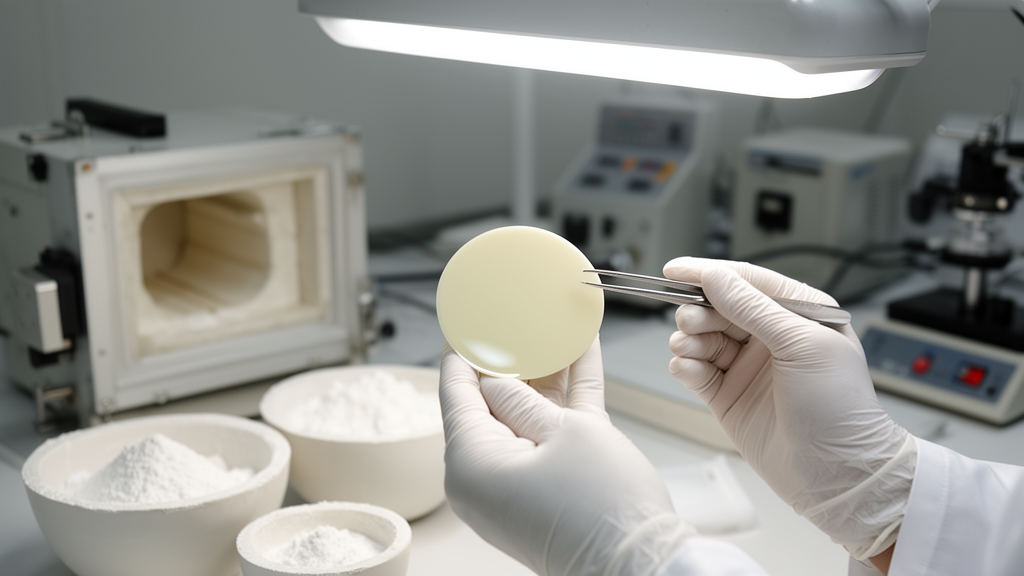
Experimental work described in the Journal of Materials Science reports that substituting (Zn0.5Ti0.5)3+ into cordierite ceramics produced a stable solid solution and enhanced the measured microwave dielectric properties of an optimized formulation. The study’s abstract reports a relative permittivity, εr, of 4.482, a quality factor–resonant frequency product, Q×f, of 55,772 GHz, and a resonant frequency temperature coefficient, τf, of −19.7 ppm/°C.

The researchers fabricated Mg2Al4−x(Zn0.5Ti0.5)xSi5O18 ceramics using a conventional solid-state reaction method. They investigated the materials’ phase composition, structural evolution and microwave dielectric properties. According to the abstract, Zn/Ti co-doping was incorporated into the cordierite lattice, while a secondary MgAl2O4 phase appeared as the doping content increased. The optimized composition showed a higher Q×f value and a relatively higher εr than the other tested formulations.

The authors associated the increase in εr with improved relative density, formation of the secondary phase and enhanced polarizability from (Zn0.5Ti0.5)3+. They also associated the Q×f enhancement with increased relative density, the secondary phase, a reduced full width at half maximum and improved crystal structural symmetry. In addition, the abstract reports a pronounced correlation between τf, structural distortion of the [MgO6] octahedra and the occurrence of the secondary phase. These are the study authors’ proposed explanations and observed associations rather than independent device-level demonstrations.

To explore possible use in 5G communication, the researchers designed a microstrip antenna operating at 4.97 GHz based on the developed ceramic. The abstract describes this as a design and an indication of potential for wireless communication; it does not report measured antenna gain, bandwidth, efficiency or operation in an operational 5G system. The available evidence is limited to the journal abstract and does not provide the full experimental dataset, the optimized value of x, uncertainty estimates for the reported properties or a complete comparison with undoped cordierite. The findings therefore establish a promising laboratory material result while leaving application performance and broader comparative performance to be evaluated in the full study.

Subject of Research: Experimental evaluation of Zn/Ti co-doped cordierite ceramics for microwave dielectric applications

Article Title: Effects of (Zn0.5Ti0.5)3+ substitution on the sintering behavior and microwave dielectric properties of cordierite-based ceramics

Article References: Yang, X., Wu, Z., Yang, X., Peng, B., Yan, Z., Guo, X., & Xiao, L. (2026). Effects of (Zn0.5Ti0.5)3+ substitution on the sintering behavior and microwave dielectric properties of cordierite-based ceramics. Journal of Materials Science, 61(43), 33461-33478. https://doi.org/10.1007/s10853-026-13715-7

Image Credits: AI Generated

DOI: 10.1007/s10853-026-13715-7

Keywords: cordierite ceramics, Zn/Ti co-doping, microwave dielectrics, relative permittivity, quality factor, temperature coefficient, solid-state reaction, microstrip antenna, 5G components, Journal of Materials Science, Effects, substitution

News Source: Denise Maddox. (October 20, 2026). Zn/Ti co-doped cordierite ceramics show improved microwave dielectric properties in experimental study. Scienmag.

Tags: 5G componentscordierite ceramicseffectsJournal of Materials Sciencemicrostrip antennamicrowave dielectricsquality factorrelative permittivitysolid-state reactionsubstitutiontemperature coefficientZn/Ti co-doping
Share12Tweet7Share2ShareShareShare1

Related Posts

Hydrogen Molecules Join Atoms in Palladium Membrane Reactors

Hydrogen Molecules Join Atoms in Palladium Membrane Reactors

October 20, 2026
Hybrid deep-learning model shows favorable hourly PM2.5 prediction performance in modeling study

Hybrid deep-learning model shows favorable hourly PM2.5 prediction performance in modeling study

October 20, 2026

Research report: Artificial intelligence-based analysis of digital media engagement and user sentiment using machine learning techniques

October 20, 2026

Modeled structural resilience fell slightly despite adaptive-capacity gains in 10 dryland oasis units

October 20, 2026

POPULAR NEWS

  • Magnetic probes reveal chemical environments inside molecular framework pores

    Magnetic probes reveal chemical environments inside molecular framework pores

    29 shares
    Share 12 Tweet 7
  • Hydrogen Molecules Join Atoms in Palladium Membrane Reactors

    29 shares
    Share 12 Tweet 7
  • Tomato stalk waste growing media show mixed effects on postharvest quality and antioxidant measures in stored tomatoes

    29 shares
    Share 12 Tweet 7
  • Hybrid deep-learning model shows favorable hourly PM2.5 prediction performance in modeling study

    29 shares
    Share 12 Tweet 7

About

We bring you the latest biotechnology news from best research centers and universities around the world. Check our website.

Follow us

Recent News

Magnetic probes reveal chemical environments inside molecular framework pores

Hydrogen Molecules Join Atoms in Palladium Membrane Reactors

Tomato stalk waste growing media show mixed effects on postharvest quality and antioxidant measures in stored tomatoes

Subscribe to Blog via Email

Enter your email address to subscribe to this blog and receive notifications of new posts by email.

Join 85 other subscribers
  • Contact Us

Bioengineer.org © Copyright 2023 All Rights Reserved.

Welcome Back!

Login to your account below

Forgotten Password?

Retrieve your password

Please enter your username or email address to reset your password.

Log In
No Result
View All Result
  • Homepages
    • Home Page 1
    • Home Page 2
  • News
  • National
  • Business
  • Health
  • Lifestyle
  • Science

Bioengineer.org © Copyright 2023 All Rights Reserved.