


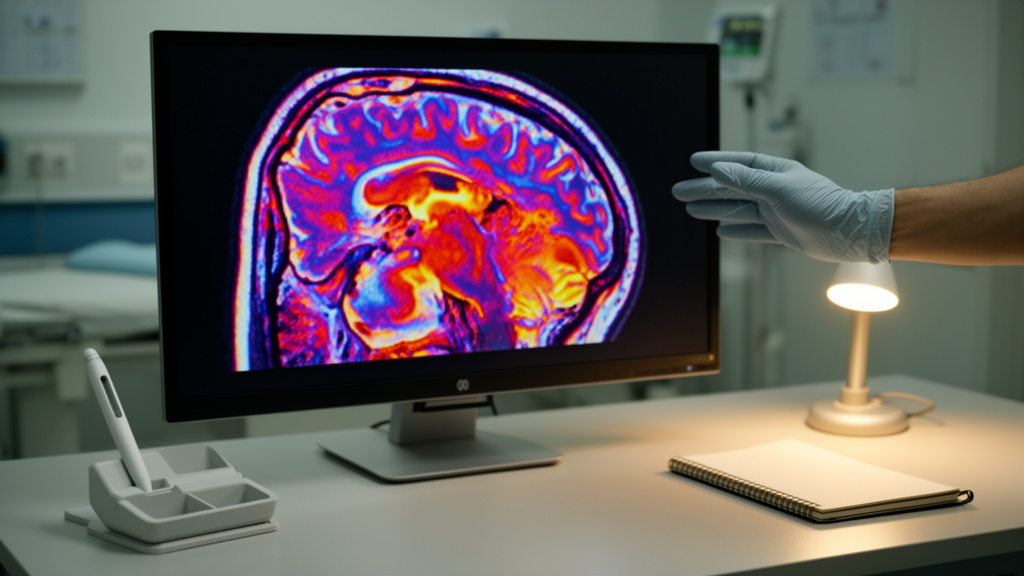
Researchers have proposed a zero-watermarking scheme for color medical images that combines deep learning feature extraction with chaos-based encryption, designed for use in the Internet of Medical Things (IoMT). The approach is described in a paper by Khalid M. Hosny, Amal Magdi, Osama ElKomy and Hanaa M. Hamza published in Neural Computing and Applications.
Unlike conventional watermarking, which embeds a mark directly into image pixels, the proposed method does not modify the original image at all.
The scheme integrates three components. First, a VGG19-based deep learning model extracts features from the color medical image. Second, the discrete cosine transform (DCT) is applied, with high-frequency DCT components omitted so that the retained features focus on more stable image information.
Third, the extracted features are binarized and combined with a scrambled binary watermark using an exclusive OR (XOR) operation. This produces a zero-watermark that serves as the copyright verification key. The key is then further protected using cyclic chaos encryption, which the authors describe as an additional safeguard for the verification data.
According to the abstract, extensive experiments were conducted to evaluate the scheme. The reported results indicate high robustness to geometric distortions and to common image-processing attacks, meaning the verification key remains reliable even when the image is subjected to such distortions or processing.
The authors also report that the method remains computationally efficient, a property they consider important for IoMT systems, where sensitive medical images must be transferred securely and processed on devices with limited resources. The scheme is framed as addressing patient privacy and data integrity requirements in connected healthcare environments.
The work is presented as an Original Article and appears in Volume 38 of the journal, published online on 24 October 2026. The published abstract is the available summary of the study; full experimental details, including the datasets used and quantitative robustness measures, are contained in the complete paper, which is behind a subscription access barrier.
Zero-watermarking approaches of this kind are of interest because they separate copyright verification from the image content itself.
Readers should note that the performance claims summarized here come from the authors’ own experiments as reported in the abstract, and independent evaluation of the scheme’s robustness and efficiency would require access to the full study.
Subject of Research: A deep learning-based zero-watermarking scheme for color medical images combining VGG19, DCT and cyclic chaos encryption for IoMT security.
Article Title: Robust zero watermarking of color medical images using enhanced VGG19, DCT, and cyclic chaos
Article References: Hosny, K. M., Magdi, A., ElKomy, O., & Hamza, H. M. (2026). Robust zero watermarking of color medical images using enhanced VGG19, DCT, and cyclic chaos. Neural Computing and Applications, 38(20), Article 836. https://doi.org/10.1007/s00521-026-12509-x
Image Credits: AI Generated
DOI: 10.1007/s00521-026-12509-x
Keywords: zero-watermarking, medical imaging, Internet of Medical Things, VGG19, discrete cosine transform, chaos encryption, copyright protection, image security, deep learning, color medical images, Robust, zero
News Source: Denise Maddox. (October 29, 2026). Zero-Watermarking Scheme Aims to Protect Color Medical Images Without Altering Them. Scienmag.



