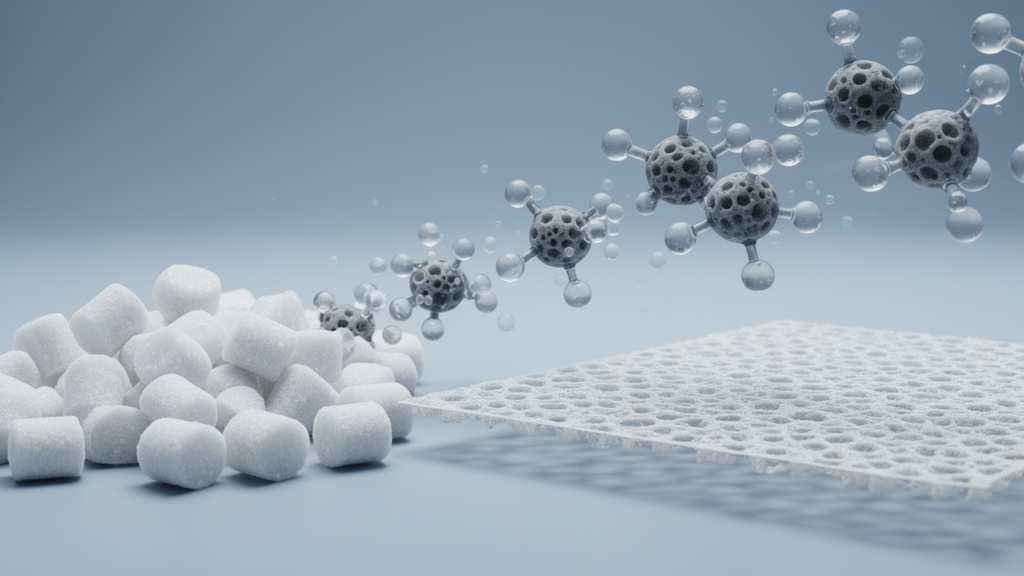
Carbon emissions continue to rise globally, now exceeding 40 billion metric tons, and the authors of a new review argue that this trend creates an urgent need for efficient capture and separation technologies. The review, published in Discover Chemical Engineering, examines zeolites — crystalline materials that have attracted considerable attention because of their pore structure, high thermal stability, and strong affinity toward CO2 — as adsorbents and membranes for carbon capture, utilization, and storage (CCUS).
According to the review, zeolite adsorbents commonly exhibit CO2 uptakes of about 1.0 to 6.0 mmol per gram under practical operating conditions, while modified systems can achieve higher values depending on the zeolite framework type, cation composition, and adsorption temperature. The authors summarize recent progress with emphasis on adsorption capacity, selectivity, cyclic stability, and cryogenic distillation, and they discuss structure–performance relationships and adsorption-assisted systems as part of the assessment of how these materials perform in real separation settings.
Beyond simple capture, the review describes zeolites as materials suited to adsorption, catalytic CO2 conversion, and integration into larger CO2 value chain pathways that transform adsorbed CO2 into useful compounds, with implications for energy, industrial sustainability, and the production of methanol and syngas. The authors also address techno-economic considerations and outline future research needs for scalable CCUS applications, framing the review as a consolidated account of where zeolite-based technology currently stands and what remains to be resolved before wider deployment.
The overall conclusion drawn by the authors is that zeolites remain strong candidates for low-cost, durable, and industrially relevant CO2 capture technologies. The article is an open-access review, published on 21 September 2026, and is being shared early as a peer-reviewed, accepted manuscript that is citable and carries a permanent DOI, subject to further edits before the final Version of Record. As a review, it synthesizes existing literature rather than presenting new experimental results, so its reported uptake ranges and performance characteristics reflect findings compiled from prior studies of zeolite frameworks, cation-exchanged variants, and membrane configurations rather than measurements from a single new experimental campaign.
Subject of Research: A review of zeolite adsorbents and membranes for CO2 capture and separation applications
Article Title: A review of zeolite adsorbents and membranes for CO2 capture and separation applications
Article References: Sivalingam, S., & Niranjan, R. (2026). A review of zeolite adsorbents and membranes for CO2 capture and separation applications. Discover Chemical Engineering. https://doi.org/10.1007/s43938-026-00149-5
Image Credits: AI Generated
DOI: 10.1007/s43938-026-00149-5
Keywords: zeolites, CO2 capture, adsorbents, membranes, CCUS, carbon emissions, adsorption capacity, selectivity, cyclic stability, cryogenic distillation, methanol, syngas
News Source: Sloane Callahan. (October 28, 2026). Zeolite adsorbents and membranes reviewed for CO2 capture and separation. Scienmag.