In a commercial greenhouse tunnel in Zapopan, Jalisco, Mexico, rows of two-year-old highbush blueberry plants grew in bags of coconut coir and wood chips, their roots threaded through an acidic, carefully aerated substrate. What made this ordinary-looking crop extraordinary was the hardware: titanium cathodes and mixed-metal-oxide anodes arranged in a triangular lattice around each root crown, delivering a gentle direct-current field of 0.2 volts per centimeter into the growing medium. Alongside the electrodes, a liquid consortium of plant growth-promoting bacteria—strains of Pseudomonas and Shimwellia deposited under ATCC record PTA-122530—was flushed through the irrigation lines at a concentration of 1.2 billion cells per milliliter. The experiment, conducted by researchers from CIATEJ, CIDETEQ, and the commercial grower AgriTrop and published in Discover Agriculture, set out to answer a question that has barely been asked before: what happens when you combine electricity and beneficial microbes in the same crop?
The rationale for pairing the two interventions rests on well-characterized but previously separate bodies of evidence. Electrical stimulation of plants has a long, checkered history, stretching back to nineteenth-century electroculture experiments that produced inconsistent results because power delivery could not be controlled precisely. Modern bioelectronics has changed that picture. When a low-intensity electric field is applied to soil or substrate, three transport phenomena come into play: electromigration, which accelerates the movement of mineral cations and anions toward the root absorption zone; electroosmosis, which alters the hydraulic conductivity of the substrate and evens out moisture and nutrient fluxes; and electrophoresis, which can mobilize charged particles, including bacterial cells. At the cellular level, these forces appear to trigger a mild, controlled stress response. Studies cited by the team report upregulation of antioxidant enzyme cascades, induction of heat-shock proteins, activation of membrane-bound H⁺-ATPases, and increased plasma membrane permeability, all of which can accelerate metabolism, photosynthetic efficiency, and nutrient uptake. In one striking recent demonstration, a bioelectronic cellulose-based growth scaffold delivering low-voltage current to seedling roots increased vegetative dry weight by up to fifty percent within two weeks, apparently by enhancing nitrogen metabolism and transcription factors governing root elongation.
Biological stimulation works through an entirely different but complementary toolkit. Plant growth-promoting bacteria benefit their hosts directly by synthesizing phytohormones, most notably indole-3-acetic acid, which stimulates root hair proliferation and expands the functional surface area available for water and nutrient uptake. They also solubilize recalcitrant mineral forms of phosphorus and potassium, fix atmospheric nitrogen, and produce iron-chelating siderophores. Indirectly, they can induce systemic resistance, priming the plant’s own biochemical defenses against drought, heat, and pathogens. The Mexican team hypothesized that a precisely calibrated electric field could serve a dual purpose: physically driving the bacterial inoculant toward the root zone through electroosmotic flow and electrophoresis, while simultaneously priming the plant’s ion transporters to make the most of the microbial nutrient packages once they arrived. If correct, the combination should outperform either intervention alone.
To test this, the researchers ran a unifactorial field design with 125 plants divided into five groups of twenty-five: an untreated control, electrical stimulation alone, biological stimulation alone, and two sequential combinations—electricity followed by bacteria, and bacteria followed by electricity. Treatments were synchronized to three critical phenological stages: pre-flowering in October 2021, fruit set and filling in January 2022, and the onset of commercial harvest in May 2022. Each electrical exposure lasted four hours per stage, delivered through the triangular electrode matrix mirrored on both sides of the root system to guarantee homogeneous field coverage. The bacterial inoculant was applied at a dosage equivalent to just five liters per hectare, a fraction of the ninety to 450 liters per hectare reported in earlier berry trials that relied on microbes alone. Repeated measurements of yield, fruit count, floral buds, structural fruiting twigs, flower-to-fruit conversion, and chlorophyll index were analyzed with generalized linear mixed models, while single-time-point quality metrics were assessed with ANOVA and nonparametric tests.
The headline result came from the sequential treatment in which electricity preceded the bacterial application. Over an eleven-week harvest window, those plants produced a cumulative yield of 1,387 grams per plant, an eleven percent increase over the untreated control’s 1,249 grams. Electrical stimulation alone, by contrast, yielded the lowest output at 1,173 grams per plant, a six percent reduction against the control—evidence that the current, applied without a biological buffer, may induce localized micro-polarization or small zones of substrate depletion under the stringent acidic conditions, pH 4.5 to 5.5, that blueberries demand. Neither yield difference reached statistical significance, and the models showed that time, not treatment, was the dominant factor driving the measured variables. But the pattern was consistent and mechanistically coherent: the electric field appeared to enhance the electroosmotic transport of the liquid inoculant through the coir and wood-chip substrate, accelerating the chemotaxis and spatial spread of the bacteria through the rhizosphere, where their hormone production and nutrient solubilization could take full advantage of the electromigration-concentrated minerals.
Perhaps the most commercially telling finding concerned fruit size rather than total tonnage. The control and electrically stimulated plants produced mostly smaller berries, with the two smallest diameter categories—under 12 millimeters and 13 to 15 millimeters—accounting for 63 percent of the control yield and 64 percent of the electrically stimulated yield. The sequential electricity-then-bacteria treatment flipped that distribution, achieving the highest proportion of large berries in the premium 16-to-18-millimeter class at 33.7 percent while cutting the small-fruit fraction to 19.3 percent. The reverse-sequencing and bacteria-only groups performed similarly, keeping small berries below 19 percent and concentrating roughly 60 to 64 percent of their yield in the medium and large tiers. All treatments held a stable ten percent of jumbo berries above 19 millimeters, except electricity alone, which slipped to eight percent. The researchers interpret this as a shift in resource allocation: instead of initiating a larger number of smaller, carbohydrate-deficient fruits, the stimulated plants redirected metabolic energy into maximizing the volumetric growth of existing fruits, likely through upregulated membrane transporters that let individual berries accumulate more water and photoassimilates during the critical filling phase.
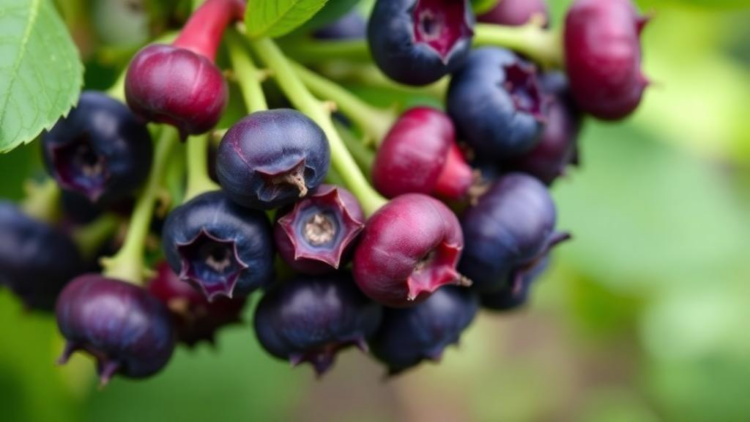
Color, the quality trait most tightly linked to anthocyanin content and consumer appeal, responded most robustly of all. Using a Konica Minolta spectrophotometer, the team measured lightness, the chromatic index, the Hue angle, and the overall color difference from the control baseline. Electrical stimulation alone produced the brightest fruit, with the highest lightness value of 27.10 and the highest chromatic index at 4.16. The bacteria-then-electricity sequence achieved the highest Hue angle at 256.34 degrees, significantly different from the control’s 251.20 degrees. Most strikingly, the electricity-then-bacteria treatment posted a total color divergence of 3.53, a statistically significant shift away from the control. Because blueberry color is conferred by anthocyanins—the flavonoid pigments responsible for the fruit’s celebrated antioxidant activity—these results suggest the mild, controlled stress imposed by the electric field upregulated the phenylpropanoid pathway, accelerating pigment accumulation in the fruit skin and producing berries that are brighter, more uniformly saturated, and potentially richer in health-promoting compounds.
Not every metric moved, and the authors are candid about the boundaries of their results. Sugar accumulation, measured as degrees Brix, stayed within an excellent commercial range of 13.4 to 14.7 across all groups, with the control actually posting the highest value at 14.7, significantly above only the bacteria-then-electricity treatment at 13.5. The team attributes this localized dip to a dilution effect: plants producing larger fruits spread their sugars across a greater tissue volume. Mechanical firmness, measured by compression testing with a TA.XT.plus analyzer, showed no significant differences among treatments, remaining stable at roughly 2.05 to 2.14 newtons for both small and large berries. That stability is good news in itself, because it demonstrates that neither the electrical currents nor the microbial inoculants disrupted the pectin matrix or cell wall integrity that governs shelf life and transport tolerance. Early-season measurements told a similarly nuanced story: bacteria alone achieved the highest flower-to-fruit conversion efficiency at 89.5 percent and the top chlorophyll index at 14.1, while the bacteria-then-electricity group produced an average of 53 fruiting twigs per plant against the control’s 40 to 47, the only variable significantly modified by treatment alone.
The study’s limitations are as instructive as its successes. With only four intensively monitored plants per treatment in a single growing season, the statistical power to detect differences in highly variable cumulative traits like yield was inherently limited, even as biochemically regulated traits like colorimetry achieved significance. The authors acknowledge that multi-season trials with expanded plant cohorts are needed before the eleven percent yield trend can be confirmed for commercial deployment, and that no formal sensory evaluations were conducted to verify whether the color and size improvements translate into consumer preference. Still, the efficiency argument is compelling. Earlier berry studies that achieved larger yield gains—55.9 percent in strawberries, 27 to 29 percent in blueberries with mycorrhizal biostimulants—required inoculum volumes of 90 to 450 liters per hectare, whereas this integrated bio-electric approach reached its result with just five. If subsequent trials bear out the trend, the implication is that a modest, precisely timed electric field can dramatically reduce the biological inputs needed for premium berry production, offering growers a zero-residue, physically driven lever in an industry under pressure to abandon chemical-intensive practices. For now, the Zapopan experiment stands as a proof of concept that the rhizosphere can be engineered with electrons as deliberately as with microbes—a small current, in every sense, with potentially outsized consequences for sustainable agriculture.
Subject of Research: Combined electrical and biological stimulation of blueberry production in a semihydroponic system
Article Title: Electrical and biological stimulation of blueberry production using semihydroponic system
Article References: Barrera-Martínez, I., García-García, G., González-Serrano, D. L., Noguerón-Hernández, F. J., Morales-Martinez, J. C., Contreras-Ramos, S. M., & Bustos-Bustos, E. (2026). Electrical and biological stimulation of blueberry production using semihydroponic system. Discover Agriculture, 4(1), Article 300. https://doi.org/10.1007/s44279-026-00775-1
Image Credits: AI Generated
DOI: 10.1007/s44279-026-00775-1
Keywords: blueberries, electrical stimulation, plant growth-promoting bacteria, semihydroponics, electromigration, electroosmosis, anthocyanins, fruit quality, sustainable agriculture, biostimulants, rhizosphere, Pseudomonas
Cite Scienmag News
APA
MLA
Chicago
Alan Morgan. (October 1, 2026). Zapping Roots and Adding Bacteria Boosts Blueberry Size and Color in Field Trial. Scienmag. https://scienmag.com/zapping-roots-and-adding-bacteria-boosts-blueberry-size-and-color-in-field-trial/
Alan Morgan. “Zapping Roots and Adding Bacteria Boosts Blueberry Size and Color in Field Trial.” Scienmag, 1 October 2026, https://scienmag.com/zapping-roots-and-adding-bacteria-boosts-blueberry-size-and-color-in-field-trial/. Accessed 1 October 2026.
Alan Morgan. “Zapping Roots and Adding Bacteria Boosts Blueberry Size and Color in Field Trial.” Scienmag. October 1, 2026. https://scienmag.com/zapping-roots-and-adding-bacteria-boosts-blueberry-size-and-color-in-field-trial/
Copy citation
Download RIS
Tags: agritech innovations in berry productionanthocyaninsbeneficial bacteria in agriculturebiostimulantsblueberriesBlueberry crop enhancementCIATEJ and CIDETEQ agricultural researchcombined microbial and electrical crop treatmentselectric field plant stimulationelectrical stimulationelectroculture in fruit cultivationelectromigrationelectroosmosisfield trial blueberry size improvementfruit qualityimpact of electric currents on plant colorplant growth-promoting bacteriaplant growth-promoting bacteria strainsPseudomonasrhizospheresemihydroponicssoil microbiome and plant growthsustainable agriculturesustainable blueberry farming techniques