UD engineering professor honored for excellence in molecular beam research
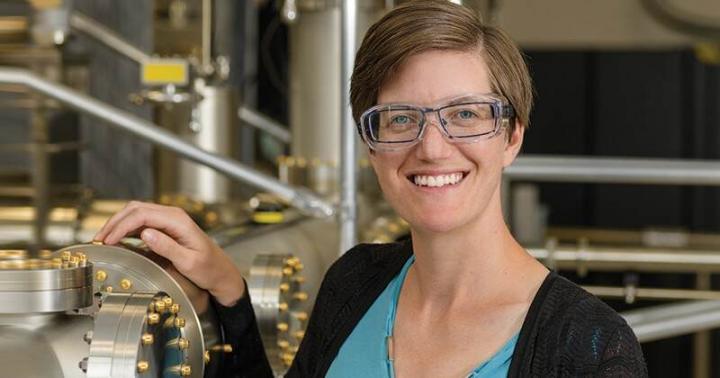
Credit: Photo by Evan Krape
Periods of history are often defined by the materials used to make critical tools — from the stone age to the bronze age to today — a period some experts regard as the silicon age. Silicon is used in semiconductors and other technologies that are critical for computing and communications. The development of sophisticated new materials could accelerate further societal progress.
A University of Delaware professor is being recognized as a leading expert in molecular beam epitaxy, a technique used to make promising, novel materials.
Stephanie Law, associate professor of materials science and engineering and co-director of the UD Materials Growth Facility, received the Young Investigator Award from the 21st International Conference on Molecular Beam Epitaxy 2020.
Molecular beam epitaxy is a method used to grow materials, such as crystals or thin films, by depositing layers of molecules or atoms one at a time. Molecular beam epitaxy enables the creation of novel, precisely designed materials for use in many applications, such as ultra-sensitive gas sensing or new qubits for quantum computing.
Law was selected for the Young Investigator Award from the 21st International Conference on Molecular Beam Epitaxy 2020 for advances in the growth of novel optical materials including heavily doped semiconductors, topological insulators, and other van der Waals materials. She was selected for this award by leaders in the field of molecular beam epitaxy — and she is fast becoming a world leader in the subject herself.
Her research group focuses on improving the quality of materials used for infrared and terahertz optics and plasmonics. “The techniques we have developed for good material growth are applicable to a wide range of related systems,” she said.
What’s more, exciting new possibilities are on the horizon. The Materials Growth Facility at UD, which already features an array of world-class equipment for nanofabrication, growth characterization and monitoring, microscopy and calibrations, is expanding. New funding through UD’s Center for Hybrid, Active and Responsive Materials, an NSF-funded Materials Research Science and Engineering Centers (MRSEC), will enable the purchase of a new sputtering system. Funds from a private foundation will enable the purchase of a new electron beam evaporator.
“These are significant new capabilities that will allow us to grow new materials and complex material stacks for applications in infrared and terahertz optics, quantum materials, and hybrid devices,” said Law.
Law will accept the Young Investigator Award and share highlights from her research group in a presentation at the next International Conference on Molecular Beam Epitaxy, slated to be held in September 2021 in Mexico.
This accolade is one of many for Law, a widely recognized scholar in molecular beam epitaxy. She has been honored with the Peter Mark Memorial Award from the American Vacuum Society (2019), Presidential Early Career Award for Scientists and Engineers (2019), Early Career Award from the U.S. Department of Energy (2017) and North American Molecular Beam Epitaxy Young Investigator Award (2016).
Law earned her doctorate in physics at the University of Illinois at Urbana-Champaign in 2012 and did postdoctoral research there in electrical and computer engineering before joining the UD faculty in 2014.
Law describes creating materials of tomorrow one atom at a time in this video.
###
Media Contact
Peter Kerwin
[email protected]
Original Source
https:/