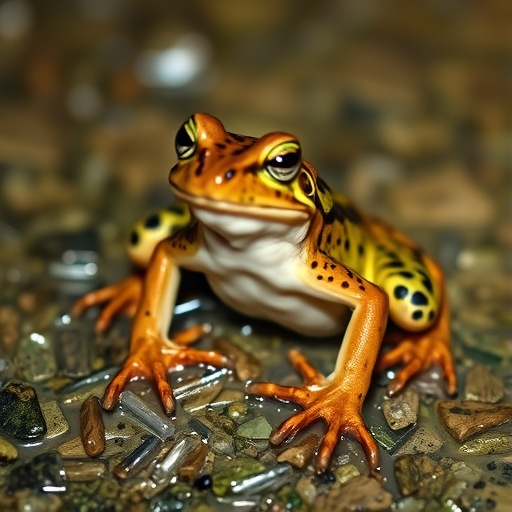
For a diminutive amphibian measuring no larger than a single fingernail, the allocation of energy can mark the fine line between survival and demise. Recent groundbreaking research from the University of Florida delves into the intricate decisions juvenile frogs make regarding energy distribution, especially when confronted with lethal pathogens. By leveraging a blend of empirical data and computational modeling, the study uncovers nuanced strategies these tiny creatures adopt, balancing growth and immune defense — insights that not only illuminate amphibian biology but also shed light on broader ecological and evolutionary dynamics.
Central to this study is the common coqui frog (Eleutherodactylus coqui), an emblematic species native to Puerto Rico known for its direct development, bypassing the traditional tadpole stage. This biological peculiarity means these frogs hatch as fully formed miniature adults, profoundly influencing how energy constraints impact their early life stages. Given their extraordinarily small size, approximately equivalent to a human pinky nail, tracking individual frogs in natural environments is virtually impossible. Consequently, the research team integrated robust field and experimental observations into sophisticated computer models, simulating how these frogs allocate scarce resources across growth and immunity throughout a typical year.
The research focuses poignantly on the interplay between the coqui frogs and a devastating fungal pathogen, Batrachochytrium dendrobatidis (Bd), commonly known as chytrid fungus. This pathogen has wreaked havoc on amphibian populations globally, making it a critical subject for understanding disease ecology. Leveraging data encompassing seasonal fluctuations in food availability and infection risk, the models capture the dynamic energy budgeting decisions these amphibians undertake. Intriguingly, findings reveal a compelling survival strategy: juvenile frogs prioritize rapid growth during early life phases, deferring costly immune investments until infection intensity escalates to dangerous levels.
This strategic delay in immune response is hypothesized to optimize survival probabilities. Small, slow-growing individuals face heightened predation risks, making early growth paramount. By investing in immunity only when faced with a significant pathogenic threat, frogs effectively balance the trade-offs between immediate survival pressures and long-term health. The models demonstrate that this energy allocation strategy maximizes fitness, highlighting the sophistication of amphibian physiological responses to environmental and pathogenic stressors.
Temporal variation emerges as a decisive factor modulating these energy allocation decisions. Seasonal oscillations in temperature and precipitation orchestrate changes in food resources and pathogen prevalence. Frogs hatching during favorable summer conditions, when prey is abundant, can allocate energy more flexibly across growth and immune defense, enhancing their chances for survival and successful maturation. Conversely, cohorts born during cooler and drier periods encounter constrained energy budgets, compelling a more frugal distribution that compromises both growth rates and immune competence, with dire consequences for survival.
This research also illuminates the broader implications of climate change for amphibian populations. Extending or intensifying cool, dry periods could exacerbate energetic limitations faced by juvenile frogs, impeding rapid growth and compromising immune defenses. Such shifts threaten to undermine population resilience against pathogens like chytrid fungus, potentially precipitating more severe declines. Understanding these vulnerabilities is crucial for conservation efforts aiming to buffer amphibian species against accelerating environmental perturbations.
Methodologically, the study exemplifies the power of integrating mechanistic disease models with empirical data sets. By simulating individual-level energy trade-offs in relation to pathogen exposure within fluctuating environments, the researchers transcend traditional population-level disease modeling. This approach unveils heterogeneity in individual responses, a key dimension often masked in aggregate analyses, enabling a more precise understanding of disease dynamics and host resilience.
The study’s lead author, Zuania Colón-Piñeiro Ph.D., emphasizes the importance of dissecting individual heterogeneity in disease ecology: “Not all individuals respond identically to pathogens, and understanding this heterogeneity is vital for predicting population outcomes.” Her collaboration with senior author Ana V. Longo Ph.D. underscores the synergy between empirical natural history and theoretical modeling, with Longo highlighting the unique biology of coqui frogs that facilitates this research and provides broader insights into amphibian developmental strategies.
The implications of these findings extend beyond the realm of wild amphibians. The computational framework developed by the team offers a valuable tool for conservationists managing captive breeding programs. By modeling energy allocation strategies under varying environmental conditions and pathogen pressures, conservationists can optimize rearing protocols to boost survival rates post-release, enhancing the efficacy of reintroduction programs. This translational potential exemplifies the study’s impact, providing a bridge between fundamental ecological theory and practical wildlife management.
Importantly, the research team advocates for the continued integration of fieldwork and modeling. Models, while powerful, rely on accurate and extensive biological data to yield meaningful predictions. Field studies that track environmental variables, pathogen prevalence, and individual growth trajectories remain indispensable. This dual approach ensures that theoretical insights remain grounded in biological reality, ultimately guiding more effective interventions to safeguard vulnerable species.
The study, entitled “Playing it safe at early life stages: Balancing energy allocations to maximize fitness under seasonal pathogen dynamics,” stands as a testament to interdisciplinary collaboration, involving expertise across multiple departments at the University of Florida, the University of Puerto Rico, and partner institutions. By illuminating how minute amphibians navigate the energetic tightrope of survival amidst disease threats and fluctuating environments, it adds a significant chapter to our understanding of life history evolution and disease ecology.
As amphibian declines continue to raise alarms on global biodiversity fronts, insights from such detailed mechanistic studies are invaluable. They remind us that survival strategies are seldom straightforward and that even the tiniest creatures deploy sophisticated physiological tactics honed by evolution. Understanding these strategies underpins efforts to stem biodiversity loss, highlighting the intricate tapestry connecting organismal biology, environmental dynamics, and disease.
Subject of Research: Animals
Article Title: Playing it safe at early life stages: Balancing energy allocations to maximize fitness under seasonal pathogen dynamics
News Publication Date: 15-Jun-2026
Web References: http://dx.doi.org/10.1111/1365-2656.70282
Image Credits: Alberto López
Keywords: Frogs, Amphibians, Developmental biology, Evolutionary developmental biology, Immune system, Adaptive immune system, Immune regulation
Tags: amphibian disease response strategiesamphibian evolutionary adaptationsamphibian immune defense mechanismsamphibian survival tacticscomputational modeling in wildlife studiescoqui frog ecological behaviordirect development in coqui frogsecological dynamics of Puerto Rican frogsenergy trade-offs in small amphibiansfield and experimental amphibian researchimpact of pathogens on amphibian growthjuvenile frog energy allocation