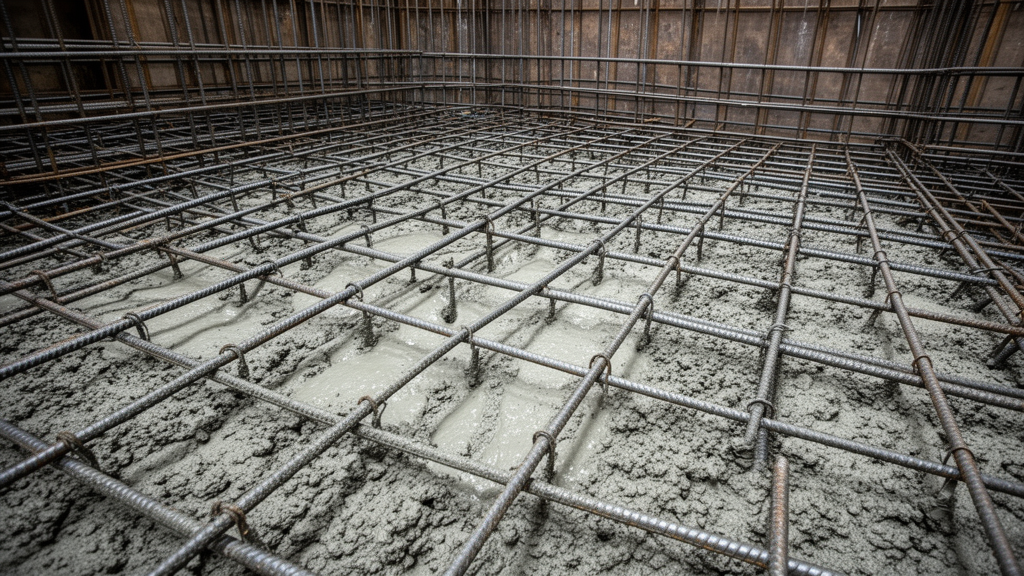
A comprehensive multiscale experimental investigation has revealed that conventional slump-based workability metrics fail to reliably predict fresh concrete placement and passing behavior within the densely congested reinforcement networks typical of nuclear power plant containment structures. Researchers evaluated fresh cement pastes and concrete mixtures across multiple binder systems, measuring polycarboxylate ether admixture adsorption, rotational rheological properties, standard test performance, and physical placement behavior inside custom-built simulation chambers. The empirical findings demonstrated that concrete mixtures exhibiting nearly identical slump values displayed starkly divergent passing capacities when forced through congested steel grids under gravitational flow. In vertical placement tests through orthogonal layers of large-diameter reinforcing bars, the initiation of concrete flow was governed by the apparent dynamic yield stress of the cement paste matrix. Specifically, mixtures with paste yield stress values exceeding an empirical threshold of approximately 0.3 pascals suffered from severe interparticle bridging and structural blockage, leaving substantial volumes of material trapped above the reinforcement bars regardless of nominal slump ratings.
The engineering motivation behind this evaluation stems from escalating global investments in nuclear power facilities as reliable, low-carbon energy sources, which have concurrently accelerated the demand for high-performance nuclear-grade structural concrete. Reactor containment buildings function as primary physical barriers safeguarding against severe internal and external loading scenarios, including extreme thermal gradients, elevated internal pressures, and severe seismic accelerations. To withstand these severe mechanical demands, containment walls incorporate multi-layered configurations of heavy rebar, including large-diameter reinforcing bars such as D43 and D57 arranged in dense patterns. While American Concrete Institute guidelines such as ACI 301 permit slump limits up to 230 millimeters for structural concrete, field practice for nuclear facilities routinely restricts delivered slump values to approximately 150 millimeters to satisfy strict long-term durability, thermal cracking control, and mixture robustness criteria. Internal mechanical vibration is routinely mandated on construction sites to consolidate these stiff mixtures, yet field experiences, including documented void formation and honeycombing incidents at operational facilities such as South Korea’s Hanbit plant, confirm that standard vibration often fails to guarantee complete filling within heavily congested zones.
Complicating fresh concrete management further is the extensive incorporation of supplementary cementitious materials, specifically ground granulated blast-furnace slag and Class F fly ash, which are required in massive containment elements to suppress hydration heat evolution and mitigate thermal cracking. The experimental program incorporated three cementitious binders: ordinary Portland cement, ground granulated blast-furnace slag with a median particle diameter of 8.6 micrometers, and Class F fly ash with a median particle diameter of 18.0 micrometers. Laser diffraction and pycnometer testing confirmed binder densities of 3.13 grams per cubic centimeter for Portland cement, 2.91 for slag, and 2.36 for fly ash. The fly ash exhibited a spherical particle morphology characteristic of coal combustion residues and complied with ASTM C618 standards with a loss on ignition of 1.6 percent, indicating residual unburnt carbon. Crushed fine aggregate with a maximum particle size of 4.75 millimeters, a fineness modulus of 2.94, a specific gravity of 2.5, and 0.5 percent absorption was paired with crushed coarse aggregate having a nominal maximum aggregate size of 19 millimeters, a fineness modulus of 6.38, a solid volume fraction of 59 percent, and 0.7 percent absorption.
To rigorously explore performance sensitivity across practical construction envelopes, the experimental matrix evaluated two distinct binder systems formulated at targeted water-to-binder ratios. The primary system blended 50 percent ordinary Portland cement with 50 percent ground granulated blast-furnace slag across water-to-binder ratios of 0.35, 0.40, and 0.45. A secondary comparative system utilized 75 percent Portland cement and 25 percent Class F fly ash at a fixed reference water-to-binder ratio of 0.40. Within every binder and water-to-binder series, liquid polycarboxylate ether superplasticizer, containing an active solid content of 17.9 percent alongside an integrated air-entraining component, was dosed systematically to produce three designated target slump levels of 150, 180, and 210 millimeters. Additionally, a self-consolidating concrete mixture with a target slump flow of 600 millimeters served as a benchmark for highly fluid placement. Mixing was executed in 70-liter batches using a forced-action pan mixer, beginning with a 60-second dry blend followed by five minutes of wet mixing with superplasticizer-treated water, allowing all fresh-state tests to proceed within twenty minutes of batching at 20 degrees Celsius.
Initial fresh property evaluations confirmed that all manufactured concrete mixtures achieved target slump levels within an allowable tolerance of plus or minus 10 millimeters, verifying that nominal workability had been equalized through chemical admixture adjustments prior to placement testing. However, fresh air content measurements revealed profound divergence between the binder formulations. For the 50 percent slag series at a water-to-binder ratio of 0.35, air content expanded from 7.0 to 8.8 percent as the target slump increased from 150 to 210 millimeters, driven by elevated superplasticizer demand. At a ratio of 0.40, slag mixtures exhibited stable air contents between 6.4 and 7.2 percent, complying with ACI 301 freeze-thaw requirements of 6.0 plus or minus 1.5 percent. In contrast, increasing the water-to-binder ratio to 0.45 reduced chemical dosage demand and produced low air contents of 2.5 to 4.7 percent. Most strikingly, the fly ash mixtures at a 0.40 ratio maintained air contents below 2.0 percent across all slump grades, as residual unburnt carbon selectively adsorbed the air-entraining surfactant components from the pore liquid, leaving insufficient active chemical species to stabilize microscopic air voids.
The mechanics of chemical interaction were clarified through total organic carbon analysis conducted on aqueous pore solutions extracted from companion cement paste fractions after centrifuging at 3000 revolutions per minute for five minutes and filtering at 0.2 micrometers. Across all tested mixtures, calculated polymer adsorption exhibited a strong direct linear correlation with applied chemical dosage, yielding a coefficient of determination of 0.96. Within the slag series, reducing the water-to-binder ratio from 0.45 down to 0.35 intensified particle crowding, squeezed water film thickness, and drove calculated polymer adsorption from a range of 215.5 to 485.4 milligrams per liter up to 428.3 to 1073.7 milligrams per liter. The fly ash pastes exhibited pronounced adsorption magnitudes spanning 858.1 to 1473.5 milligrams per liter. The porous surface architecture and high organic affinity of residual unburnt carbon in the fly ash served as preferential adsorption sinks, consuming significant fractions of the polycarboxylate ether polymers without delivering proportional increases in fluidity or matrix dispersion.
Fundamental matrix rheology was characterized using a rotational rheometer equipped with a 35-millimeter parallel-plate geometry at a 2-millimeter gap, applying a descending stepwise shear protocol from 50 down to 0.01 reciprocal seconds following sixty seconds of high-shear pre-shearing. The descending shear stress flow curves were fitted using the Bingham plastic model, which yielded correlation coefficients exceeding 0.98 for most pastes. Dynamic yield stress systematically decreased with increasing slump, but absolute magnitudes varied dramatically at the lower workability threshold. At a 150-millimeter nominal slump, the dense particle network of the 0.35 water-to-binder slag mixture generated an apparent yield stress of 1.80 pascals, whereas the 0.45 slag mixture and 0.40 fly ash mixture registered significantly lower values of 0.34 and 0.31 pascals, respectively. When slump exceeded 180 millimeters, dynamic yield stress values converged near zero. Meanwhile, Bingham plastic viscosity demonstrated a strong dependency on liquid availability, with the 0.35 slag series displaying the highest viscous resistance and the 0.45 series showing the lowest, confirming that mixtures sharing identical slump values inhabit fundamentally distinct rheological regimes.
The transmission of matrix rheology to macroscopic flow was evaluated using vibration-assisted L-box and U-box passing apparatuses incorporating internal D13 reinforcement obstacles. In the L-box, where concrete travels along a horizontal channel following gate release, transit time decreased consistently as target slump increased, ranging from 9.4 to 13.0 seconds at 150 millimeters down to 6.9 to 9.8 seconds at 210 millimeters. Statistical analysis revealed that L-box transit time correlated strongly with paste plastic viscosity, yielding a Spearman rank correlation coefficient of 0.753. This strong monotonic correlation demonstrated that once external vibration fluidizes the granular skeleton and overcomes initial yield resistance, horizontal propagation rate is controlled primarily by viscous dissipation within the lubricating paste phase. The same vibration input, however, proved unable to fully break down yield resistance in the highly cohesive 0.35 water-to-binder slag mixtures.
Conversely, U-box testing generated severe experimental scatter and failed to show meaningful statistical correlations with either yield stress or plastic viscosity, recording negligible coefficients of determination of 0.013 and 0.001, respectively. Unlike the unidirectional horizontal motion of the L-box, concrete traversing a U-box must negotiate an upward vertical trajectory after clearing the bottom gate. This upward displacement requires kinetic energy to continuously overcome opposing gravitational head, frictional resistance along vertical container walls, and mechanical interlocking among coarse aggregates. When local particle networks restructured under upward strain, temporary blockages and aggregate arching occurred across the rebar obstructions, triggering dramatic spikes in transit duration. This vulnerability was acutely pronounced in the low-air fly ash mixtures, where the deficiency of lubricating microscopic air bubbles intensified interparticle friction under dynamic excitation, preventing steady upward fluidization despite acceptable nominal slump measurements.
To evaluate structural-scale performance under realistic boundary constraints without the confounding assistance of vibration, the investigators designed a custom vertical drop tower featuring a 60-liter delivery hopper and orthogonal layers of massive D43 and D57 reinforcing bars spaced at 25 centimeters, mounted above a precision load cell. Highly workable mixtures proportioned for 180- and 210-millimeter slumps consistently discharged within six seconds, stabilizing at the anticipated full payload mass of approximately 1270 newtons. However, several 150-millimeter slump mixtures experienced severe structural bridging, recording arrested discharge values between 920 and 1000 newtons due to concrete hanging over the upper bar layers. Correlating discharged masses with paste rheology established an empirical threshold: mixtures with a paste yield stress below 0.3 pascals passed unimpeded, whereas pastes exceeding 0.3 pascals suffered catastrophic flow stoppage. Because gravity discharge initiated from rest without vibration, the capacity to yield under self-weight proved decisively paramount, whereas plastic viscosity exhibited no meaningful influence over vertical passing success.
Gravity-driven horizontal placement proved to be an even more demanding operational regime during evaluations inside a custom horizontal simulation channel equipped with bolted D14 and D57 rebar grids, observation ports, and a model containment liner plate. Preliminary trials revealed that conventional nuclear-grade concrete mixtures proportioned up to 210 millimeters of slump could not reach the liner plate under self-weight alone, with the 150-millimeter fly ash mixture arresting completely at the very first rebar obstacle. Even the highly fluid self-consolidating benchmark concrete, boasting a 600-millimeter slump flow, revealed critical physical constraints: although the fluid mass advanced beneath the steel plate under its own head, internal viscous drag left substantial voids and incomplete filling at the channel’s terminal boundaries. These findings demonstrate that horizontal flow paths through dense reinforcement impose significantly higher geometric resistance than vertical drops, establishing that gravity flow alone cannot achieve void-free encapsulation without targeted compaction protocols.
Collectively, these multiscale experimental findings prove that traditional slump measurements provide an inadequate basis for quality control in congested nuclear civil engineering. Because slump is an empirical equilibrium measurement vulnerable to batching history, superplasticizer interactions, and environmental delays, it fails to quantify dynamic yield thresholds or viscous resistance under confinement. The authors emphasize that the 0.3-pascal yield stress criterion represents a material-specific empirical benchmark that necessitates future validation across varied aggregate gradings and structural forms through compact, site-deployable rheological testing apparatuses. Ultimately, transitioning from empirical slump limits to rigorous, rheology-based placement standards is essential to eliminate honeycombing defects, ensure structural integrity, and guarantee the operational reliability of modern nuclear energy infrastructure.
Subject of Research: Rheological evaluation and placement reliability of concrete in heavily reinforced nuclear structures
Article Title: Systematic Evaluation of Concrete Placement Reliability in Heavily Reinforced Nuclear Structures
Article References: Jun, H., Ju, S., Wi, S., Kim, M., Park, J., Seo, E.-A., Lee, H., Park, G.-J., & Yoon, J. (2026). Systematic Evaluation of Concrete Placement Reliability in Heavily Reinforced Nuclear Structures. International Journal of Concrete Structures and Materials, 20(1), Article 81. https://doi.org/10.1186/s40069-026-00964-8
Image Credits: AI Generated
DOI: 10.1186/s40069-026-00964-8
Keywords: nuclear containment structures, concrete placement, rheology, yield stress, plastic viscosity, slump test, polycarboxylate ether, admixture adsorption, supplementary cementitious materials, fly ash, ground granulated blast-furnace slag, reinforcement congestion, vertical drop test, horizontal filling test, total organic carbon, self-consolidating concrete, containment liner plate
News Source: Denise Maddox. (November 19, 2026). Yield Stress Threshold Controls Concrete Placement Reliability in Congested Nuclear Containment. Scienmag.