Steamed bread, the fluffy staple that anchors breakfast tables across Asia and increasingly appears on menus worldwide, has long depended on yeast fermentation to achieve its characteristic texture. But yeast has drawbacks: fermentation takes hours, results vary with temperature and humidity, and some consumers report intolerance to yeast or simply prefer products made without it. A new study published in Current Research in Food Science offers a detailed molecular explanation of how chemical leavening could replace yeast in steamed bread production, and in doing so reveals a surprising truth about how these systems actually work. The research, led by Aixia Wang of University College Dublin and colleagues including Li-Tao Tong and Nima Mohammadi, demonstrates that the quality of chemically leavened dough is not determined by carbon dioxide gas alone, but by a coordinated partnership between the gas and a salt that forms simultaneously during the leavening reaction.
The team focused on a leavening combination of glucono-delta-lactone, commonly abbreviated GDL, and sodium bicarbonate. When these two food-grade compounds meet in water, GDL gradually hydrolyzes into gluconic acid, which then reacts with the bicarbonate to release carbon dioxide and produce sodium gluconate as a byproduct. This slow hydrolysis is precisely what makes GDL attractive compared with fast-acting acids such as citric acid, which floods dough with gas almost instantly and risks losing much of it before the gluten network can develop. Conventional formulation practice has always treated the stoichiometric ratio, the exact chemical balance between acid and base, as the gold standard for optimizing recipes. The researchers set out to test a provocative question: does the stoichiometric ratio actually represent the optimal functional balance, or are the two reaction products doing fundamentally different jobs that need to be tuned separately?
To answer this, the team designed an elegant experimental strategy. They prepared doughs at three sodium bicarbonate levels, 1.0, 1.5, and 2.0 percent of flour weight, each paired with the corresponding amount of GDL according to its neutralization value. Then, in a crucial second step, they decoupled the salt from the gas. By completely reacting GDL with sodium bicarbonate in water at 60 degrees Celsius for 24 hours, they generated a solution of pure sodium gluconate with all the carbon dioxide already released. This pre-formed salt was then added to dough formulations on top of the normal reaction, allowing the researchers to observe what the salt alone contributes, independent of any additional gas production. A yeast-leavened dough served as the commercial benchmark throughout.
The molecular story begins with the gluten proteins themselves. Using measurements of free sulfhydryl groups, disulfide bonds, intrinsic fluorescence, and surface hydrophobicity, the researchers tracked how protein structure shifted across the reaction levels. Moving from the low to the intermediate level, disulfide bond content rose while free sulfhydryl groups declined, a signature of the sulfhydryl-disulfide exchange reactions that knit gluten chains into a three-dimensional network. Fluorescence intensity and surface hydrophobicity also increased, indicating that hydrophobic amino acid residues such as tryptophan, tyrosine, and phenylalanine were being progressively exposed as protein chains unfolded in an ordered fashion. This moderate unfolding, driven by the gradual acidification of GDL hydrolysis, appears to be the sweet spot where proteins are flexible enough to interact but not so disrupted that the network collapses.
The high reaction level told a cautionary tale. At 2.0 percent sodium bicarbonate, disulfide bonding dropped to its lowest while free sulfhydryl groups peaked, and surface hydrophobicity climbed even higher. The researchers interpret this as evidence that the intense ionic environment generated by abundant sodium gluconate intensified electrostatic shielding between gluten chains, promoting irregular and excessive re-aggregation rather than orderly network construction. Zeta potential measurements reinforced this picture: the absolute value fell steadily from 32 millivolts at the low level to 26 millivolts at the high level, eroding the electrostatic energy barrier that normally keeps protein particles from clumping. Particle size distributions shifted correspondingly toward larger aggregates, with the 2.0 percent samples showing the broadest peaks and the strongest signals around 10,000 nanometers, hallmarks of runaway protein aggregation.
Because expanding dough is essentially a foam, the behavior of proteins at the air-water interface matters enormously. Proteins must diffuse to bubble surfaces, penetrate the interface, unfold, and rearrange into a cohesive film that resists deformation as bubbles grow. The researchers measured all of these stages using dynamic interfacial tension, adsorption kinetics modeling, and dilatational rheology. The intermediate reaction level proved optimal at every step: it produced the fastest penetration and rearrangement rate constants, and the highest elastic and viscous moduli of the interfacial films. Lissajous plots, which visualize how interfacial films respond to cyclic stretching and compression, showed that the 1.5 percent films retained a regular, resilient response even at large deformations, while the 2.0 percent films became increasingly distorted and heterogeneous. In short, moderate salt formation built the toughest bubble armor.
Microscopy and rheology translated these molecular findings into dough-level reality. Scanning electron microscopy and confocal laser scanning microscopy revealed that at the intermediate level, starch granules were uniformly embedded in a continuous, well-stretched protein network, and adding extra sodium gluconate made the network even more homogeneous. Dynamic rheology confirmed that the 1.5 percent plus salt dough had the highest storage and loss moduli of all formulations, meaning it was the most elastic and resistant to deformation. Rheo-fermentation measurements then delivered the most striking numbers: at the intermediate level, dough height reached 28 centimeters, already exceeding the yeast control at 22 centimeters, and salt supplementation pushed it to 32 centimeters. At the high reaction level, despite abundant gas production, the gap between gas release profiles with and without added salt revealed that much of the carbon dioxide was simply escaping from a weakened, poorly structured dough.
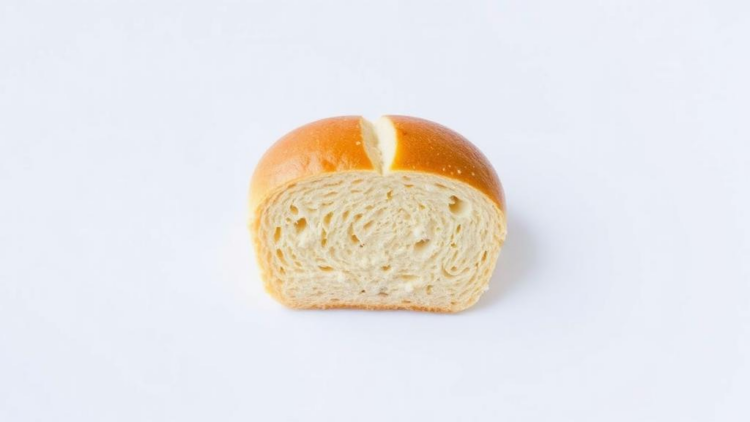
The final proof arrived in the steamer. Steamed bread made at the intermediate level with salt supplementation achieved the highest specific volume of the entire study, 2.63 milliliters per gram, with a fuller appearance, finer and more uniform crumb cells, and improved texture. The high reaction level produced larger but coarser and less evenly distributed gas cells, the result of bubble coalescence in a dough that could not hold what it had generated. The authors conclude that optimal steamed bread quality depends on a balance between adequate carbon dioxide generation and a sufficiently strong viscoelastic network to retain that gas, with moderate sodium gluconate formation providing the gas-holding capacity that gas alone cannot supply. Neither factor working alone can produce a superior product.
The implications extend well beyond steamed bread. The principle that in situ generated salts actively shape protein interactions, interfacial films, and dough mechanics, rather than serving as inert byproducts, could reshape how formulators approach any chemically leavened cereal product, from cakes to tortillas to biscuits. It suggests that acid and bicarbonate selection should account not only for gas release kinetics but also for the structural properties of the salt each pairing produces. The study does carry limitations the authors acknowledge: carbon dioxide could not be introduced independently into the dough, and pH was not treated as an explicit variable, so future work with controlled gas supplementation and pH monitoring will be needed to fully separate the contributions. Still, for a food industry actively seeking yeast-free alternatives driven by consumer interest and intolerance concerns, this research provides something rare: a mechanistic roadmap showing that the secret to great chemically leavened bread lies not just in making gas, but in making the right salt at the right time to keep it.
Subject of Research: Chemical leavening of wheat dough and steamed bread quality through coordinated carbon dioxide evolution and in situ sodium gluconate formation
Article Title: Insights into the Coordinated roles of CO 2 Evolution and in situ Generated Sodium Salts across Gluten Protein, Dough Development, and Steamed Bread Quality, in a Chemically Leavened System.
Article References: Wang, A., Mohammadi, N., Tong, L.-T., & Scannell, A. G. (2026). Insights into the Coordinated roles of CO2 Evolution and in situ Generated Sodium Salts across Gluten Protein, Dough Development, and Steamed Bread Quality, in a Chemically Leavened System.. Current Research in Food Science, Article 101585. https://doi.org/10.1016/j.crfs.2026.101585
Image Credits: AI Generated
DOI: 10.1016/j.crfs.2026.101585
Keywords: chemical leavening, steamed bread, gluten protein, sodium gluconate, glucono-delta-lactone, carbon dioxide, dough rheology, air-water interface, disulfide bonds, gas retention, yeast-free, food science
Cite Scienmag News
APA MLA Chicago
Alan Morgan. (October 1, 2026). Yeast-Free Steamed Bread: How Carbon Dioxide and Sodium Salts Team Up to Build the Perfect Dough. Scienmag. https://scienmag.com/yeast-free-steamed-bread-how-carbon-dioxide-and-sodium-salts-team-up-to-build-the-perfect-dough/
Alan Morgan. “Yeast-Free Steamed Bread: How Carbon Dioxide and Sodium Salts Team Up to Build the Perfect Dough.” Scienmag, 1 October 2026, https://scienmag.com/yeast-free-steamed-bread-how-carbon-dioxide-and-sodium-salts-team-up-to-build-the-perfect-dough/. Accessed 1 October 2026.
Alan Morgan. “Yeast-Free Steamed Bread: How Carbon Dioxide and Sodium Salts Team Up to Build the Perfect Dough.” Scienmag. October 1, 2026. https://scienmag.com/yeast-free-steamed-bread-how-carbon-dioxide-and-sodium-salts-team-up-to-build-the-perfect-dough/
Copy citation Download RIS
Tags: air-water interfacealternative bread leavening methodsbaking with GDL and bicarbonatebread fermentation alternativescarbon dioxidecarbon dioxide and sodium salts in bakingchemical leaveningchemical leavening in bread makingdisulfide bondsdough rheologyfood sciencegas retentionGDL and sodium bicarbonate reactionglucono-delta-lactonegluten proteingluten-free steamed breadimpact of chemical leavening on bread texturemolecular mechanisms of chemical leaveningsodium gluconatesteamed breadsteamed bread without yeastyeast-freeYeast-free steamed bread