Clean-energy momentum is driving an intense effort to squeeze more electricity from the sunlight that reaches solar panels. One promising route is front-surface light management: by reducing reflection and lengthening the optical path inside the device, more photons can be harvested by the active layer. Yet the micro- and nano-structures that deliver this effect have often depended on expensive silicon master templates, making large-scale manufacturing difficult and costly.
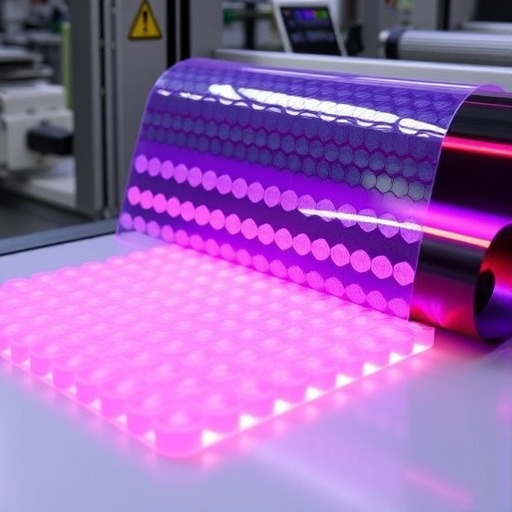
Now, researchers at Xi’an Jiaotong University report a manufacturing breakthrough designed specifically for scale. Led by Prof. Jinyou Shao and Prof. Xiangming Li, the team developed a flexible light-trapping film built from “multiply indented, hybrid 3D-nanobowls.” Instead of relying on costly master molds, they established a low-cost production route compatible with continuous roll-to-roll (R2R) UV nanoimprint lithography.
At the heart of the process is a chemical strategy that bypasses traditional template fabrication. The team used a metal replacement reaction between aluminum (Al) and zinc (Zn) ions to spontaneously generate core templates with complex geometries on large-area substrates. This bottom-up approach reduces cost while enabling the continuous production needed for commercial adoption.
Optically, the nanobowl surface is engineered to behave like an “optical maze.” When light strikes the multiply indented edges and curved features, it undergoes strong refraction and multi-level scattering rather than passing straight through. The results are striking: the film preserves a high transmission of about 87% while achieving an ultra-high transmission haze reaching 98%.
That combination matters because haze-driven scattering increases the residence time and propagation path of photons within a solar cell’s photoactive region. In practice, this should improve light absorption efficiency without sacrificing the amount of light entering the device.
Equally important, the film retains mechanical flexibility and is produced through a fabrication pathway designed for large-area throughput. The authors highlight compatibility with R2R manufacturing, positioning the technology for practical integration rather than purely lab-scale demonstrations.
The team published the work in Nano Research on 27-Apr-2026. In addition to perovskite and organic photovoltaics, the researchers note potential relevance to flexible organic light-emitting diodes, where controlled light extraction and optical scattering can be beneficial.
If this manufacturing concept translates smoothly to industrial lines, front-surface light trapping may shift from template-limited novelty to customizable, scalable optical engineering—bringing higher efficiency closer to cost-effective deployment.
Subject of Research: Front-surface light-trapping micro/nano film; low-cost R2R UV nanoimprint lithography; 3D nanobowl optics
Article Title: Breaking the Boundaries of Light Management: Xi’an Jiaotong University Team Achieves Low-Cost, Roll-to-Roll Production of ‘3D Nanobowl’ Light-Trapping Films with Ultra-High Haze
News Publication Date: 27-Apr-2026
Web References: http://dx.doi.org/10.26599/NR.2026.94908395
References: Nano Research (published article DOI above)
Image Credits: Not provided
Keywords
Light trapping, 3D nanobowl, UV nanoimprint lithography, roll-to-roll manufacturing, transmission haze, solar cells, scattering optics, flexible photonic film, perovskite photovoltaics, organic photovoltaics
Tags: cost-effective large-scale nanostructure manufacturingflexible light-trapping films for solar panelshybrid nanostructures for solar enhancementincreasing photon absorption in photovoltaic devicesinnovative optical maze nanostructureslow-cost 3D nanobowl light-trapping filmsmetal replacement reaction for template creationnanostructured surfaces for improved light captureroll-to-roll nanofabricationscalable solar light managementsustainable manufacturing techniques forUV nanoimprint lithography for energy devices