For decades, one of the most elegant tricks in laser physics has come with an annoying limitation. When researchers blast atoms with intense ultrashort laser pulses, the atoms respond by emitting a whole ladder of higher frequencies — integer multiples of the driving laser’s frequency, a phenomenon known as high-harmonic generation. These harmonics are the workhorse behind some of the shortest light pulses ever created and the basis for compact X-ray sources that fit on a laboratory table. But like a guitar with fixed frets, the technique only ever produces certain notes. If the exact X-ray energy an experiment needs falls in the gap between two harmonics, there has been no way to reach it — until now.
A team at TU Wien in Vienna, working with colleagues at the University of California San Diego, has developed a method that makes the frequency of generated X-ray light continuously tunable. Writing in the journal Communications Physics, the researchers describe how they can shift the entire harmonic ladder up or down at will, sliding smoothly across the gaps between neighbouring harmonics until they land on precisely the X-ray frequency required. The analogy the team itself draws is musical: instead of a fretted guitar that only plays fixed pitches, they have built something closer to a slide guitar operating in the extreme ultraviolet and soft X-ray range, where the player can glide continuously between notes in either direction.
“For decades, high-harmonic light has behaved a little like a guitar with fixed frets,” says Prof. Tenio Popmintchev from the Institute of Photonics at TU Wien. “You get certain notes, at exactly the intervals dictated by physics. What we have now built is more like a slide guitar in the X-ray range: we can move continuously between the harmonics, in either direction, and select exactly the energy we need.”
To understand why this matters, it helps to think about how musical instruments produce sound. When a violin plays a note at 440 hertz, it does not emit just that single frequency. Overtones at 880 hertz and still higher multiples of the fundamental appear automatically, giving the instrument its characteristic timbre. Laser physics works the same way in high-harmonic generation: irradiate an atom with a laser of a given frequency, and the atom emits a comb-like series of frequencies at integer multiples of the original. Researchers call the resulting spectrum a “frequency comb” because the emitted frequencies are always separated by a fixed interval, like the evenly spaced teeth of a comb. The strength of this approach is that a single experimental setup generates a whole range of frequencies at once. The weakness is that if the wavelength an experiment actually needs lies between two of those frequency teeth, the setup is of little use. That becomes a serious problem when the goal is to excite an atomic resonance that demands one very specific frequency.
The insight behind the new method is deceptively simple: rather than trying to modify the X-rays directly, the team modified the laser used to generate them. Because every X-ray harmonic is an integer multiple of the driving laser frequency, even a small change in the laser’s frequency produces a much larger change in the resulting X-ray frequencies. A comparatively modest shift in the laser wavelength is therefore enough to bridge the entire gap to the next harmonic in the X-ray range. In effect, the researchers detuned the light frequencies upstream so that, at the end of the process, exactly the desired X-ray frequency emerges.
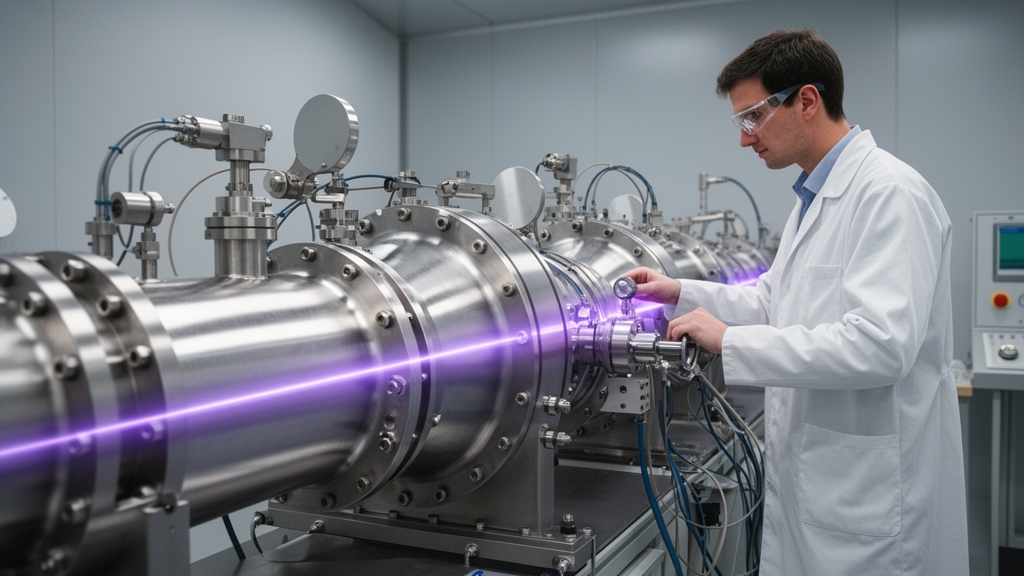
Making that idea work in practice, however, demanded considerable technical ingenuity. The team started with an ytterbium infrared laser and sent its light through a hollow waveguide six metres long, filled with gas. Inside the waveguide, a strong nonlinear interaction between the light and the gas modifies the spectrum of the pulse, broadening and shifting it in controlled ways. This specially prepared infrared light is then converted into visible light with the help of a crystal, and only this visible light — spanning a colour range from blue to yellow-green — is directed at helium atoms to drive the harmonic generation.
That detour through the visible range is not a stylistic choice; it carries crucial physical advantages. Compared with the infrared light normally used for high-harmonic generation, visible light can be controlled far more accurately, so that it oscillates at a pace matched to the emerging X-rays. Only when this timing precision is maintained — in physical terms, when phase matching of the electromagnetic waves is achieved — can the illuminated atoms jointly produce a brighter, narrower-linewidth X-ray beam rather than uncoordinated X-ray waves that partially cancel each other out. There is a bonus as well: with visible-light driving, each atom’s electrons are accelerated and recombine within a shorter interval than with infrared pulses. That speed matters, because it gives quantum diffusion of the electron wavepacket less time to erode the efficiency of the process, so each atom produces more intense harmonics.
“Spectral broadening, such as the kind we produce in our gas-filled waveguide, would normally mean losing control of the pulse,” says Dr. Dimitar Popmintchev from the Institute of Photonics at TU Wien, first author of the study. “We realised that exactly the same nonlinearity can also be used to steer the pulse in a controlled way.” The direction and magnitude of the frequency shift depend on the gas used. Atomic gases broaden the spectrum towards both higher and lower frequencies, while molecular gases can produce a stronger shift towards longer wavelengths through energy exchange with their internal degrees of freedom. “The type of gas and the pressure can therefore be used to control both the direction and the magnitude of the frequency shift,” explains Dr. Paolo Carpeggiani from TU Wien. Crucially, the X-ray emission remains bright across the entire tuning range while the narrow spectral lines are preserved — a combination that has long eluded the field.
The implications reach well beyond the laboratory curiosity stage. Many of the most compelling experiments in modern physics and chemistry require light tuned precisely to a specific resonance: precision spectroscopy, the emerging field of nuclear clocks, and semiconductor metrology all depend on interrogating transitions at exact energies. “Nature does not place its resonances where our harmonics happen to fall,” says Tenio Popmintchev. “If we can scan continuously across an entire energy range instead of simply jumping back and forth between fixed frequencies, many experiments become practically feasible in the first place, using laboratory-scale apparatus — much smaller than large-scale photon factories such as synchrotrons and free electron lasers.” In other words, the new technique could bring within reach of an ordinary lab table experiments that previously demanded access to kilometre-scale facilities where beamtime is scarce and fiercely contested.
The broader vision is a light source tailored as flexibly as possible to the task at hand. Until now, the logic of X-ray science has largely run in one direction: researchers adapted their experiments to whatever properties of the radiation happened to be available, contorting sample geometry, detection schemes, and scientific questions around the fixed frequencies their sources could deliver. With a continuously tunable harmonic source, that relationship flips. The radiation itself can be adapted to the experiment, selected note by note with the freedom of a fretless instrument — and for a field built on probing nature at its most precise resonances, that may prove to be the most important new song in the X-ray repertoire.
Subject of Research: Continuously tunable high-harmonic X-ray light generation using a gas-filled waveguide
Article Title: X-ray light is like guitar music
Article References: X-ray light is like guitar music. (n.d.). Original publication
Image Credits: AI Generated
DOI: Not provided
Keywords: high-harmonic generation, X-ray light, frequency comb, TU Wien, tunable laser, Communications Physics, X-ray, light, like, guitar, music, scientific research
News Source: Bethany Barker. (October 18, 2026). X-ray light on demand: Scientists tune X-ray frequencies continuously like a fretless guitar. Scienmag.