Small and medium-sized businesses have access to free pollution prevention and productivity improvement consulting thanks to grant support enabling West Virginia University industrial engineers to leverage their expertise on behalf of local enterprises.
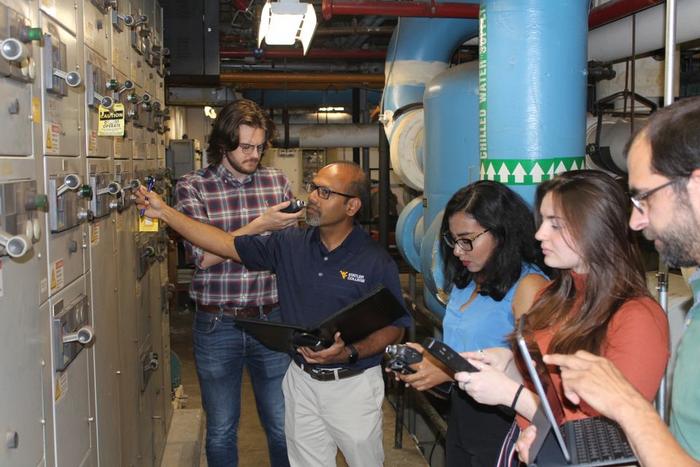
Credit: WVU Photo
Small and medium-sized businesses have access to free pollution prevention and productivity improvement consulting thanks to grant support enabling West Virginia University industrial engineers to leverage their expertise on behalf of local enterprises.
The WVU Pollution Prevention Program, or P2, is looking to sign up businesses for no-cost assessments of their operational efficiency and environmental sustainability.
“All throughout the manufacturing process of producing finished goods from raw materials, there is waste,” said Ashish Nimbarte, chair and professor of industrial and management systems engineering at the Benjamin M. Statler College of Engineering and Mineral Resources, and P2 project leader. “Probably the most effective way to be sustainable and profitable is pollution prevention or ‘source reduction’ — eliminating or reducing waste at the source level before it’s released into the environment. We are excited to work one-on-one with West Virginia’s industrial businesses to provide them with customized source reduction solutions and to train, equip and upskill their workers.”
Three Environmental Protection Agency grants totaling $900,000 support the P2 Program. Over the next two years, the program will provide participating industrial facilities with technical assistance and training on new digital technologies and on opportunities to minimize every kind of waste, from wasted labor to runoff of hazardous materials.
The P2 Program team also includes Thorsten Wuest, associate professor, Imtiaz Ahmed, assistant professor, and Christopher Moore, research associate.
“Bigger organizations have their own dedicated research and development departments that continuously look at processes and try to improve them,” Nimbarte said. “Our team wants to serve as the R&D department for West Virginia’s small manufacturing facilities, helping them identify best practices to optimize their water, material, tools, machine and labor use. At no cost to the facility, we’ll look at operations and give detailed recommendations for eliminating waste, with costs and payback periods for each proposed solution.”
The P2 Program will assess greenhouse gas emissions, conduct “clean and green” assessments that identify waste streams, consider factors like supply chain delays and transportation costs, and look for ways businesses can benefit from next generation technologies like artificial intelligence.
High-tech solutions will be at the forefront even for businesses that might believe they can’t afford to upgrade to “Industry 4.0” standards.
“Industry 4.0, also called the fourth industrial revolution, is about digital transformation of the manufacturing sector,” Wuest explained. “You have sensors collecting data from various components in the manufacturing process, including humans, machines and materials; and with the help of data-driven modeling and predictive analytics, you use the sensor data to identify opportunities to reduce energy consumption, increase safety and productivity, or improve the process and product quality.”
Wuest said recent advances in sensor technologies have lowered the price of sensors and the cost for industries to install them.
“As a simple example, a glass manufacturing facility uses a furnace to make glass and the furnace must maintain a certain temperature. Many times, the temperature is monitored manually, and adjustments are made manually to the furnace to keep that temperature consistent. But if a human operator is not attentive, the temperature can easily overshoot. This wastes energy, it wastes money, it’s a poor use of operators’ time, it increases emissions and, perhaps most importantly from the manufacturer’s perspective, it can have a negative impact on the quality of the glassware.
“Instead, they can get a simple temperature sensor and mount it inside the furnace. With the information from that sensor, an AI can help human operators make automated, data-driven adjustments to hold the temperature steady. That’s ‘smart manufacturing.’”
According to teammate Ahmed, an important part of the group’s work will involve estimating a business’s future carbon emissions. Using data about raw materials, fuels, water and chemical usage, and hazardous and nonhazardous waste, the researchers will model each enterprise’s path to carbon neutrality. “We’ll assist interested businesses in fine-tuning those models to suit their operations and realize their long-term carbon neutrality goals,” Ahmed said.
“The main idea is that we are here to help and we want businesses in this state to prosper,” Nimbarte added. “There’s no commitment for manufacturers and no cost. No one has to follow through with our recommendations after our assessment, but what we can do to eliminate waste from their processes is going to add to their bottom line.”
Nimbarte invites manufacturers to email him at [email protected] with questions or to request an assessment.