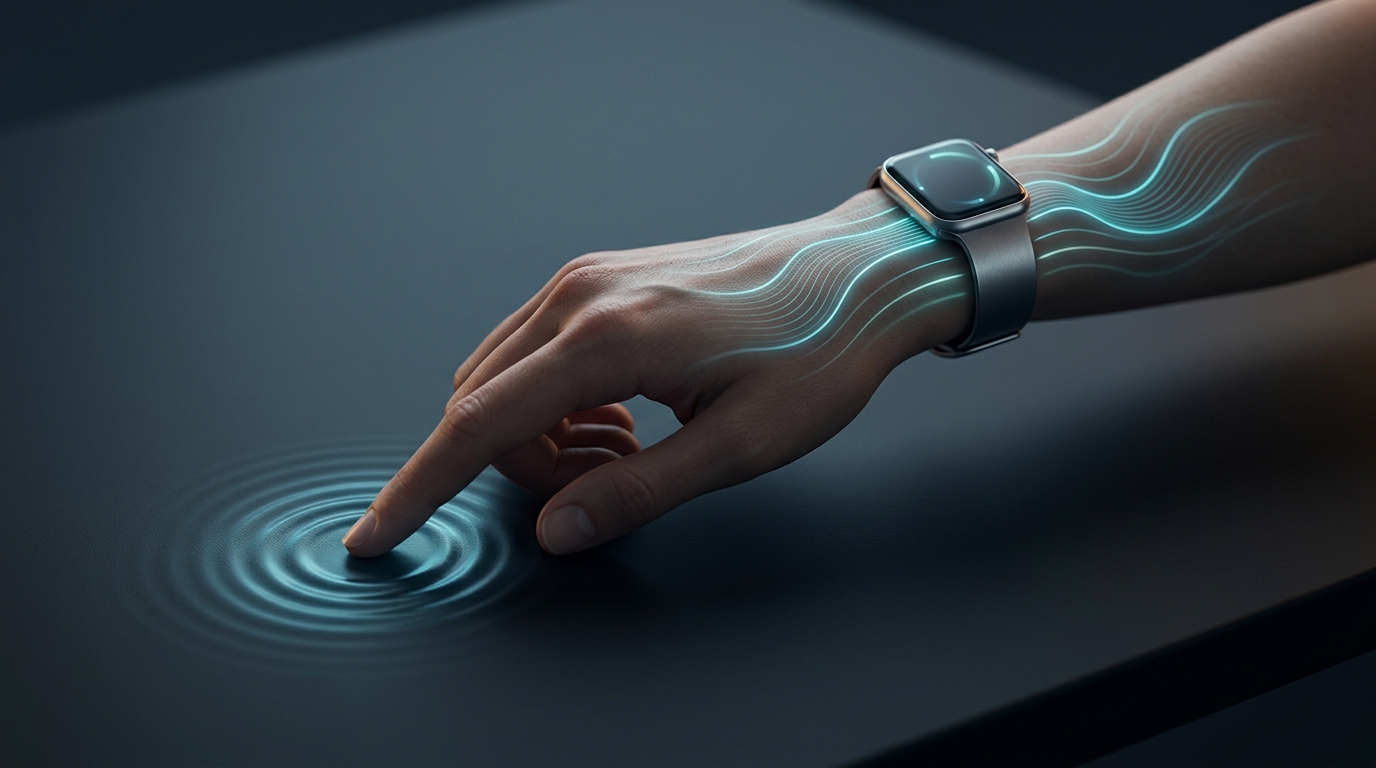
Engineers have built a wristband that can tell when a prosthetic hand touches something, using a single motion sensor and a compact neural network instead of the pressure sensors normally stitched into prosthetic fingers. The system, described in the journal Discover Robotics, pairs a wrist-worn six-axis inertial measurement unit with a one-dimensional convolutional neural network that classifies touch events directly from arm movements. In tests with ten participants, the best model reached 99.1 percent accuracy and an F1-score of 0.85, and a simplified version ran in real time on a low-cost microcontroller with latency under nine milliseconds.
The motivation comes from a persistent gap in prosthetics. Upper-limb prosthesis users typically lack comprehensive touch feedback, which forces them to rely on visual cues to manipulate objects. According to the researchers, that reliance can contribute to cognitive fatigue and eventual device abandonment, and restoring sensory feedback has been linked in prior work to mitigation of phantom limb pain, a condition affecting a significant majority of amputees. Even advanced prostheses are often used as tools rather than felt as extensions of the body, a usability problem the authors attribute primarily to the absence of sensory feedback.
Existing approaches to restoring touch split into invasive and non-invasive camps. Direct neural stimulation offers more natural feedback but requires complex surgery and carries prohibitive expense. Non-invasive haptic systems, which use small motors to vibrate an intact part of the amputee’s limb, are cheaper and easier to configure, and prior studies have shown users can differentiate multiple levels of vibration intensity. The harder problem is triggering that feedback accurately. Some systems embed force or pressure sensors in the prosthetic hand itself, raising cost and complexity, while EEG- and EMG-based solutions demand per-user tuning that is impractical at scale.
The new system takes a different route: it listens for contact at the wrist rather than at the fingertips. The authors draw on human-computer interaction research showing that mechanical vibrations from finger taps and hand impacts propagate through the soft tissue and the radius and ulna bones to the wrist, letting commodity smartwatches classify subtle gestures and object interactions. Prior work has also shown the arm acts as a waveguide for mechanical vibrations, allowing finger taps to be localized, and robot manipulator researchers have used end-effector IMU vibrations for collision detection. Those findings suggested the wrist is a viable sensing point for contact events happening at the end of the limb.
To test the idea, the team built a watch-like wearable housing a Teensy 4.1 microcontroller and an inertial measurement unit, worn on the wrist of a 3D-printed plastic hand that participants held as a stand-in for a real prosthesis. Ten subjects, seven male and three female with an average age of 24.5 years, performed paired activities designed to isolate the difference between motion and contact: walking versus walking and bumping into an object, waving versus sweeping a surface, pointing versus touching, and arbitrary daily-living movements with and without contact. Each subject completed each of the eight activities five times, producing 400 samples in the initial dataset. The study was approved by an Institutional Review Board, and all participants gave written consent.
Ground truth came from an electrical continuity circuit rather than human observation. The plastic hand was covered in aluminum foil, and interactions were made with a metal probe wired to the microcontroller; contact closed the circuit and registered a binary signal recorded in parallel with the IMU data at 100 Hz, ensuring exact alignment between movement and touch labels. After cleaning and removing calibration buffers, the data was cut into sliding windows of 20 samples, representing 200 milliseconds, with 70 percent overlap between neighboring windows. The authors note that window size sits close to the average human reaction time for touch stimuli, about 155 milliseconds, and that the high overlap preserves detection resolution without overloading the microcontroller.
Four models were trained on the windowed data: a logistic regression baseline using 56 handcrafted features, a support vector machine and a random forest on the same features, and a 1D-CNN that learned features directly from raw six-channel time series. The dataset was heavily imbalanced, roughly 96.8 percent no-touch windows versus 3.2 percent touch windows, so a naive model that always guessed no-touch would score 96.8 percent accuracy with an F1-score of 0.00. The team addressed the imbalance with a partial SMOTE oversampling technique and a Focal Loss function that pushes the network to focus on hard-to-classify minority samples. Twenty full activity recordings were held out entirely as an unseen test set to guard against data leakage inflating the final results.
The 1D-CNN, built from three convolutional blocks with filter sizes of 32, 64 and 128, achieved the best performance: 99.1 percent accuracy, an F1-score of 0.85, with precision of 0.92 and recall of 0.78 on the touch class, meaning it correctly identified 78 percent of true touch events while keeping false alarms low. An ablation study found a shallower two-block variant suffered lower recall, while a deeper four-block variant added latency beyond the real-time requirement without meaningful accuracy gains. Training on initial contact instances rather than the full contact duration improved results. Robustness testing with Gaussian noise and signal scaling showed steady degradation as augmentation intensity rose, but the model still held 66.8 percent accuracy and an F1-score above 0.70 at intensity 0.15, and 82 percent accuracy at intensity 0.05 used to mimic intense real-world sensor noise.
Deployment revealed a practical trade-off. The trained 1D-CNN was converted to TensorFlow Lite for Microcontrollers with 8-bit integer quantization, shrinking it to just 143 kilobytes, but its computational demands proved difficult on the Teensy board. As a proof of concept, the team instead deployed the lighter logistic regression model, which classified each sensor reading in under nine milliseconds, within the ten-millisecond frame required for 100 Hz sampling. The setup was tested with a buzzer standing in for a haptic motor, and the detection bracelet was also attached to the end-effector of a robotic arm, where it mostly detected collisions, grasping and object pickup accurately.
The authors are candid about limitations. The model struggled with non-impact activities such as sweeping, where the smooth sliding motion lacks the sharp impulse the system was optimized to detect, and all data came from non-amputee participants using a simulated prosthesis, so the model must be trained and tested further with amputee users before real-world use. Future work outlined in the paper includes expanding classification to three states, no touch, initial impact and sustained contact, running comprehensive amputee trials, and further optimization through model pruning or more capable hardware. The researchers suggest the underlying approach, classifying contact from kinematic data with a single IMU, could also extend to rehabilitation sensory feedback and to robotic grippers, offering contact detection without fragile fingertip sensors.
Subject of Research: A wrist-worn inertial sensor and deep learning system that detects touch events for upper-limb prosthetic users
Article Title: Single sensor Wrist-Worn contact detection system for upper limb prosthetics using deep learning
Article References: Hazboun, J., Torres, A., & Rastgaar, M. (2026). Single sensor Wrist-Worn contact detection system for upper limb prosthetics using deep learning. Discover Robotics, 2(1), Article 15. https://doi.org/10.1007/s44430-026-00030-8
Image Credits: AI Generated
DOI: 10.1007/s44430-026-00030-8
Keywords: prosthetics, sensory feedback, wearable sensors, inertial measurement unit, deep learning, touch detection, haptics, machine learning, microcontrollers, rehabilitation, biomedical engineering, convolutional neural network
News Source: Blake Davidson. (November 3, 2026). Wristwatch-style sensor reads touch through the arm with deep learning. Scienmag.