


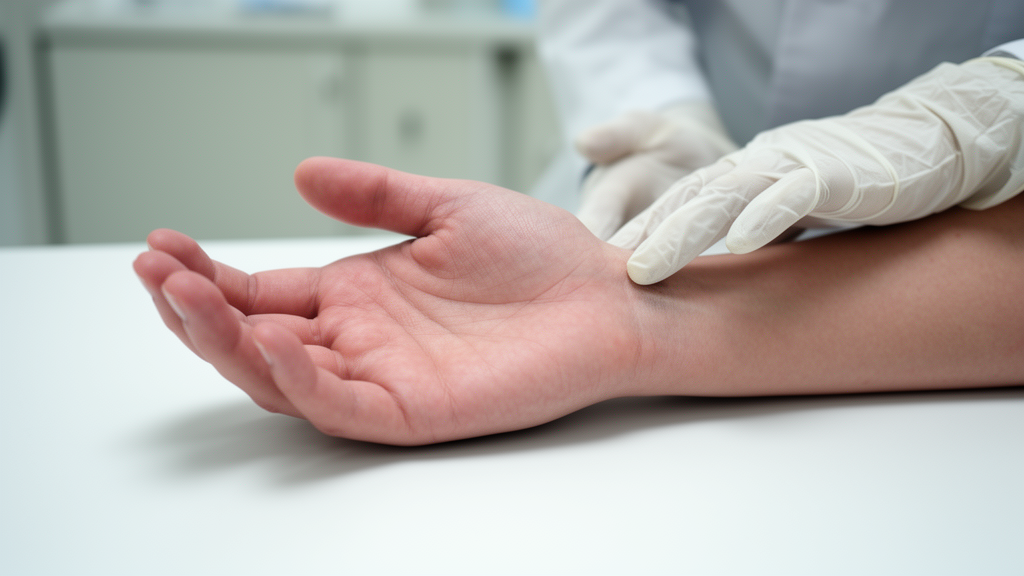
Patients whose carpal tunnel syndrome has lasted longer, whose wrists are wider across the carpus, and whose wrist circumference is small relative to that width tend to show more advanced nerve damage on electrical testing, according to a retrospective study of 148 patients treated at a single hospital in Baiyin, Gansu, China. The research, published in Frontiers in Neurology, also found that the same preoperative severity grades lined up with poorer scores on three standardized hand-function questionnaires measured three weeks after carpal tunnel release surgery. Because the study was retrospective, single-center and limited to patients with positive electrodiagnostic findings, the results describe associations within this particular group of patients rather than proven causal rules that generalize to everyone with the condition.
Carpal tunnel syndrome is the most common peripheral neuropathy, accounting for roughly 90 percent of all peripheral nerve entrapment disorders, with an estimated incidence of 1.5 to 3.8 percent and a typical age of onset between 40 and 60 years. Most patients experience symptoms in both hands, and women are affected more often than men, with reported prevalence of about 3.0 percent in women versus 2.1 percent in men. The condition arises when the median nerve, which runs through the carpal tunnel at the wrist alongside the flexor tendons, becomes compressed. Repetitive wrist movements are thought to thicken the transverse carpal ligament and reduce the tunnel’s volume, squeezing the nerve and impairing its microcirculation. That obstruction of lymphatic and venous return disrupts axonal transport, decreases permeability of the perineurium and endoneurium, and triggers oedema and, ultimately, demyelination of the nerve. In severe cases, axonal degeneration joins demyelination as the dominant pathology.
Symptoms typically include numbness and pain in the wrist and the radial three and a half fingers—the thumb, index and middle fingers and the radial half of the ring finger—along with wrist weakness, clumsiness of hand movements and difficulty with flexion. Severe cases may involve visible wasting of the hand muscles. The authors of the new study note that carpal tunnel syndrome impairs grip strength and fine motor skills, interferes with daily activities and work, and can in extreme cases cause permanent hand disability, which is why early detection and treatment are considered important for prognosis.
Diagnosis rests on a patient’s history, clinical presentation and physical examination, but nerve conduction studies are regarded as the gold standard, with needle electromyography serving as a supplementary tool. In the study, patients met clinical diagnostic criteria if they showed two or more of five features, including abnormal sensory symptoms in the affected hand, nocturnal paraesthesia, a positive Phalen’s sign, a positive Tinel’s sign or abnormal wrist sensations. Electrophysiological diagnosis followed criteria formulated in 2011 by the American Association of Neuromuscular and Electrodiagnostic Medicine, covering prolonged or unelicitable sensory latencies of the median nerve, reduced sensory amplitudes and conduction velocities, prolonged motor latencies, and abnormalities on needle EMG.
To grade severity, the researchers used reference nerve conduction values from the EMG Laboratory of Peking Union Medical College Hospital, treating a value deviating more than 2.5 standard deviations from the mean as abnormal. Mild disease meant a prolonged sensory latency with a distal motor latency of 4.5 milliseconds or less, normal sensory and muscle action potential amplitudes, and normal needle EMG findings. Moderate disease involved a distal motor latency up to 6.0 milliseconds, amplitudes reduced by up to 50 percent, and mild EMG abnormalities such as a small number of spontaneous potentials. Severe disease was defined by a distal motor latency above 6.0 milliseconds, amplitude reductions greater than 50 percent or unmeasurable potentials, and spontaneous potentials or abnormal motor unit potentials on needle EMG. Testing was performed with an eight-channel Keypoint.NET system, with room temperature held at 25.0 degrees Celsius and skin temperature above 32.0 degrees.
The 148 patients, enrolled between January and December 2024, were split into mild (46 patients), moderate (43) and severe (59) groups. Alongside the electrophysiological work-up, the team recorded demographic data, medical histories and anthropometric measurements. Transverse carpal diameter—the maximal distance between the most prominent points of the radial and ulnar styloid processes, measured on the dorsal wrist with a digital caliper—and wrist circumference, taken as the minimal circumference at the level of the distal wrist crease with a flexible tape, were each measured three times by two experienced clinicians, with the mean recorded. For unilateral cases, measurements came from the affected side; for bilateral cases, from the side with subjectively worse symptoms, or the dominant hand if both sides felt equally severe.
The central results were consistent across the severity spectrum. Mean disease duration rose from 14.66 months in the mild group to 27.35 months in the moderate group and 34.81 months in the severe group. Transverse carpal diameter increased in parallel, from 36.68 millimetres to 38.78 and then 40.92 millimetres. The ratio of wrist circumference to transverse carpal diameter moved in the opposite direction, falling from 4.24 to 4.07 to 3.92. All three comparisons were statistically significant at p < 0.001. Age, sex, body mass index, unilateral versus bilateral involvement and wrist circumference on its own showed no significant differences across the groups, suggesting that the ratio, rather than absolute wrist size, carries the signal.
An ordinal logistic regression, treating severity as an ordered outcome, confirmed that disease duration, transverse carpal diameter and the circumference-to-diameter ratio were independently associated with electrophysiological severity, with an omnibus test p-value below 0.001 and a Nagelkerke pseudo R-squared of 0.622, meaning the three variables accounted for about 62 percent of the variance in severity grade in this sample. Each additional month of disease duration carried an odds ratio of 1.238 for higher severity, each additional millimetre of carpal diameter an odds ratio of 1.164, and each unit increase in the ratio an odds ratio of 0.599, indicating that a smaller ratio predicted more severe findings. No multicollinearity was detected among the predictors.
The second part of the study examined how preoperative severity related to early recovery. Patients completed the Levine Carpal Tunnel Questionnaire, the Patient-Rated Wrist Evaluation and the Disabilities of the Arm, Shoulder and Hand questionnaire before surgery and again three weeks after carpal tunnel release. Preoperative scores were significantly higher in the severe group than in the mild or moderate groups for all three instruments. By three weeks postoperatively, every score had improved significantly from baseline in all groups, but the severe group still scored worse than the others: postoperative LCTQ scores were 24.33, 26.12 and 31.95 in the mild, moderate and severe groups respectively, with PRWE scores of 45.57, 48.44 and 51.05 and DASH scores of 71.57, 77.88 and 82.15. Spearman’s rank correlation showed preoperative severity was positively correlated with preoperative LCTQ (r = 0.63), PRWE (r = 0.42) and DASH (r = 0.87) scores.
The authors are careful about what the three-week timepoint can and cannot show. At this very early stage, they write, improvements in questionnaire scores likely reflect early symptom relief, such as reduced nocturnal paraesthesia, and wound healing rather than definitive axonal regeneration or true neurological recovery. They also acknowledge broader limitations: the single-centre retrospective design, the modest sample size, the exclusion of patients with negative EMG results, the likelihood that some people with mild-to-moderate disease never sought care, and the possibility of selection bias—noting, for example, that women made up 81.8 percent of their cohort, a much higher proportion than the roughly 1:1.4 male-to-female ratio reported in epidemiological surveys. Because the PRWE and DASH assess general upper-limb function, scores on those instruments may also be influenced by shoulder or elbow problems unrelated to the carpal tunnel. The team calls for larger, prospective studies with follow-up of six to twelve months to test whether preoperative electrophysiological severity retains its prognostic value over the longer term.
Subject of Research: Associations between anthropometric measurements, disease duration and electrophysiological severity in carpal tunnel syndrome, and their relation to early postoperative hand function
Article Title: Factors associated with the preoperative electrophysiological severity of carpal tunnel syndrome and correlation with early postoperative hand function status
Article References: Zhang, L., Wang, B., Su, Y., Li, S., He, L., & An, Q. (2026). Factors associated with the preoperative electrophysiological severity of carpal tunnel syndrome and correlation with early postoperative hand function status. Frontiers in Neurology, 17, Article 1817141. https://doi.org/10.3389/fneur.2026.1817141
Image Credits: AI Generated
DOI: 10.3389/fneur.2026.1817141
Keywords: carpal tunnel syndrome, nerve conduction studies, electromyography, transverse carpal diameter, wrist circumference, ordinal logistic regression, DASH questionnaire, carpal tunnel release, median nerve, retrospective study, Factors, associated
News Source: Ophelia Keating. (October 29, 2026). Wrist Shape and Symptom Duration Track Nerve Damage Severity in Carpal Tunnel Syndrome. Scienmag.



