• HOME
  • NEWS
  • EXPLORE
    • CAREER
      • Companies
      • Jobs
    • EVENTS
    • iGEM
      • News
      • Team
    • PHOTOS
    • VIDEO
    • WIKI
  • BLOG
  • COMMUNITY
    • FACEBOOK
    • INSTAGRAM
    • TWITTER
Thursday, September 24, 2026
BIOENGINEER.ORG
No Result
View All Result
  • Login
  • HOME
  • NEWS
  • EXPLORE
    • CAREER
      • Companies
      • Jobs
        • Lecturer
        • PhD Studentship
        • Postdoc
        • Research Assistant
    • EVENTS
    • iGEM
      • News
      • Team
    • PHOTOS
    • VIDEO
    • WIKI
  • BLOG
  • COMMUNITY
    • FACEBOOK
    • INSTAGRAM
    • TWITTER
  • HOME
  • NEWS
  • EXPLORE
    • CAREER
      • Companies
      • Jobs
        • Lecturer
        • PhD Studentship
        • Postdoc
        • Research Assistant
    • EVENTS
    • iGEM
      • News
      • Team
    • PHOTOS
    • VIDEO
    • WIKI
  • BLOG
  • COMMUNITY
    • FACEBOOK
    • INSTAGRAM
    • TWITTER
No Result
View All Result
Bioengineer.org
No Result
View All Result
Home NEWS Science News

WPI wave motion research may lead to protections for police, missile silos and satellites

Bioengineer by Bioengineer
October 8, 2019
in Science News
Reading Time: 2 mins read
0
IMAGE
Share on FacebookShare on TwitterShare on LinkedinShare on RedditShare on Telegram

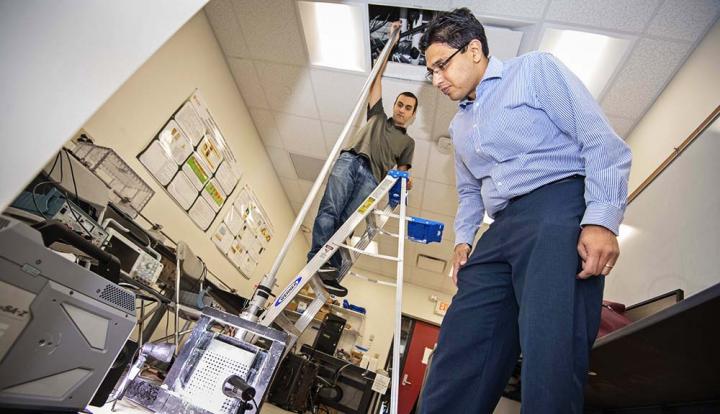
Funding from the National Science Foundation will support research of a new class of granular materials that should provide shock protection from a projectile, such as a bullet, to safeguard police and military personnel
IMAGE

Credit: Worcester Polytechnic Institute


An aerospace engineer at Worcester Polytechnic Institute (WPI) is conducting wave motion research to one day create a bulletproof vest that not only will sense the speed, angle of approach, and size of an incoming bullet, but the material inside the vest will instantly change properties to provide greater shock protection at the exact point of impact. These materials could be used in protective gear, and to create protective covers for buildings, satellites, and underwater missile silos. The pioneering work is being funded by a five-year, $500,000 Faculty Early Career Development Program (CAREER) award from the National Science Foundation.

Nikhil Karanjgaokar, assistant professor of aerospace engineering, is using his expertise in wave motion and interruption to explore the mechanical and physical properties of granular materials that can alter their shapes or change their original properties to absorb and redirect the force of an incoming bullet or object. Karanjgaokar hopes to develop shock protection technology that can protect people and objects from being pierced or affected by the shock from projectiles. The technology could be used in personal protective equipment, such as vests and helmets, that can be worn by the military, police, and other professionals, like athletes and construction workers. The technology also could be used as a protective covering for buildings or even to protect NASA’s International Space Station, satellites, and spacecraft from being damaged by space junk and meteorites.

“I want to design materials that can absorb impact,” said Karanjgaokar, whose previous research was focused on understanding wave motion through granular material. “People trying to protect themselves from bullets or shrapnel have used sandbags since before the Second World War to absorb impacts. I’m working from the same basic principle. How can we create a versatile material to create a barrier against any impact?”

Media Contact
Andy Baron
[email protected]
508-831-5916

Original Source

https://www.wpi.edu/news/sea-space-wpi-wave-motion-research-may-lead-shape-shifting-material-will-provide-shock

Tags: Chemistry/Physics/Materials SciencesCollaborationGrants/FundingMechanical EngineeringNanotechnology/MicromachinesOrganizationResearch/DevelopmentResearchers/Scientists/Awards
Share13Tweet8Share2ShareShareShare2

Related Posts

Mapping the Next Outbreak: How Satellites and GPS Are Reshaping Veterinary Medicine

Mapping the Next Outbreak: How Satellites and GPS Are Reshaping Veterinary Medicine

September 24, 2026
Jumping Genes Divide the Animal Kingdom into Sea and Land Clades

Jumping Genes Divide the Animal Kingdom into Sea and Land Clades

September 24, 2026

Wrist-Worn CO2 Sensor Uses Silicone Layer and Smart Statistics to Deliver Reliable Early Readings

September 24, 2026

How Organoids Became Biology’s Most Powerful Miniature Laboratories

September 24, 2026
Please login to join discussion

POPULAR NEWS

  • Mapping the Next Outbreak: How Satellites and GPS Are Reshaping Veterinary Medicine

    29 shares
    Share 12 Tweet 7
  • Jumping Genes Divide the Animal Kingdom into Sea and Land Clades

    29 shares
    Share 12 Tweet 7
  • Wrist-Worn CO2 Sensor Uses Silicone Layer and Smart Statistics to Deliver Reliable Early Readings

    29 shares
    Share 12 Tweet 7
  • How Organoids Became Biology’s Most Powerful Miniature Laboratories

    29 shares
    Share 12 Tweet 7

About

We bring you the latest biotechnology news from best research centers and universities around the world. Check our website.

Follow us

Recent News

Mapping the Next Outbreak: How Satellites and GPS Are Reshaping Veterinary Medicine

Jumping Genes Divide the Animal Kingdom into Sea and Land Clades

Wrist-Worn CO2 Sensor Uses Silicone Layer and Smart Statistics to Deliver Reliable Early Readings

Subscribe to Blog via Email

Enter your email address to subscribe to this blog and receive notifications of new posts by email.

Join 85 other subscribers
  • Contact Us

Bioengineer.org © Copyright 2023 All Rights Reserved.

Welcome Back!

Login to your account below

Forgotten Password?

Retrieve your password

Please enter your username or email address to reset your password.

Log In
No Result
View All Result
  • Homepages
    • Home Page 1
    • Home Page 2
  • News
  • National
  • Business
  • Health
  • Lifestyle
  • Science

Bioengineer.org © Copyright 2023 All Rights Reserved.