A team of scientists from MSMU discovered that earthworms efficiently process rice straw and enrich the soil with organic matter increasing its fertility and preventing the burning of the straw
Credit: Courtesy of Andrey Zaitsev
A team of scientists from I.M. Sechenov First Moscow State Medical University (MSMU) discovered that earthworms efficiently process rice straw and enrich the soil with organic matter increasing its fertility and preventing the burning of the straw that takes quite long to naturally decompose. The results of the study were published in the European Journal of Soil Biology. The work was supported with a grant of the Russian Science Foundation.
Rice is staple food product for the majority of the Earth’s population. The demand for it is constantly growing, making its production increase annually. Harvesting and grain peeling leave a considerable amount of crop residues which are not naturally consumed by herbivorous animals and therefore is burned down. Burning causes the emission of greenhouse gases (carbon dioxide and methane) and black carbon, which negatively affects the climate. Therefore, it is important to develop a more eco-friendly method for rice straw recycling.
The authors of the study collected soil samples at three regions of Russia where rice is grown: Krasnodarsky Krai, Kalmykia, and Primorsky Krai. It turned out, that in all three regions the rice fields lacked earthworms, and the scientists selected the cheapest kind of them to be tested – Eisenia fetida that is cultivated in Russia on an industrial scale for fishing and humus production. The scientists wanted to find out if they were able to process rice straw.
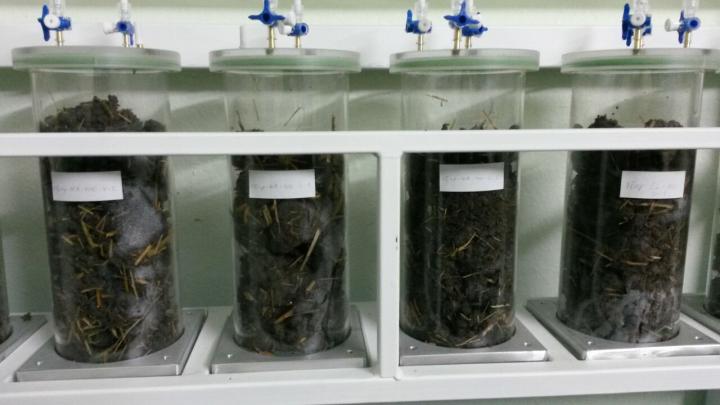
The team created several mesocosms (closed confinements imitating natural conditions) to study the ratio between the emission of carbon dioxide, methane, and organic carbon and the type of soil, presence of straw, and the number of earthworms in it. Each system contained 1 kg of soil with or without rice straw. Finally, different amounts of earthworms were placed into each mesocosm to find out how their activity would influence the concentration of greenhouse gases and carbon input into soil.
It turned out that adding rice straw to any type of soil increases carbon dioxide emission at least by the factor of three. The ratio between the emitted CO2 and the number of earthworms varied depending on the soil type. For example, the emissions barely changed when the worms were added to the mesocosms with soil from Primorsky Krai. In other types of soil with rice straw the emission of carbon dioxide considerably increased after the worms were added. The highest effect in the soils from Kalmykia was reached at the density of 6 worms per mesocosm, and from Krasnodar Krai – at 4 worms per mesocosm. At the same time the increase in concentration of organic carbon in Krasnodar soils turned out to be 10,000 times higher than its loss in the course of emissions. When bound with the soil, organic carbon improves its fertility and erosion resistance, and when burned – produces carbon dioxide or black carbon. As for methane emissions, the worms did not influence those.
“This work is of practical importance. We’ve found a way to efficiency process rice straw instead of burning it which is currently the most common practice worldwide. Along with increasing sustainability and climate safety of rice growing, it reduces the risks for the environment and mankind associated with agricultural burns as causes of fires and atmospheric pollution, including that with carcinogenic substances. Moreover, adding earthworms to soils will increase the quality, fertility, and soil health of the fields and reduce the risk of erosion due to binding with organic substances,” added Andrey Zaitsev, a researcher from MSMU and a senior researcher at the laboratory of soil ecosystem functions, A.N. Severtsov Institute of Ecology and Evolution of the Russian Academy of Sciences.
###
Among the participants of the work there also were scientists from Lomonosov Moscow State University.
Media Contact
Nataliya Rusanova
[email protected]
Original Source
https:/
Related Journal Article
http://dx.