Credit: Stefan Bengtson
Scientists at the Swedish Museum of Natural History have found fossils of 1.6 billion-year-old probable red algae. The spectacular finds, publishing on 14 March in the open access journal PLOS Biology, indicate that advanced multicellular life evolved much earlier than previously thought.
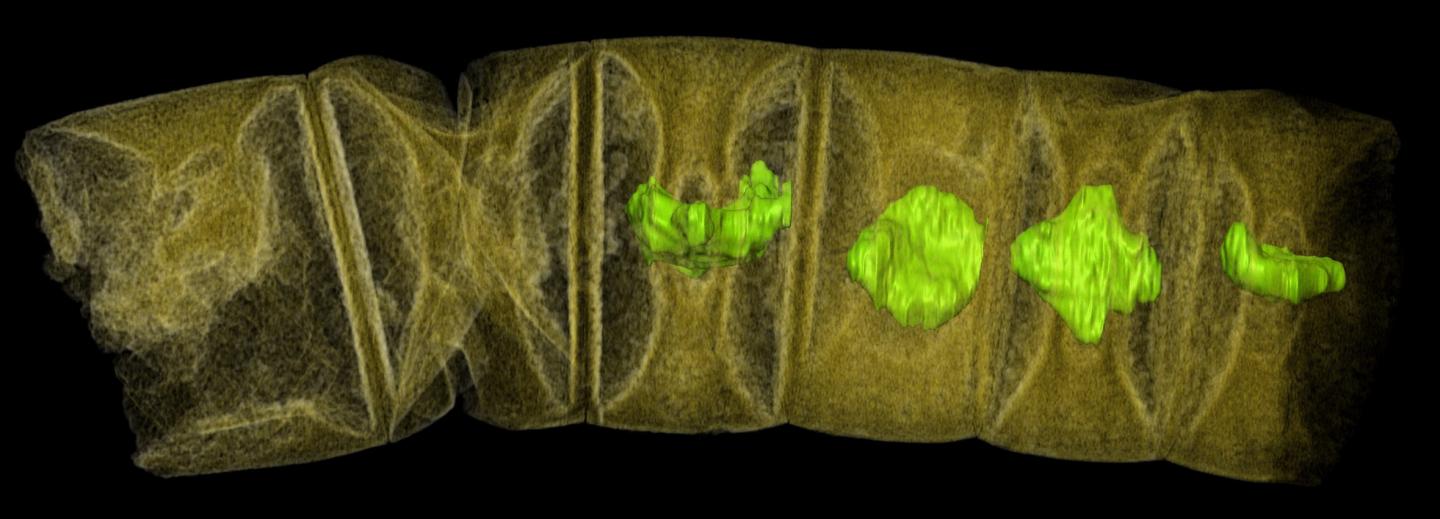
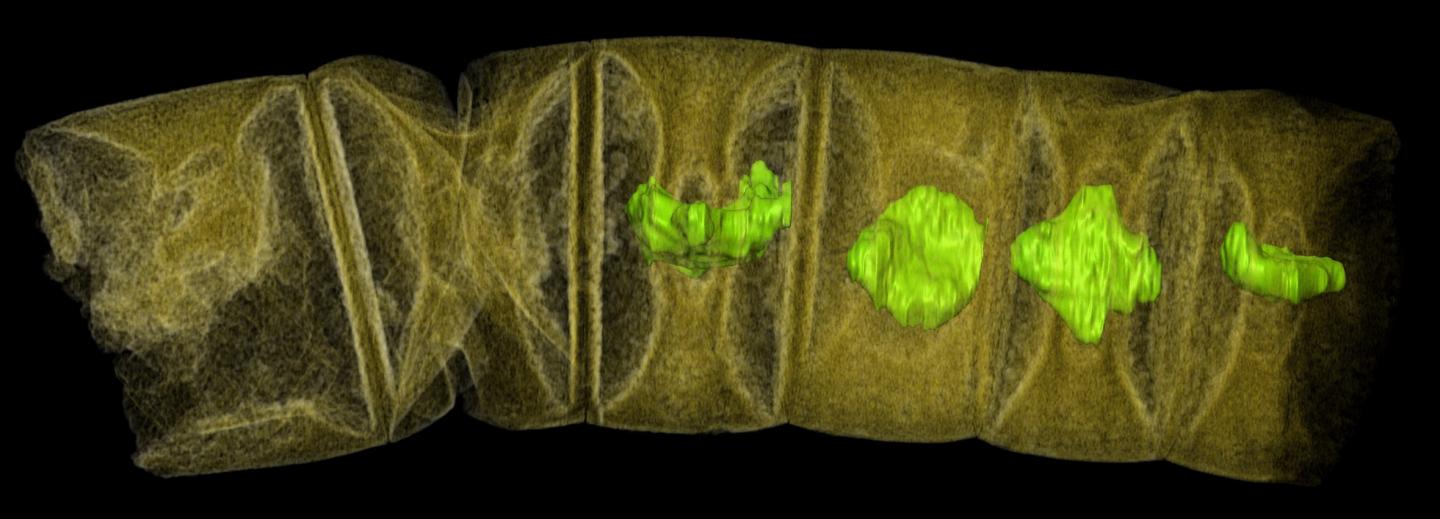
The scientists found two kinds of fossils resembling red algae in uniquely well-preserved sedimentary rocks at Chitrakoot in central India. One type is thread-like, the other one consists of fleshy colonies. The scientists were able to see distinct inner cell structures and so-called cell fountains, the bundles of packed and splaying filaments that form the body of the fleshy forms and are characteristic of red algae.
"You cannot be a hundred per cent sure about material this ancient, as there is no DNA remaining, but the characters agree quite well with the morphology and structure of red algae," says Stefan Bengtson, Professor emeritus of palaeozoology at the Swedish Museum of Natural History.
The earliest traces of life on Earth are at least 3.5 billion years old. These single-celled organisms, unlike eukaryotes, lack nuclei and other organelles. Large multicellular eukaryotic organisms became common much later, about 600 million years ago, near the transition to the Phanerozoic Era, the "time of visible life."
Discoveries of early multicellular eukaryotes have been sporadic and difficult to interpret, challenging scientists trying to reconstruct and date the tree of life. The oldest known red algae before the present discovery are 1.2 billion years old. The Indian fossils, 400 million years older and by far the oldest plant-like fossils ever found, suggest that the early branches of the tree of life need to be recalibrated.
"The 'time of visible life' seems to have begun much earlier than we thought," says Stefan Bengtson.
The presumed red algae lie embedded in fossil mats of cyanobacteria, called stromatolites, in 1.6 billion-year-old Indian phosphorite. The thread-like forms were discovered first, and when the then doctoral student Therese Sallstedt investigated the stromatolites she found the more complex, fleshy structures.
"I got so excited I had to walk three times around the building before I went to my supervisor to tell him what I had seen!" she says.
The research group was able to look inside the algae with the help of synchrotron-based X-ray tomographic microscopy. Among other things, they have seen regularly recurring platelets in each cell, which they believe are parts of chloroplasts, the organelles within plant cells where photosynthesis takes place. They have also seen distinct and regular structures at the centre of each cell wall, typical of red algae.
###
In your coverage please use this URL to provide access to the freely available article in PLOS Biology: http://dx.doi.org/10.1371/journal.pbio.2000735
Citation: Bengtson S, Sallstedt T, Belivanova V, Whitehouse M (2017) Three-dimensional preservation of cellular and subcellular structures suggests 1.6 billion-year-old crown-group red algae. PLoS Biol 15(3): e2000735. doi:10.1371/journal.pbio.2000735
Funding: Paul Scherrer Institute https://www.psi.ch/useroffice/useroffice (grant number 20070197, 20080872, 20100167, 20110963, 20130185, 20141047). The funder had no role in study design, data collection and analysis, decision to publish, or preparation of the manuscript. Swedish Research Council http://www.vr.se/inenglish.4.12fff4451215cbd83e4800015152.html (grant number 2007-4484, 2010-3929, 2013-4290). The funder had no role in study design, data collection and analysis, decision to publish, or preparation of the manuscript.
Competing Interests: The authors have declared that no competing interests exist.
Media Contact
Therese Sallstedt
[email protected]
############
Story Source: Materials provided by Scienmag