

• HOME
  • NEWS
  • EXPLORE
    • CAREER
      • Companies
      • Jobs
    • EVENTS
    • iGEM
      • News
      • Team
    • PHOTOS
    • VIDEO
    • WIKI
  • BLOG
  • COMMUNITY
    • FACEBOOK
    • INSTAGRAM
    • TWITTER
Saturday, April 18, 2026
BIOENGINEER.ORG
No Result
View All Result
  • Login
  • HOME
  • NEWS
  • EXPLORE
    • CAREER
      • Companies
      • Jobs
        • Lecturer
        • PhD Studentship
        • Postdoc
        • Research Assistant
    • EVENTS
    • iGEM
      • News
      • Team
    • PHOTOS
    • VIDEO
    • WIKI
  • BLOG
  • COMMUNITY
    • FACEBOOK
    • INSTAGRAM
    • TWITTER
  • HOME
  • NEWS
  • EXPLORE
    • CAREER
      • Companies
      • Jobs
        • Lecturer
        • PhD Studentship
        • Postdoc
        • Research Assistant
    • EVENTS
    • iGEM
      • News
      • Team
    • PHOTOS
    • VIDEO
    • WIKI
  • BLOG
  • COMMUNITY
    • FACEBOOK
    • INSTAGRAM
    • TWITTER
No Result
View All Result
Bioengineer.org
No Result
View All Result
Home NEWS Science News Biology

World’s most efficient production of succinate from carbon dioxide

Bioengineer by Bioengineer
June 6, 2018
in Biology
Reading Time: 2 mins read
0
Share on FacebookShare on TwitterShare on LinkedinShare on RedditShare on Telegram
IMAGE

Credit: Kobe University

Succinate is widely used as a raw ingredient for petrochemicals, and there is high demand for a way of producing succinate that is renewable and environmentally benign. A Japanese researcher has discovered that succinate production levels increase when cyanobacteria is grown above the ideal temperature for cell growth. He used insights into the metabolic pathway engineering to achieve the world's most efficient production rate for bio-succinate.

The discovery was made by Professor Tomohisa Hasunuma (Kobe University Graduate School of Science, Technology and Innovation) as a Japan Science and Technology Agency Strategic Basic Research Program. The findings were published in Metabolic Engineering on May 27.

Professor Hasunuma's research team aimed to find the reaction that acts as the bottleneck in the metabolic pathway when CO2 is converted into succinate, then use genetic engineering to speed up this bottleneck reaction and increase the production of succinate.

Metabolome analysis measures the amounts of the various metabolic substances within cells, and it can be used to estimate the metabolic intermediates that contribute to increased production of succinate. The research team built on this technology to develop a dynamic metabolome analysis technique that can observe the turnover in amounts of intracellular metabolites. By applying dynamic metabolome analysis when they observed an increase in succinate production, they were able to identify the bottleneck reaction in the succinate biosynthesis pathway.

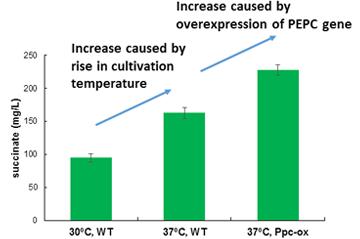
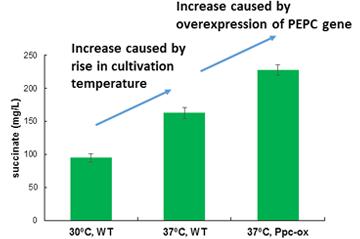
The cyanobacterium used in this study (Synechocystis sp. PCC 6803) is one of the most popular cyanobacteria for research worldwide. The team found that the ideal temperature for making succinate from this cyanobacterium is about 7 degrees Celsius higher than the cell growth temperature of 30 degrees Celsius. Using dynamic metabolome analysis they clarified the mechanism for producing succinate at high temperatures, and showed that PEPC (phosphoenolpyruvate carboxylase) is involved in the bottleneck reaction. The group then developed a recombinant Synechocystis which has higher PEPC activity than the wild type through genetic engineering. By improving PEPC reaction, and growing cyanobacteria at 37 degrees Celsius, they managed to raise the production rate of succinate to 7.5 times higher than previous studies.

"This study is an important step towards producing bio-succinate from CO2. We now aim to increase the production of succinate by refining the metabolic pathway" comments Professor Hasunuma. "By targeting various metabolic systems, this line of research could make large contributions in basic research into metabolic pathway control structures, and applied research into substance production."

###

Media Contact

Eleanor Wyllie
[email protected]
@KobeU_Global

http://www.kobe-u.ac.jp/en/

Original Source

http://www.kobe-u.ac.jp/research_at_kobe_en/NEWS/news/2018_06_06_01.html http://dx.doi.org/10.1016/j.ymben.2018.05.013


Share12Tweet8Share2ShareShareShare2

Related Posts

On-Demand Growth of Liver Tissue Directly Within the Body

On-Demand Growth of Liver Tissue Directly Within the Body

April 17, 2026
Conserved DNA Architect Links Chloroplasts to Cell Cycle

Conserved DNA Architect Links Chloroplasts to Cell Cycle

April 17, 2026

UTS Study Reveals Toxic Metal Exposure from E-Cigarette Devices

April 17, 2026

Can Exercise Help You Beat Stress Hormones? New Insights from a Clinical Trial

April 17, 2026
Please login to join discussion

POPULAR NEWS

  • Scientists Investigate Possible Connection Between COVID-19 and Increased Lung Cancer Risk

    62 shares
    Share 25 Tweet 16
  • NSF funds machine-learning research at UNO and UNL to study energy requirements of walking in older adults

    100 shares
    Share 40 Tweet 25
  • Boosting Breast Cancer Risk Prediction with Genetics

    47 shares
    Share 19 Tweet 12
  • Popular Anti-Aging Compound Linked to Damage in Corpus Callosum, Study Finds

    46 shares
    Share 18 Tweet 12

About

We bring you the latest biotechnology news from best research centers and universities around the world. Check our website.

Follow us

Recent News

Major UKHSA Study Finds Maternal RSV Vaccination Reduces Infant Hospitalization Risk by More Than 80%

Persistent Measles Vaccine Gaps Found Among Emergency Room Patients

Viral Immunity and Behavior Sustain Low Mpox Rates

Subscribe to Blog via Email

Enter your email address to subscribe to this blog and receive notifications of new posts by email.

Join 79 other subscribers
  • Contact Us

Bioengineer.org © Copyright 2023 All Rights Reserved.

Welcome Back!

Login to your account below

Forgotten Password?

Retrieve your password

Please enter your username or email address to reset your password.

Log In
No Result
View All Result
  • Homepages
    • Home Page 1
    • Home Page 2
  • News
  • National
  • Business
  • Health
  • Lifestyle
  • Science

Bioengineer.org © Copyright 2023 All Rights Reserved.
