New technique doubles the highest electron energy ever produced by a laser plasma accelerator, bringing the promise of tera electron volt electron-positron colliders one step closer
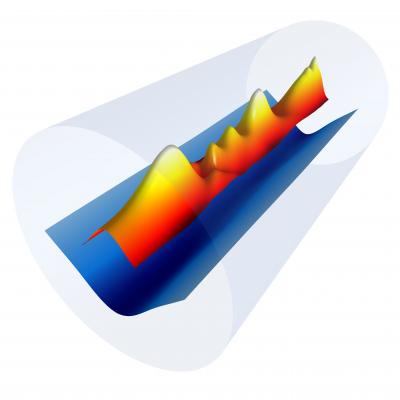
Credit: Gennadiy Bagdasarov/Keldysh Institute of Applied Mathematics; Anthony Gonsalves and Jean-Luc Vay/Berkeley Lab
Fort Lauderdale, Fla.–To understand the fundamental nature of our universe, scientists would like to build particle colliders that accelerate electrons and their antimatter counterparts (positrons) to extreme energies (up to tera electron volts, or TeV). With conventional technology, however, this requires a machine that is enormously big and expensive (think 20 miles long). To shrink the size and cost of these machines, the acceleration of the particles–how much energy they gain in a given distance–must be increased.
This is where plasma physics could have a dramatic impact: a wave of charged particles–a plasma wave–can provide this acceleration through its electric field. In a laser plasma accelerator, intense laser pulses are used to create a plasma wave with electric fields that can be thousands of times stronger than those attainable in conventional accelerators.
Recently, the team at Berkeley Lab’s BELLA Center doubled the previous world record for energy produced by laser plasma accelerators, generating electron beams with energies up to 7.8 billion electron volts (GeV) in an 8-inch-long plasma. This would require about 300 feet using conventional technology.
The researchers achieved this feat by counteracting the natural spreading of the laser pulse using a new type of plasma waveguide. In this waveguide, an electrical discharge is triggered in a sapphire tube filled with gas to form a plasma, and a “heater” laser pulse drills out some of the plasma in the middle, making it less dense so that it focuses the laser light (Figure 1). The plasma channel is strong enough to keep the focused laser pulses well-confined over the 8-inch accelerator length.
“The heater beam allowed us to control the propagation of the driver laser pulse,” said Dr. Anthony Gonsalves. “The next experiments will aim to gain precision control over electron injection into the plasma wave for achieving unprecedented beam quality, and to couple multiple stages together to demonstrate the path to even higher energy.”
Getting the next generation of electron-positron colliders to TeV energies will require linking a series of laser plasma accelerators, with each stage giving the particles an energy boost. The Berkeley Lab achievement is exciting because 7.8 GeV is about the energy needed for these stages to be efficient.
###
This work is supported by the U.S. Department of Energy under contract No. DE-AC02-05CH11231.
For additional information see also:
Physical Review Letters cover image for Volume 122, Issue 8; Petawatt Laser Guiding and Electron Beam Acceleration to 8 GeV in a Laser-Heated Capillary Discharge Waveguide, A. J. Gonsalves et al, Phys. Rev. Lett. 122, 084801 (2019)
Contact:
Anthony Gonsalves, Lawrence Berkeley National Laboratory, [email protected]
Abstract:
Petawatt laser guiding and electron beam acceleration to 8 GeV in laser-heated capillary discharge waveguides
9:30 AM–12:30 PM, Wednesday, October 23, 2019
Room: Floridian Ballroom CD
http://meetings.
About APS/DPP:
The 61st Annual Meeting of the American Physical Society’s Division of Plasma Physics will take place from October 21-25, 2019 in Fort Lauderdale, Florida. All technical sessions will be located at the Fort Lauderdale/Broward County Convention Center, where over 1,900 papers will be presented by scientists from over 20 countries around the world.
The American Physical Society (APS) is a nonprofit membership organization working to advance and diffuse the knowledge of physics through its outstanding research journals, scientific meetings, and education, outreach, advocacy, and international activities. APS represents over 55,000 members, including physicists in academia, national laboratories, and industry in the United States and throughout the world.
Media Contact
Saralyn Stewart
[email protected]
512-694-2320