• HOME
  • NEWS
  • EXPLORE
    • CAREER
      • Companies
      • Jobs
    • EVENTS
    • iGEM
      • News
      • Team
    • PHOTOS
    • VIDEO
    • WIKI
  • BLOG
  • COMMUNITY
    • FACEBOOK
    • INSTAGRAM
    • TWITTER
Wednesday, April 29, 2026
BIOENGINEER.ORG
No Result
View All Result
  • Login
  • HOME
  • NEWS
  • EXPLORE
    • CAREER
      • Companies
      • Jobs
        • Lecturer
        • PhD Studentship
        • Postdoc
        • Research Assistant
    • EVENTS
    • iGEM
      • News
      • Team
    • PHOTOS
    • VIDEO
    • WIKI
  • BLOG
  • COMMUNITY
    • FACEBOOK
    • INSTAGRAM
    • TWITTER
  • HOME
  • NEWS
  • EXPLORE
    • CAREER
      • Companies
      • Jobs
        • Lecturer
        • PhD Studentship
        • Postdoc
        • Research Assistant
    • EVENTS
    • iGEM
      • News
      • Team
    • PHOTOS
    • VIDEO
    • WIKI
  • BLOG
  • COMMUNITY
    • FACEBOOK
    • INSTAGRAM
    • TWITTER
No Result
View All Result
Bioengineer.org
No Result
View All Result
Home NEWS Science News Biology

World-famous sardine migration explained by genomics

Bioengineer by Bioengineer
September 15, 2021
in Biology
Reading Time: 3 mins read
0
The sardine run in southeastern Africa is a mass migration into an ecological trap
Share on FacebookShare on TwitterShare on LinkedinShare on RedditShare on Telegram

Scientists have discovered how the Sardine Run, one of the world’s biggest migration events, works.
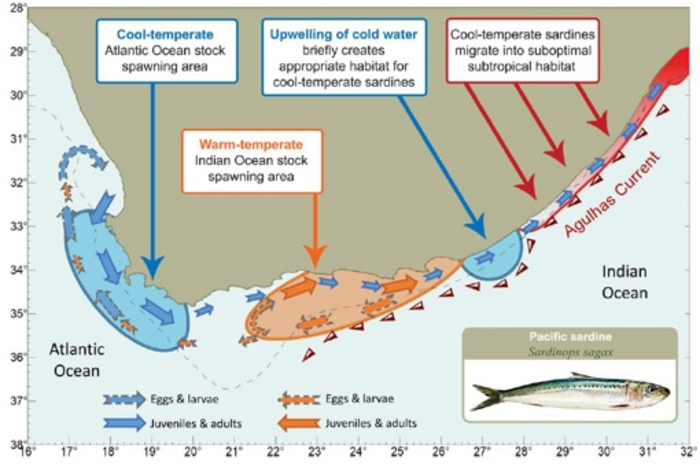
The sardine run in southeastern Africa is a mass migration into an ecological trap

Credit: Professor Luciano Beheregaray, Flinders University in Science Advances.

Scientists have discovered how the Sardine Run, one of the world’s biggest migration events, works.

This spectacular event, considered the “Greatest Shoal on Earth”, involves the movement of hundreds of millions of sardines from their cool-temperate core range into the warmer subtropical waters of the Indian Ocean, on South Africa’s east coast.

The sardine run is triggered by the upwelling of cold water on the southeast coast and as they swarm north they get sandwiched between the coast and a southward-flowing hot current that exceeds the sardines physiological capacity. They are then predated by huge numbers of dolphins, sharks, seabirds and even whales, an event that has featured in many nature documentaries.

A new study in the journal Science Advances by South African and Australian scientists tested the hypothesis that the Sardine Run represents the spawning migration of a distinct east coast stock adapted to warm subtropical conditions. The scientists generated genomic data for hundreds of sardines from around South Africa, including data from regions of the genome that are primarily associated with differences in water temperature along the coast.

The results showed two sardine populations in South Africa, one in the cool-temperate west coast (Atlantic Ocean) and the other in warmer east coast waters (Indian Ocean). Each regional population appears adapted to the temperature range that it experiences in its native region.

“Surprisingly, we also discovered that sardines participating in the migration run are primarily of Atlantic origin and prefer colder water”, says Professor Luciano Beheregaray at the Flinders University Molecular Ecology Lab, one of the study authors.

“The cold water of the brief upwelling periods attracts the west coast sardines, which are not adapted to the warmer Indian Ocean habitat”, says author Professor Peter Teske from Johannesburg.  

“This is a rare finding in nature, since there are no obvious fitness benefits for the migration, so why do they do it? “We think the sardine migration might be a relic of spawning behaviour dating back to the glacial period. What is now subtropical Indian Ocean habitat was then an important sardine nursery area with cold waters”, says Professor Teske.

This visually breathtaking migration run attracts tourists from around the world who are keen to get a glimpse of the underwater spectacle, but it may not be around forever.

“Given the colder water origins of sardines participating in the run, projected warming could lead to the end of the sardine run”, says Professor Beheregaray. Despite the huge numbers of fish involved, the run involves only a small portion of the South African population so while it’s end would mean the loss of one of nature’s most spectacular migrations, the effects on the population as a whole are likely to be negligible.


Journal

Science Advances

DOI

10.1126/sciadv.abf4514

Subject of Research

Animals

Article Title

The sardine run in southeastern Africa is a mass migration into an ecological trap

Article Publication Date

15-Sep-2021

Share12Tweet8Share2ShareShareShare2

Related Posts

How Cells Determine When to Respond Could Transform Future Cancer and Fibrosis Treatments — Biology

How Cells Determine When to Respond Could Transform Future Cancer and Fibrosis Treatments

April 29, 2026
Effortless Learning: How the Single-Celled Stentor Masters New Information — Biology

Effortless Learning: How the Single-Celled Stentor Masters New Information

April 29, 2026

UH Professor Advocates Enhanced Prevention and Treatment Strategies to Alleviate Liver Disease Impact

April 28, 2026

Impact of Toxic PCBs on Sex-Biased Genes and Brain Development

April 28, 2026

POPULAR NEWS

  • Research Indicates Potential Connection Between Prenatal Medication Exposure and Elevated Autism Risk

    828 shares
    Share 331 Tweet 207
  • New Study Reveals Plants Can Detect the Sound of Rain

    706 shares
    Share 282 Tweet 176
  • Scientists Investigate Possible Connection Between COVID-19 and Increased Lung Cancer Risk

    67 shares
    Share 27 Tweet 17
  • Salmonella Haem Blocks Macrophages, Boosts Infection

    60 shares
    Share 24 Tweet 15

About

We bring you the latest biotechnology news from best research centers and universities around the world. Check our website.

Follow us

Recent News

Postneoadjuvant Treatment Insights for Triple-Negative Breast Cancer

Enhancing Patient Outcomes: The Science of Pre-Surgical Exercise and Nutrition Optimization

Breakthrough Ferroelectric Bioelectronic Interfaces Enable Safe Long-Term Vagus Nerve Modulation

Subscribe to Blog via Email

Enter your email address to subscribe to this blog and receive notifications of new posts by email.

Join 82 other subscribers
  • Contact Us

Bioengineer.org © Copyright 2023 All Rights Reserved.

Welcome Back!

Login to your account below

Forgotten Password?

Retrieve your password

Please enter your username or email address to reset your password.

Log In
No Result
View All Result
  • Homepages
    • Home Page 1
    • Home Page 2
  • News
  • National
  • Business
  • Health
  • Lifestyle
  • Science

Bioengineer.org © Copyright 2023 All Rights Reserved.