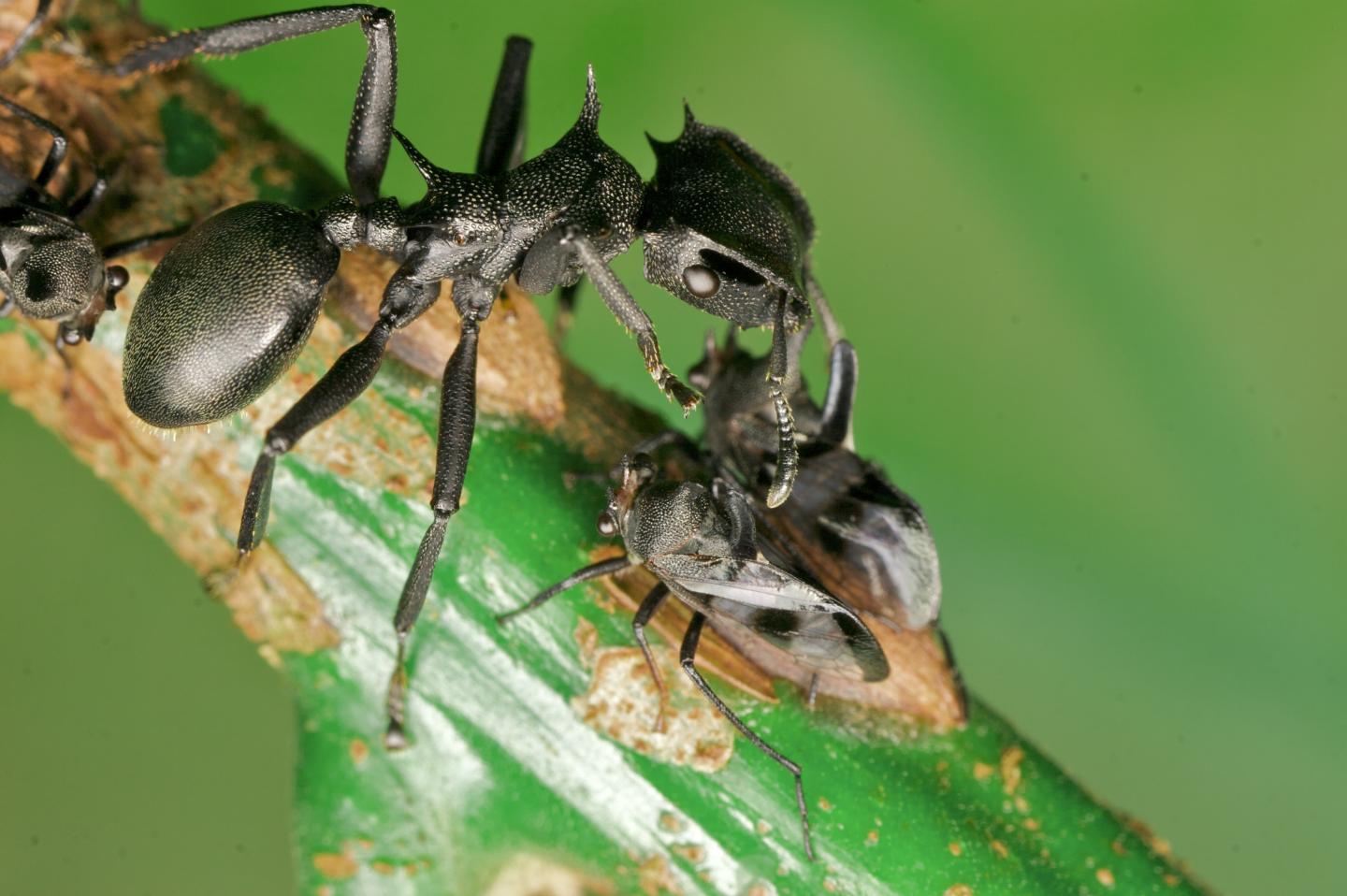
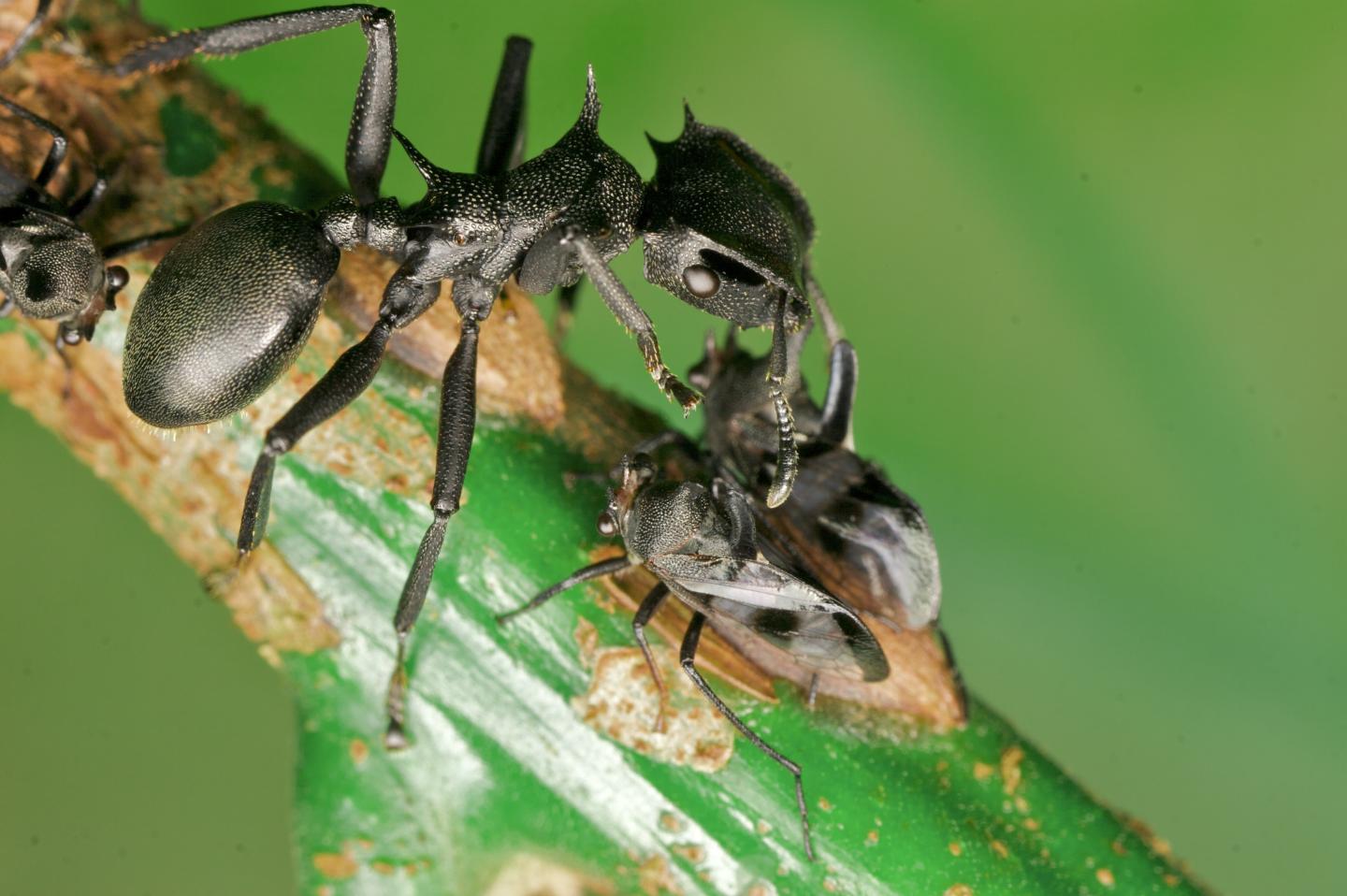
Credit: Photo by Jon Sanders.
You've probably heard about poop pills, the latest way for humans to get benevolent bacteria into their guts. But it seems that a group of ants may have been the original poop pill pioneers — 46 million years ago.
A new collaborative study, published in Nature Communications, determined that turtle ants (Cephalotes) are able to supplement their low-nitrogen diets by passing helpful bacteria from older ants to younger ones through anal secretions. Once this is done, the now-internalized microbes (tiny bacteria) naturally produce the nitrogen necessary for turtle ants to survive.
"Turtle ants eat a lot of food that is hard to digest and contains few essential nutrients in accessible form," said Jacob Russell, PhD, an associate professor in Drexel University's College of Arts and Sciences and the paper's senior author. "The fact that they can subsist on such diets and have moved away from aggressively competing for more optimal food resources with other ants is almost certainly a function of their investment in symbioses with gut bacteria."
Carried out by researchers at Drexel, the University of California San Diego, the University of Pennsylvania, Harvard University, The Rockefeller University, Calvin College, and the Field Museum of Natural History, this multi-institution, international study was spearheaded by Yi Hu, PhD, while finishing a postdoc at Drexel, and Jon Sanders, PhD, a postdoc at UC San Diego.
The study was inspired by work Russell did with Carrie Moreau, PhD, and Naomi Pierce, PhD, in Pierce's lab more than a decade ago when they discovered that many ants with low-quality diets harbored specialized bacterial symbionts – likely to supplement their diets.
It turned out that turtle ants were a great example of this. While many ants attack other animals for their food or scavenge the carcasses of dead animals, turtle ants rely on foraging for nectar, pollen, fungi and other resources from plant canopies. They also consume urine from mammals and bird feces, which do contain lots of nitrogen — but in forms inaccessible to animals without the aid of microbes.
To test whether the gut bacteria significantly contributed to the ants' nutrient intake, the researchers kept some of the turtle ants in a lab, put them on a diet of urea (the main waste in urine), and gave them antibiotics — which killed their gut bacteria. In this case, the ants weren't able to get the nitrogen they normally did when on a diet strictly made up of urea.
Finding that turtle ants keep nitrogen producing bacteria in their guts shows how they can survive so well while eating foods that so few other animals seem to want.
With a seemingly reduced use for offensive capabilities, in conjunction with their shifts to these lower quality diets, turtle ants have lost many traits that other ants utilize to compete for or attack their food.
"These ants have evolved reduced mandibles — jaws — and lost the ability to sting," said Russell. "As a result, they are not very good at preying on living invertebrate animals or scavenging dead ones. This also means they have lost features that are integral to competing with other ant species."
In turn, the ants evolved more passive defenses, like thick armor and "a specialized caste of adults that use their heads to plug the entrances of their hollow tree branch nests," Russell explained.
What's interesting is that the thick defensive armor these ants developed requires a good deal of nitrogen, which again points back to the importance of turtle ants' symbiotic relationship with their gut bacteria.
"That armor may be possible due to the large contributions gut microbes make to their nitrogen budgets," Russell said.
Since the microbes are so important to their lives, it would seem that turtle ants have also evolved a way to protect them.
"These ants develop a fine-mesh filter near the start of their digestive tract, which may insulate their downstream gut microbes from foreign invaders. This has likely helped to reinforce the integrity of these ancient bacterial communities," Russell said.
Direct information on the functions of ant-associated bacteria has been relatively limited, with leaf-cutter and carpenter ants making up the majority of this knowledge. So knowing that turtle ants benefit to such a degree from their bacteria — especially that microbially provisioned nitrogen may be essential to their survival — is significant.
"This work illustrates that members of complex communities can evolve together, laying the groundwork for future research on how these organisms evolve in response to reliable partnerships," Russell said.
Mammals, like us, have a complex set of bacteria in our guts that may have also evolved with hosts for millions of years — albeit in a much less specific fashion. Knowing now about the turtle ants and their symbiotic bacteria raises further questions about how we developed, ourselves. At the same time, it may also provide answers.
"The turtle ant system — which is relatively simple — may prove useful in helping us to model questions about our own partnerships with microbes and how important they are for human health," Russell concluded.
###
Media Contact
Frank Otto
[email protected]
215-571-4244
@DrexelNews
http://www.Drexel.edu/