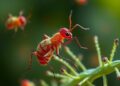
Up to three million specimens, translated into human terms about twice as many inhabitants as Munich – that’s how large a single colony of leafcutter ants can become. To feed so many creatures at the same time, the animals have developed a sophisticated system: In their underground nests, they grow fungi, which they distribute to the colony as food. The nutrient medium for the fungus growth is a mixture of chopped leaf pieces that the animals obtain from surrounding trees and shrubs.
Credit: Daniela Römer / JMU
Up to three million specimens, translated into human terms about twice as many inhabitants as Munich – that’s how large a single colony of leafcutter ants can become. To feed so many creatures at the same time, the animals have developed a sophisticated system: In their underground nests, they grow fungi, which they distribute to the colony as food. The nutrient medium for the fungus growth is a mixture of chopped leaf pieces that the animals obtain from surrounding trees and shrubs.
A study by the Julius-Maximilians-University of Würzburg has now investigated how leafcutter ants measure the correct size of these leaf pieces. “Until now, it was assumed that the length of an animal alone determined this – that smaller ants simply cut smaller pieces and larger ones cut larger pieces,” explains Dr. Daniela Römer, a biologist at the Department of Zoology II at the University of Würzburg. “We have now been able to show that the animals not only use their body length as a tool, but also their hind legs and heads.”
Two measuring systems decisive for leaf size
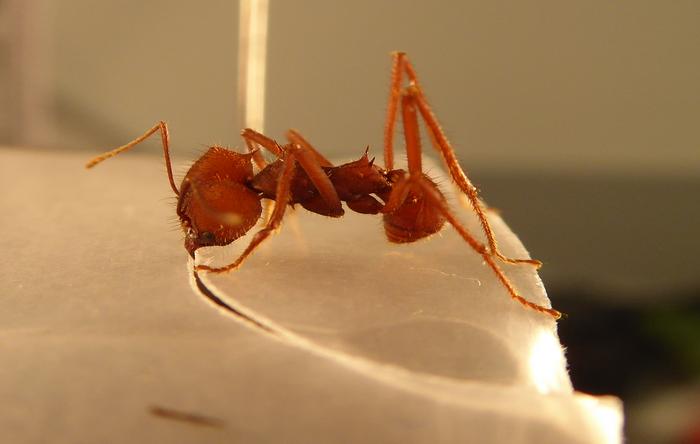
As part of the research, the scientists had ants cut artificial leaves from parafilm, a whitish translucent foil. In doing so, they first prevented the hind legs from contacting the edge of the leaf. “During the cutting process, the ants almost always hold on with their hind legs,” Römer says. “We therefore assumed that the position of their legs played a major role in leaf cutting.” While the ants did indeed separate their leaf pieces more irregularly as a result, it was only to a small extent.
More successful was the focus on another body part. “Ants repeatedly angle their heads when separating leaves – that’s where fine mechanosensory hairs are located,” explains Römer. The team found that when these hairs are shaved off (in addition to lacking hind leg posture), they completely lose control over the cutting process and fragment size. “Our research shows: Leafcutter ants have a much more plastic cutting behavior than previously thought,” Römer said. “The measurement of leaf fragment size goes far beyond just body length.”
Researchers aim to decipher more cutting mechanisms
In further research, the scientists now want to offer ants not just uniform leaf material, but different sizes, thicknesses and leaf vein structures to better reflect natural diversity. “Using automated motion analysis, we will then determine how plastic ants respond to different mechanical properties of the leaves during the cutting process,” Römer explains. To do this, the team will collaborate with Dr. Jan Ache, the Emmy Noether group leader at the Würzburg Chair of Neurobiology and Genetics, and Dr. Till Bockemühl from the University of Cologne. The project was financially supported by the Chair of Behavioral Psychology and Sociobiology of the University of Würzburg.
Journal
Journal of Experimental Biology
DOI
10.1232/jeb.244246
Method of Research
Observational study
Subject of Research
Animals
Article Title
Two feedback mechanisms involved in the control of leaf fragment size in leaf-cutting ants
Article Publication Date
22-Jun-2023
COI Statement
The authors declare no competing or financial interests.