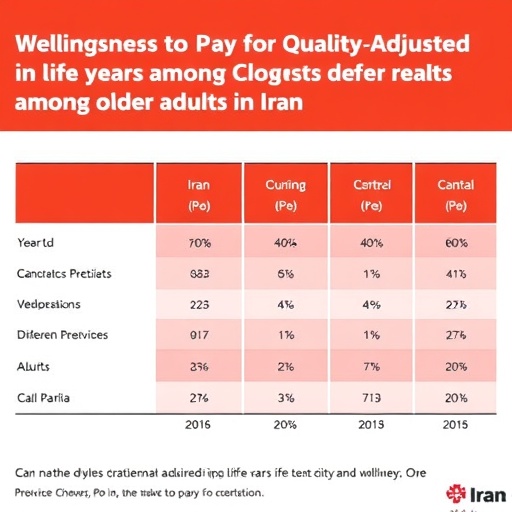
A new study from Iran is putting a spotlight on how older adults weigh health gains in everyday economic terms, using the Quality-Adjusted Life Year (QALY) framework. QALYs combine length of life with health-related quality, allowing researchers to translate clinical outcomes into a single measure that decision-makers can compare across treatments. But beyond the math, the key question is what people are willing to pay for those quality-adjusted benefits.
Researchers surveyed older adults in Iran to estimate willingness to pay (WTP) for QALY improvements. The study focuses on a population often underrepresented in health economics, where preferences may differ from those of younger groups due to health status, family roles, and changing priorities. By quantifying WTP, the authors aim to connect economic evaluation with real-world human valuation rather than relying solely on assumption-based cost-effectiveness thresholds.
Technically, WTP estimation links preference data to QALY gains, producing an implied monetary value per unit of health improvement. This is particularly relevant in cost-effectiveness analysis, where the incremental cost-effectiveness ratio (ICER) is compared against a societal willingness-to-pay benchmark. When the benchmark is misaligned with population preferences, policy choices can drift away from what patients and communities actually value.
The results also help illuminate how QALY valuation may vary with demographic and health-related factors. Such heterogeneity matters because older adults do not represent a single uniform perspective; differences in chronic disease burden, perceived mobility, and risk tolerance can shift how health improvements are valued. Those nuances can influence how health systems set priorities for screening, treatment, and long-term care interventions.
In addition, the study’s emphasis on QALYs underscores the growing importance of patient-centered metrics in resource allocation. While clinicians may judge outcomes in clinical terms, policymakers increasingly seek approaches that can integrate quality-of-life impact. By using willingness-to-pay data, the research provides a bridge between preference-based outcomes and the economic language of budgets.
The authors frame their findings as evidence to support more locally grounded health technology assessment. Instead of adopting values transferred from other countries, WTP studies can help tailor benchmarks to cultural, economic, and healthcare context. That is crucial in low- and middle-income settings, where affordability constraints can strongly shape perceived value.
For viral science news readers, the takeaway is straightforward: health economics is becoming less abstract. QALYs are not just a tool for analysts—they can be tied to how older citizens actually assign money to better health and more life lived with acceptable functioning.
Subject of Research: Willingness to pay for Quality-Adjusted Life Year (QALY) among older adults in Iran
Article Title: Valuing a Quality-Adjusted Life Year (QALY): willingness to pay among older adults in Iran.
Article References: Basakha, M., Anbari, Z., Khiyali, Z. et al. Valuing a Quality-Adjusted Life Year (QALY): willingness to pay among older adults in Iran. BMC Geriatr (2026). https://doi.org/10.1186/s12877-026-08003-7
DOI: 10.1186/s12877-026-08003-7
Keywords: QALY, willingness to pay, older adults, health economics, Iran
Tags: aging and healthcare resource allocationcost-effectiveness analysis in healthcareeconomic evaluation of aging populationshealth economics for elderly populationshealth priorities in Iranhealth-related quality of life measurementpolicy implications of health valuation studiespreferences for health gains among older adultsQALY and WTP estimation methodsQALY valuation in Iransocietal willingness-to-pay thresholdsWillingness to pay for health improvements in older adults