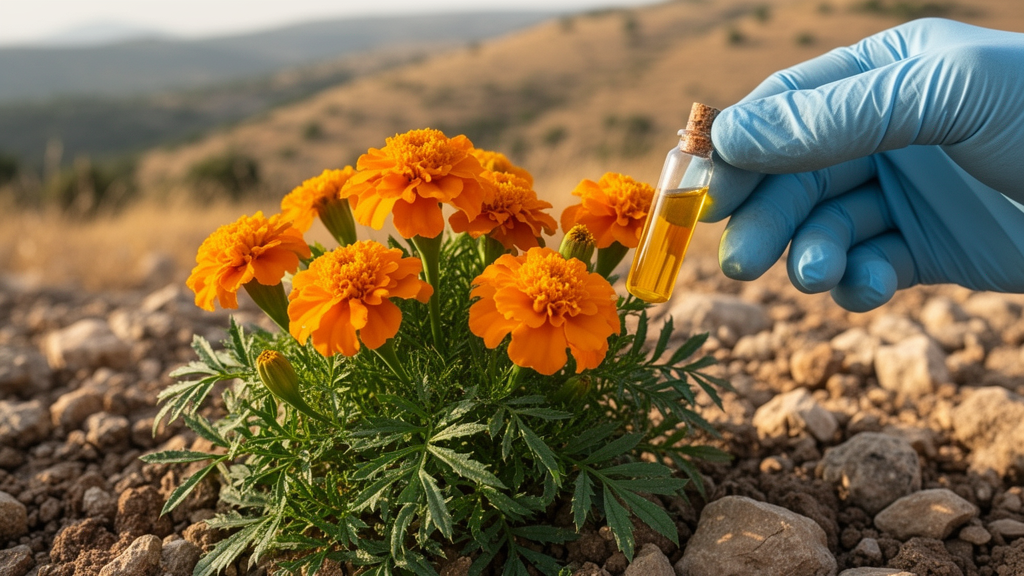
The pot marigold, Calendula officinalis, is one of the most familiar medicinal plants in the world, a golden-flowered member of the daisy family that has been cultivated for centuries in gardens and apothecary plots from Europe to Asia. Yet for all its fame in herbal medicine, the species’ biology in the wild remains surprisingly poorly documented. A new study published in Plant Biosystems has now provided one of the most complete portraits to date of wild-growing C. officinalis, combining classical morphology, microscopic anatomy, and modern chemical analysis of plants collected from four wild populations in Eskişehir Province, in central Türkiye. The work, led by Merve Kalas of Çukurova University together with Betül Demirci and Sevim Küçük of Anadolu University, offers a baseline reference that could shape future taxonomic, pharmacognostic, and phytochemical research on this economically important species.
Although Calendula officinalis has been extensively investigated for its phytochemical properties and is widely grown as both a medicinal and ornamental plant, detailed morphological and anatomical information based on wild populations from Türkiye had been lacking. Most existing descriptions derive from cultivated material, which can differ substantially from plants that have established themselves under natural ecological conditions. The research team set out to close that gap by examining plants collected directly from four wild populations in Eskişehir, a province whose steppe-influenced climate and varied habitats provide a demanding test of the species’ plasticity. One of the study’s most striking observations concerns the life cycle of these plants: the investigated populations consisted predominantly of perennial individuals, with flowering extending from spring all the way into autumn under local conditions. That prolonged flowering window is notable for a species often treated as an annual in cultivation and suggests that wild Turkish populations may harbor adaptive strategies of considerable interest to breeders and ecologists alike.
The morphological component of the study was built on fresh specimens rather than dried herbarium material alone, allowing the researchers to capture characters that are often lost or distorted in preservation. Detailed descriptions of the vegetative and reproductive organs were prepared, and the team produced original illustrations documenting the plants’ structure. Such illustrated descriptions are a cornerstone of botanical taxonomy, providing a visual standard against which future collections can be compared. For a species as variable and long-cultivated as pot marigold, having verified morphological benchmarks from documented wild populations is a valuable resource, particularly for researchers attempting to distinguish genuinely wild or naturalized plants from garden escapes.
Beneath the surface, the anatomical work revealed a suite of microscopic features characteristic of the species and, more broadly, of the Asteraceae. The researchers prepared transverse and superficial sections of roots, stems, and leaves by hand from specimens preserved in 70% ethanol, a classical technique that remains indispensable for pharmacognostic quality control. The leaves proved to be amphistomatic, meaning that stomata, the pores that regulate gas exchange, occur on both the upper and lower surfaces, and these stomata were of the anomocytic type, lacking the specialized accessory cells seen in some other stomatal configurations. The leaf mesophyll was bifacial, organized into distinct palisade and spongy layers, the standard photosynthetic architecture of many dicotyledonous plants. In the roots, the team observed a well-developed secondary structure, reflecting the perennial habit of the plants and the thickening growth that supports survival across multiple seasons.
Perhaps the most pharmacologically significant anatomical finding involved trichomes, the hair-like outgrowths that cover plant surfaces. Both glandular and non-glandular multicellular trichomes were present on the stems and leaves. Glandular trichomes are of particular interest because they are the sites where many plants synthesize and store volatile compounds, including the terpenes that dominate essential oils. Their abundance and structure are therefore directly relevant to the plant’s chemistry and to the microscopic identification of herbal drug material. In the herbal medicine trade, where adulteration and misidentification are persistent concerns, such anatomical markers serve as fingerprints that allow pharmacists and regulators to verify that a batch of dried plant material is what it claims to be.
The chemical half of the study focused on the essential oils extracted from the aerial parts of the plants by hydrodistillation, the time-honored method of steam-driven separation used throughout the flavor, fragrance, and pharmaceutical industries. The resulting oils were analyzed by gas chromatography and gas chromatography coupled with mass spectrometry, the gold-standard techniques for separating and identifying volatile compounds. Together, these analyses identified 73 constituents in the essential oils, a rich chemical inventory for a species whose volatile profile has been studied far less intensively than its better-known triterpenoids and carotenoid pigments.
The dominant compound was α-cadinol, which accounted for between 30.0 and 34.5 percent of the oil in every one of the four populations. This oxygenated sesquiterpene alcohol, part of the cadinane family of compounds, was followed in abundance by δ-cadinene at 15.2 to 18.8 percent, τ-muurolol at 6.3 to 8.2 percent, τ-cadinol at 3.3 to 5.3 percent, α-muurolene at 2.4 to 3.0 percent, and γ-cadinene at 1.9 to 4.4 percent. Taken together, oxygenated sesquiterpenes made up 51.3 to 57.2 percent of the oils, with sesquiterpene hydrocarbons contributing a further 30.7 to 33.4 percent. The consistency of this cadinol-and-cadinene-dominated chemotype across all four wild populations is chemically striking, suggesting a stable, genetically anchored oil profile rather than one driven primarily by local environmental variation. It also distinguishes these wild Turkish plants from many cultivated accessions reported in earlier literature, whose oils have often been dominated by different compound classes.
That consistency carries practical weight. Essential oils rich in oxygenated sesquiterpenes such as α-cadinol and τ-muurolol are of ongoing interest to researchers exploring antimicrobial and other biological activities, and earlier studies on Calendula oils from other regions have reported antifungal properties. By documenting both the yield-relevant anatomy and the full volatile composition of wild material, the new study gives natural-product chemists a verified starting point for selecting germplasm worth further investigation. It also feeds into a broader scientific conversation about the effects of plant age, environmental conditions, and cultivation practices on essential oil composition, factors that previous researchers have shown can substantially reshape the chemical profile of this species.
The study, which grew out of the first author’s master’s thesis at the Department of Pharmaceutical Botany of Anadolu University’s Faculty of Pharmacy and received no external funding, ultimately delivers what its authors describe as baseline information for the four investigated wild populations. In a field where wild genetic resources are increasingly recognized as a reservoir of traits lost during centuries of domestication, that baseline matters. Perennial habit, extended flowering, a distinctive cadinol-rich essential oil, and a fully documented anatomical profile together make the Eskişehir populations a potentially valuable resource for taxonomy, for pharmacognostic standardization, and for phytochemical prospecting. As demand for plant-derived medicines and natural ingredients continues to grow, careful documentation of wild populations such as these provides the verified foundation on which sustainable use must be built.
Subject of Research: Morphological, anatomical, and essential oil characterization of wild Calendula officinalis populations in Türkiye
Article Title: Integrated morphological, anatomical and essential oil characterization of four wild populations of Calendula officinalis (Asteraceae) from Eskişehir, Türkiye
Article References: Kalas, M., Demirci, B., & Küçük, S. (2026). Integrated morphological, anatomical and essential oil characterization of four wild populations of Calendula officinalis (Asteraceae) from Eskişehir, Türkiye. Plant Biosystems, 160(5), Article 285. https://doi.org/10.1007/s44473-026-00300-8
Image Credits: AI Generated
DOI: 10.1007/s44473-026-00300-8
Keywords: Calendula officinalis, Asteraceae, essential oil, α-cadinol, plant anatomy, morphology, GC-MS, sesquiterpenes, Türkiye, Eskişehir, medicinal plants, pharmacognosy
News Source: Alan Morgan. (October 9, 2026). Wild Pot Marigold in Türkiye Reveals Cadinol-Rich Essential Oil Profile. Scienmag.