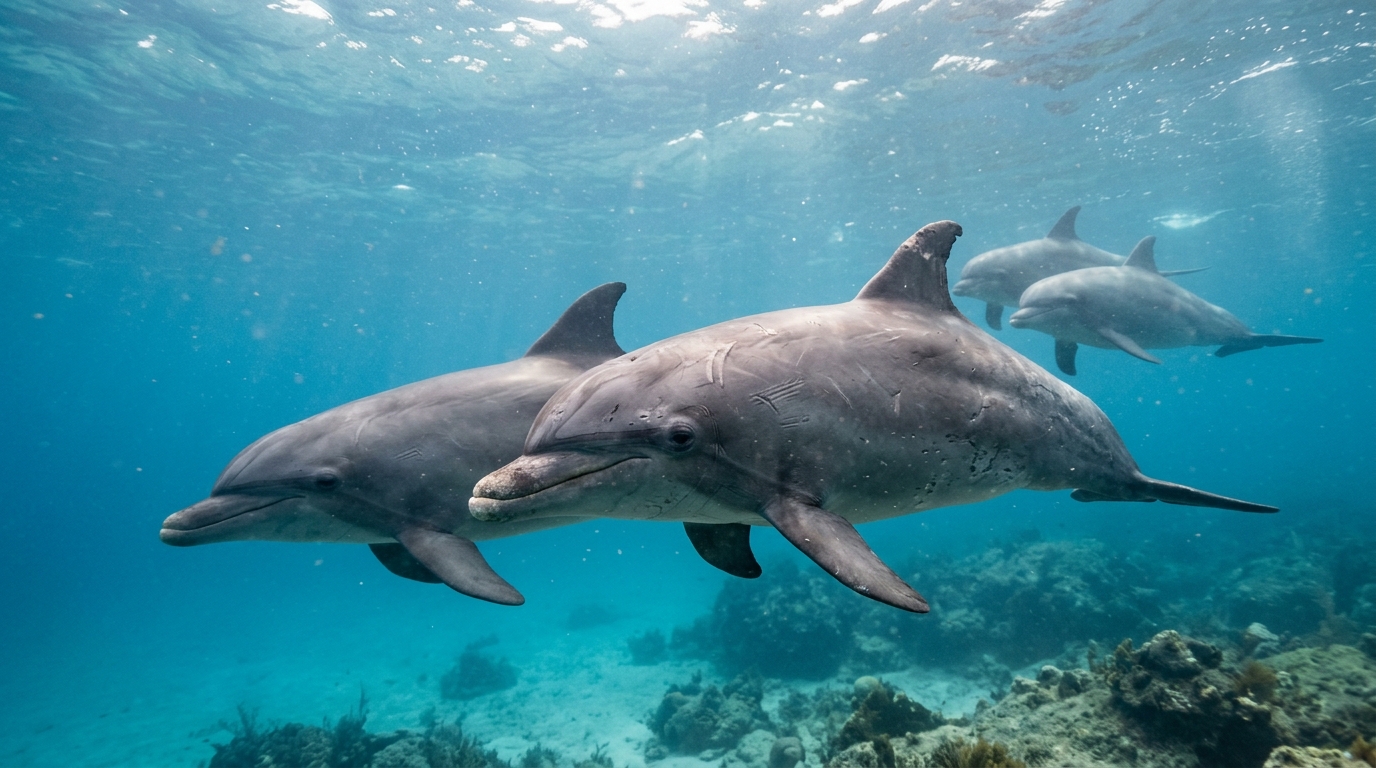
A newly published long-term investigation into wild Indo-Pacific bottlenose dolphins demonstrates that an individual’s social grouping patterns become progressively more predictable across its lifespan, with the most pronounced behavioural consistency emerging among the longest-lived animals. The findings, highlighted in a PLOS Biology Primer by Erin R. Siracusa examining research by Meehan and colleagues, illuminate an overlooked dimension of how wild animals age within their natural communities. While earlier investigations of social senescence have predominantly concentrated on whether an organism’s average number of associates or typical group size shrinks in later life, this work examines the consistency with which individuals maintain those social arrangements relative to their own personal baseline. By tracking dolphins over multiple decades in the wild, the researchers discovered that the degree of variation around an animal’s average group size narrows substantially as years advance. This steady rise in behavioural predictability indicates that late-life social modifications do not simply represent passive physiological deterioration, but may instead reflect meaningful shifts in how experienced individuals manage their daily social encounters.
Senescence, defined biologically as the gradual and progressive deterioration of an organism’s functional capacity over time, is recognized as a ubiquitous feature of wild animal populations that systematically elevates vulnerability to disease and mortality. For decades, empirical investigations across diverse taxa have documented clear age-related declines in immunological responsiveness, molecular integrity, physiological resilience, and reproductive output. More recently, evolutionary biologists and behavioural ecologists have broadened this framework to encompass behavioural phenotypes, observing that age-dependent restructuring of social networks occurs across humans, non-human primates, ungulates, carnivores, birds, and insects. In many of these animal groups, older individuals systematically exhibit reduced overall social connectedness compared to their younger conspecifics, indicating that the broader process of social ageing is strongly evolutionarily conserved. Because an extensive body of ecological literature firmly links an individual’s social relationships to its overall survival, reproductive success, and ultimate evolutionary fitness, understanding how social phenotypes change across a complete lifespan has emerged as a fundamental question in modern life-history theory.
Historically, the scientific literature on social ageing has directed its empirical focus toward plasticity, specifically assessing how an individual’s average social traits shift from maturation through advanced old age. For instance, classic observational studies typically chart whether an animal’s mean group size declines or whether its total count of interacting partners diminishes in late life. However, focusing solely on statistical averages conceals vital biological variation that may hold profound evolutionary significance. To illustrate this limitation, Siracusa notes that two distinct individuals in a wild population might share an identical mathematical mean group size of five companions, yet inhabit profoundly divergent social realities. One individual might consistently associate with cohesive groups containing four, five, or six companions, while the other fluctuates widely across unstable aggregations ranging from two to ten individuals. This degree of variability around an individual’s mean behaviour—capturing how reliably an organism acts relative to its own baseline—is termed predictability, with individuals exhibiting lower variance defined as being more predictable.
Within modern behavioural ecology, predictability is increasingly recognized not as meaningless statistical noise, but rather as an authentic biological trait in its own right. Like other quantitative traits, behavioural predictability can vary consistently among individuals within a population, experience differential selection pressures, and undergo evolutionary change across generations. In complex social settings, behavioural predictability may carry critical evolutionary advantages by facilitating the development and long-term maintenance of stable cooperative bonds, or by reflecting an organism’s gradual convergence on an optimal social strategy that maximizes personal fitness. Consequently, evaluating how behavioural predictability shifts over an individual’s lifespan can uncover hidden life-history dynamics that examinations of average behavioural trajectories cannot expose. If individuals systematically become more predictable as they grow older, this pattern might indicate that animals actively refine their social lives through acquired experience, thereby generating valuable fitness benefits that help sustain health or survival into their final life stages.
To rigorously test how social predictability develops over time in a natural environment, Meehan and colleagues analyzed a comprehensive, four-decade observational dataset collected on wild Indo-Pacific bottlenose dolphins, scientifically known as Tursiops aduncus. The research cohort encompassed more than sixty thousand distinct behavioural observations recorded across four hundred and fifty-seven individual dolphins, providing the extensive longitudinal depth necessary to separate within-individual changes from population-level cross-sectional patterns. To process this massive collection of field records, the study team implemented an advanced statistical framework designed to model an animal’s average behavioural trait and the variability surrounding that average simultaneously. This analytical architecture allowed the researchers to evaluate whether individual dolphins undergo concurrent changes in both their typical group sizes and their behavioural predictability as they mature, survive, and age in their natural marine habitat, offering an unprecedented look into the dual trajectories governing social senescence in a long-lived mammal.
The statistical modeling revealed that average group size in wild bottlenose dolphins follows a distinct quadratic trajectory across the lifespan, first expanding during young adulthood before gradually tapering off in later life stages. This curvilinear pattern closely mirrors the late-life contraction of social network size documented across diverse animal species throughout the broader biological world. Crucially, the researchers determined that the exact timing of this turning point is intimately connected to an animal’s overall lifespan. Dolphins that ultimately achieve greater longevity continue expanding their typical group size over an extended period of years, reaching their maximum group size at substantially older ages than shorter-lived conspecifics. A schematic visualization accompanying the study illustrates how a long-lived individual maintains an ascending mean group size well into adulthood before experiencing a gentle decline, whereas a shorter-lived dolphin peaks much earlier in life and maintains smaller social groupings across its fewer recorded life stages.
Parallel to these shifts in average grouping tendencies, the investigation produced the compelling discovery that predictability in group size increases significantly as dolphins grow older. Rather than remaining static, individual dolphins progressively constrain the variability of their grouping choices, resulting in tighter clustering around their personal mean as time passes. Furthermore, longer-lived dolphins proved to be substantially more predictable on average across their lives than shorter-lived individuals, suggesting that higher predictability may confer direct fitness advantages in the wild. Most remarkably, the rate at which predictability increases with age is notably steeper in dolphins that attain longer lifespans. This differential trajectory implies that the dynamic process of social ageing itself, rather than merely maintaining a high static baseline of consistency, shares an important biological association with individual survival, marking social predictability as a meaningful behavioural correlate of longevity in wild dolphin societies.
In evaluating the potential biological drivers underlying this pattern, Meehan and colleagues suggest that escalating predictability across adult life may reflect an accumulation of social competence. Under this framework, dolphins navigate complex social landscapes over decades, gaining practical experience that enables them to optimize their daily social strategies and settle on predictable association patterns that reduce costly social conflicts or energy expenditure. However, Siracusa highlights that this social competence hypothesis remains to be directly confirmed in wild populations, and alternative physiological and demographic mechanisms cannot yet be discounted. For example, age-related constraints on physical stamina or mobility might naturally restrict an older animal’s capacity to engage with varying group sizes. Alternatively, shifting kinship dynamics or the inevitable deaths of familiar social partners over decades could progressively narrow an aging dolphin’s accessible social circle, mechanically producing an observed increase in grouping predictability without requiring intentional strategic optimization.
The published analysis also underscores several vital methodological constraints that necessitate caution when interpreting the observed relationship between social predictability and longevity. Most notably, the study did not prospectively examine whether an individual’s measurable increase in predictability directly predicts its subsequent hazard of mortality or future survival probability. Instead, the analytical framework utilized the age at last sighting to reconstruct predictability trajectories retrospectively, an approach that leaves the precise direction of causality unverified. Additionally, because many dolphins remained alive at the conclusion of the forty-year observation window, their definitive lifespans were right-censored and remained unknown. To definitively confirm whether evolving social predictability actively drives enhanced longevity rather than merely correlating with extended survival, future investigations will need to model prospective survival outcomes alongside predictability metrics simultaneously, while formally accommodating individuals whose eventual fates have not yet been observed.
Despite these necessary scientific qualifications, the findings from Meehan and colleagues offer pivotal insights that challenge conventional paradigms surrounding senescence and geriatric biology in natural ecosystems. Rather than viewing late-life behavioural modifications solely as the passive consequence of physiological breakdown and decrepitude, evolutionary ecologists must consider that older organisms can implement adaptive social refinements that leverage accumulated knowledge to buffer against other aging-related functional declines. This transition toward enhanced predictability may also mirror the social selectivity documented in other species, wherein aging organisms purposefully focus their limited remaining effort on maintaining a select portfolio of familiar, stable partners. By demonstrating that substantial among-individual variation exists in both mean behaviour and predictability trajectories, the dolphin research emphasizes that individuals age along divergent social pathways. Ultimately, the study reinforces the vital principle that behavioural variability represents valuable biological signal rather than background noise, opening profound avenues for understanding how selection acts on social phenotypes throughout the animal lifespan.
Subject of Research: Age-related changes in social group size predictability and longevity in wild dolphins
Article Title: Social predictability increases with age in dolphins: A marker of longevity?
Article References: Siracusa, E. R. (2026). Social predictability increases with age in dolphins: A marker of longevity?. PLOS Biology, 24(11), e3004107. https://doi.org/10.1371/journal.pbio.3004107
Image Credits: AI Generated
DOI: 10.1371/journal.pbio.3004107
Keywords: Tursiops aduncus, Indo-Pacific bottlenose dolphin, social ageing, behavioural predictability, behavioural consistency, social group size, longevity, senescence, social competence, social selectivity, behavioural plasticity, long-term animal study, within-individual variation, social phenotypes, biogerontology, behavioural ecology, PLOS Biology
News Source: Beatrice Stafford. (November 25, 2026). Wild Dolphins Show Increasing Social Predictability With Age Linked to Longevity. Scienmag.