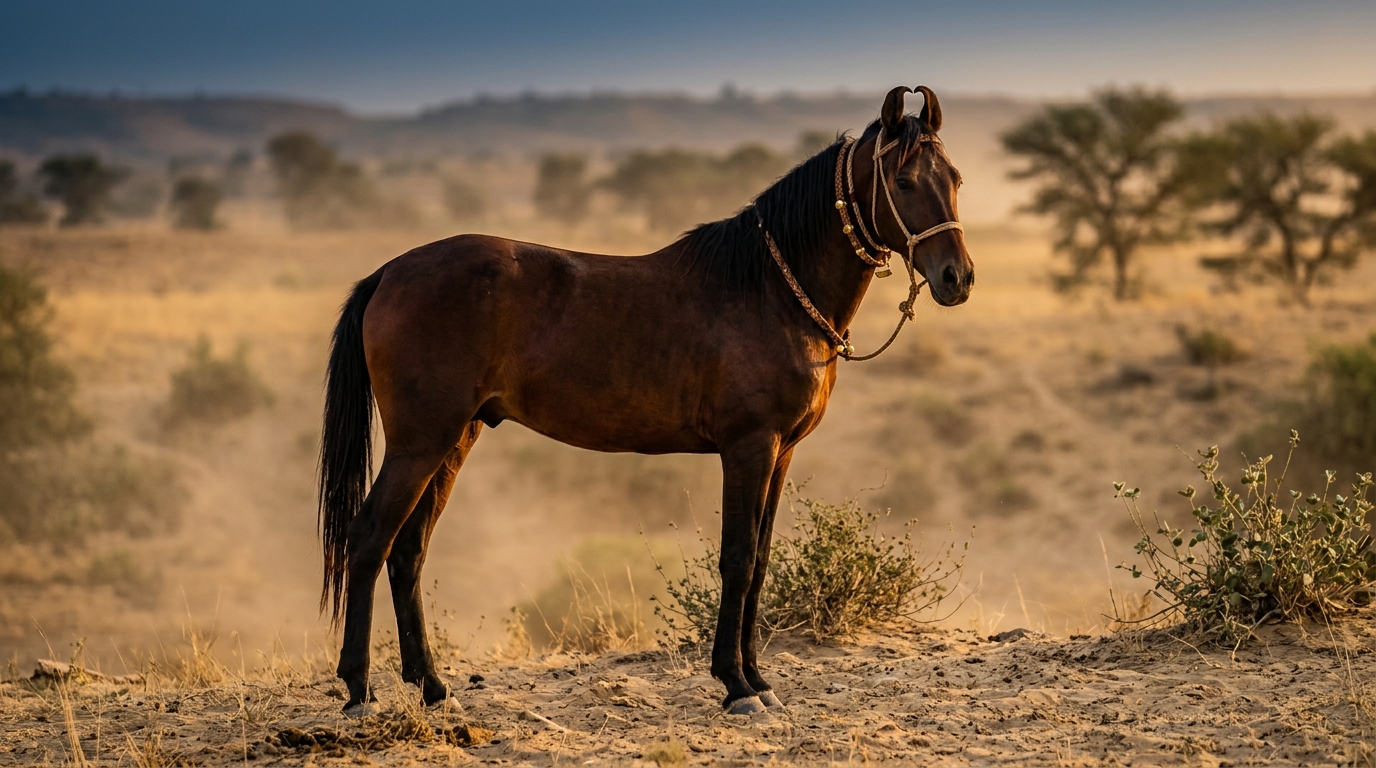
A molecular investigation of the locally recognized Majuke-type horse indicates that it constitutes a differentiated lineage within the broader Marwari background rather than an independently founded breed. Prior to this research, the genetic relationship between the Majuke-type horse and Marwari horses had not been evaluated using molecular markers. Researchers designed the study to assess whether the Majuke-type represents a genetically coherent bloodline emerging from the indigenous Marwari population or whether it traces back to a distinct founding origin.
To evaluate these population relationships, investigators genotyped 137 horses maintained across stud farms in Punjab and Haryana. The analyzed cohort comprised 18 Majuke-type horses, 79 Marwari horses, and 40 Thoroughbred horses included for comparative reference. By incorporating both indigenous groups alongside Thoroughbred reference animals, the study established a comparative framework to examine genetic diversity, differentiation, and population structure across the sampled equine groups.
Genotyping was conducted across a panel of 20 microsatellite loci. The selected marker set demonstrated substantial allelic diversity across the sampled animals, averaging 17.75 alleles per locus. In addition to measuring broader population variation, the markers were applied to parentage verification, successfully generating strict-confidence parent-pair assignments for all 67 evaluated breeding trios within the dataset.
Genetic diversity measurements revealed an expected heterozygosity of 0.721 in the Majuke-type horses compared to 0.771 in the Marwari population. Pairwise fixation index calculations between the Majuke-type and Marwari cohorts yielded an FST value of 0.107 with a statistical significance of P = 0.0001. Population-structure analyses separated Thoroughbred horses from the indigenous groups and demonstrated reproducible differentiation between the Majuke-type and Marwari cohorts.
The researchers also assessed identity-by-state distance, potential bottleneck signals, and recent migration patterns between the populations. An analysis using BayesAss supported a recent migration signal from the Majuke-type into the Marwari population of 6.87% ± 1.45% per generation. These findings indicate measurable gene flow between the groups alongside the genetic differentiation identified across the examined microsatellite loci.
The authors concluded that the sampled Majuke-type horses show reproducible microsatellite differentiation from Marwari horses while retaining a closer relationship to Marwari than to Thoroughbred horses. However, the researchers emphasized that these results support interpreting the Majuke-type as a differentiated lineage or bloodline rather than establishing an independent breed origin or registration. The team noted that genome-wide single nucleotide polymorphism data and broader sampling across farms are required to test the robustness and genomic basis of this differentiation.
Subject of Research: Microsatellite characterisation of Majuke-type and Marwari horse populations
Article Title: Microsatellite-based molecular characterisation of the Majuke-type horse as a differentiated lineage within the Marwari background
Article References: Singh, D., Mukhopadhyay, C. S., Singh, B., & Grewal, R. S. (2026). Microsatellite-based molecular characterisation of the Majuke-type horse as a differentiated lineage within the Marwari background. Molecular Biology Reports, 53(1), Article 2002. https://doi.org/10.1007/s11033-026-13197-5
Image Credits: AI Generated
DOI: 10.1007/s11033-026-13197-5
Keywords: Majuke-type horse, Marwari horse, Thoroughbred, Microsatellite loci, Genetic differentiation, Population structure, Expected heterozygosity, Fixation index, Parentage verification, BayesAss, Gene flow, Identity-by-state distance, Equine genetics, Stud farms, Punjab, Haryana, Bottleneck signals
News Source: Juliet Wilcox. (November 25, 2026). Majuke-Type Horses Form Differentiated Lineage Within the Marwari Background. Scienmag.