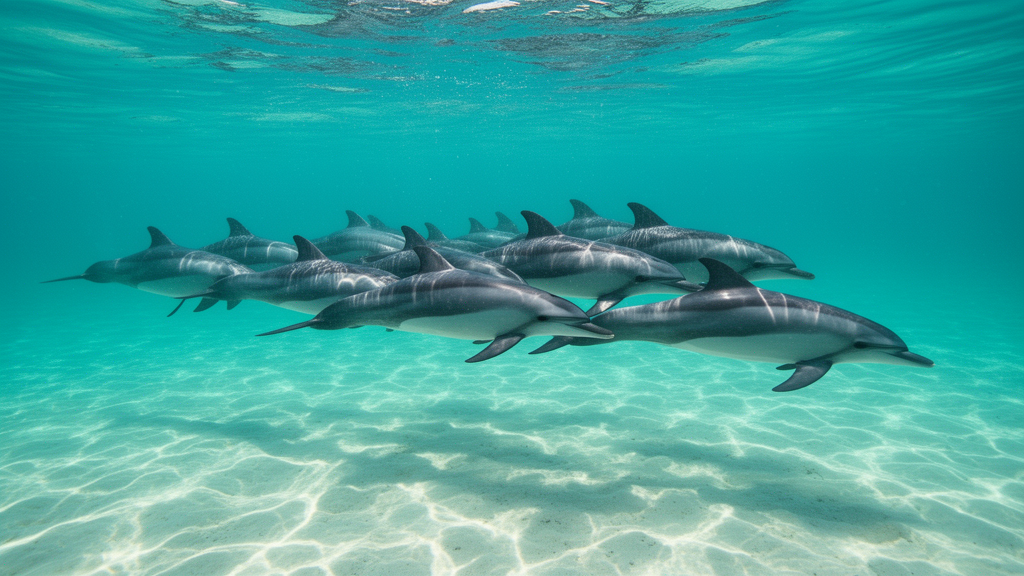
Wild Indo-Pacific bottlenose dolphins that maintain higher sociability and exhibit more predictable group sizes tend to live longer, according to an observational study published November 24 in the open-access journal PLOS Biology. Conducted by Kelley Caroline Meehan of The University of Queensland, St. Lucia, Australia, and an international team of colleagues, the investigation examined long-term grouping patterns to determine how social behavior shifts as individuals grow older. The researchers found that an individual dolphin’s average group size first increases and subsequently declines across its lifespan, revealing that stability and predictability in social grouping correlate directly with longevity.
The study addresses a broader biological question regarding how social interactions change with advanced age. Across diverse animal species, aging is known to alter sociability in multiple ways, frequently resulting in decreased social network size, increased social selectivity, reduced social connectedness and influence, and fewer affiliative interactions. However, prior investigations into social aging have overwhelmingly concentrated on trait changes evaluated at the population average level, leaving individual differences largely unexamined. To better understand individual variance in aging and sociability, the researchers examined how age, sex, and individual personality collectively influence group size over decades of life.
To investigate these individual trajectories, the team analyzed comprehensive behavioral and demographic records gathered from a 40-year study of wild Indo-Pacific bottlenose dolphins (Tursiops aduncus), a long-lived species recognized for its complex social structures. The study examined data collected from 457 individual dolphins observed in their natural habitat over timeframes ranging between 2 and 35 years. According to the study’s authors, throughout ontogeny animals are subject not only to the bounds of their physical environment, but also to a world defined by the other individuals around them, making longitudinal observations essential for providing new insights into social aging.
The researchers determined that the size of social groups does not remain static over time, but instead follows a curved trajectory as dolphins age. On average, group size first increases during earlier life stages and then progressively declines as an animal reaches older age. Furthermore, the analysis demonstrated distinct sex-specific differences in these trajectories, with declines in group size appearing considerably more pronounced in male dolphins than in females.
For example, field observations within the project’s main study area have frequently monitored allied male dolphins—such as a trio named Panky, Ningaloo, and See-ya—who are now in their mid-twenties and have been tracked continuously since they were calves in the early 2000s. These multi-decade field records provided the essential empirical foundation for the research team, which included co-authors from institutions across Australia, Germany, Canada, and the United States.
Crucially, the study established that the predictability of social group size carries significant fitness consequences for wild dolphins. Animals that exhibited less within-individual variation in their group sizes—maintaining more stable and predictable grouping preferences—tended to achieve longer lifespans. Meehan explained that dolphins inhabit a complex social environment containing hundreds of conspecifics, which they must successfully navigate by adapting their behavior based on lived experience, a process known as social competence. Over decades of life, individuals establish consistent preferences in group size, and those that continue to become more sociable and predictable throughout life live the longest.
Meehan, who conducted fieldwork for four years spending several months annually at the project’s field site at Monkey Mia, underscored that individual behavioral differences are unmistakable. Meehan noted that each animal possesses a personality as unique as a fingerprint, emphasizing that individual identity plays an indispensable role in shaping behavior.
The authors also highlighted important limitations inherent in their observational methodology, pointing out that dolphins were observed for an average duration of only 5 minutes per day. Because group composition in wild dolphins is highly dynamic and can change several times within a single hour, brief observation periods capture limited windows of daily interaction.
Subject of Research: Social aging, group size predictability, and longevity in wild Indo-Pacific bottlenose dolphins
Article Title: Highly sociable Indo-Pacific bottlenosed dolphins with stable social groups may live longer
Article References: Highly sociable Indo-Pacific bottlenosed dolphins with stable social groups may live longer. Original publication (Bibliographic details unavailable.)
Image Credits: AI Generated
DOI: Not provided
Keywords: Indo-Pacific bottlenose dolphins, Tursiops aduncus, social aging, longevity, group size predictability, social competence, individual personality, Shark Bay Dolphin Research Project, Monkey Mia, PLOS Biology, Kelley Caroline Meehan, University of Queensland, observational study, within-individual variation, behavioral ontogeny, sex differences in aging, wild animal sociability
News Source: Beatrice Stafford. (November 24, 2026). Wild Bottlenose Dolphins with Predictable Group Sizes Tend to Live Longer. Scienmag.