Researchers at the Max Planck Institute for the Structure and Dynamics of Matter (MPSD) in Hamburg, Germany, have long been exploring the effect of using tailored laser drives to manipulate the properties of quantum materials away from equilibrium. One of the most striking demonstrations of these physics has been in unconventional superconductors, where signatures of enhanced electronic coherences and super-transport have been documented in the resulting non-equilibrium states. However, these phenomena have not yet been systematically studied or optimized, primarily due to the complexity of the experiments. Technological applications are therefore still far removed from reality.
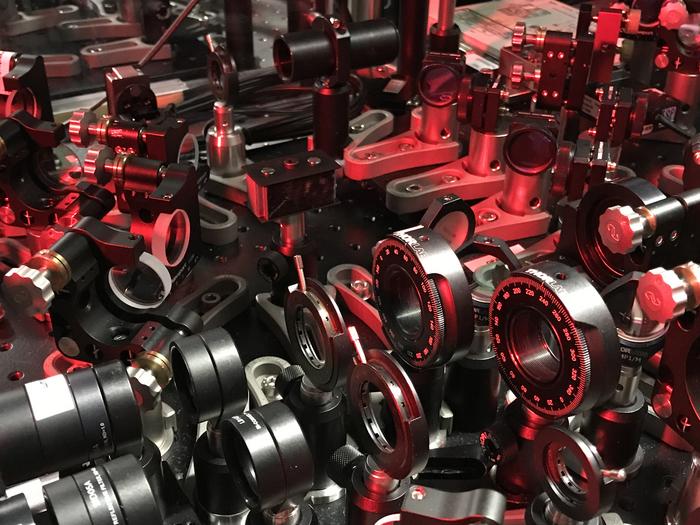
Credit: J. Witt, MPSD
Researchers at the Max Planck Institute for the Structure and Dynamics of Matter (MPSD) in Hamburg, Germany, have long been exploring the effect of using tailored laser drives to manipulate the properties of quantum materials away from equilibrium. One of the most striking demonstrations of these physics has been in unconventional superconductors, where signatures of enhanced electronic coherences and super-transport have been documented in the resulting non-equilibrium states. However, these phenomena have not yet been systematically studied or optimized, primarily due to the complexity of the experiments. Technological applications are therefore still far removed from reality.
In a recent experiment, this same group of researchers discovered a far more efficient way to create a previously observed metastable, superconducting-like state in K3C60 using laser light. The work by the Cavalleri group has appeared in Nature Physics.
The researchers showed that, when tuning the laser light to a specific low frequency resonance, far less powerful light pulses could induce the same effect at much higher temperatures. Laser technology developed at the Institute was key to this work. By tuning the light source to 10 THz, a lower frequency than previously possible, the team successfully recreated the long-lived superconducting-like state in the fullerene-based material while reducing the pulse intensity by a factor of 100. This light-induced state was directly observed to persist at room temperature for 100 picoseconds, but is predicted to have a lifetime of at least 0.5 nanoseconds (a nanosecond is a billionth of a second, a picosecond a trillionth).
Their findings shed new light on the underlying microscopic mechanism in photo-induced superconductivity, says lead author Edward Rowe, a PhD student in the Cavalleri group: “The identification of the resonance frequency will allow theorists to understand which excitations are actually important, since there is currently no widely accepted theoretical explanation of this effect in K3C60.”
Rowe envisages that a light source with a higher repetition rate at the 10 THz frequency could help sustain the metastable state for longer: “If we could deliver each new pulse before the sample returns to its non-superconducting equilibrium state, it may be possible to sustain the superconducting-like state continuously.”
“These experiments are a very nice demonstration of how suitable advances in technology can make applicable many phenomena that are so far not practical,” says MPSD Director Andrea Cavalleri, who sees a two-decade long effort in exploring these effects converging towards future technologies. “It is also clear that a crucial bottleneck to be addressed is the type and availability of laser sources, which should go hand in hand with these studies to bring the field forward.”
The research was carried out at the MPSD, in the Center for Free-Electron Laser Science (CFEL) in Hamburg. It was supported by the DFG (German Research Foundation) via the Cluster of Excellence CUI : Advanced Imaging of Matter. The K3C60 samples were prepared at the Università degli Studi di Parma, Italy.
Journal
Nature Physics
Method of Research
Experimental study
Article Title
Resonant enhancement of photo-induced superconductivity in K3C60