


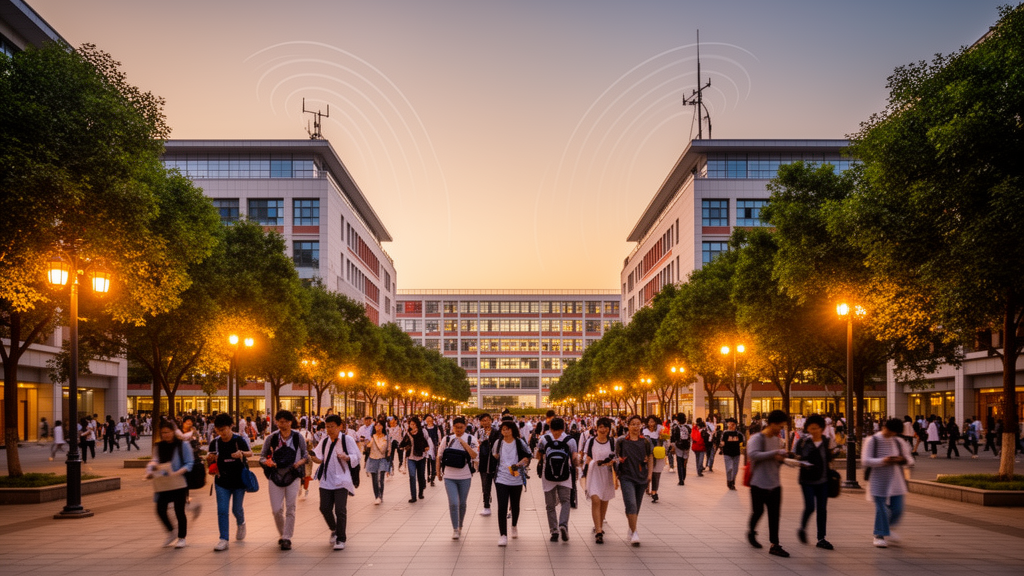
Researchers at Southeast University have trained an artificial intelligence model to learn, from anonymous Wi-Fi signals alone, what actually attracts people to different corners of a sprawling suburban campus. The study, published in the journal Architectural Intelligence, used two weeks of Wi-Fi probe records collected at the university’s Wuxi Campus in Jiangsu Province to build a pedestrian simulation model based on maximum entropy inverse reinforcement learning, a machine learning technique designed to infer the hidden motivations behind observed movement rather than assume them in advance.
The motivation for the work lies in a planning problem familiar to anyone who has watched a newly built campus fill up. As universities expand toward suburban land, campuses become increasingly self-contained social spaces where daily life depends on on-campus facilities. The authors note that existing optimization methods lean heavily on planner experience, pedestrian flow simulations built on spatial topology, rule-based models, deep learning, or reinforcement learning, and often fail to adequately incorporate the influence of environmental factors on behavior. Because campus users tend to be goal-oriented, neglecting those factors can lead to design biases. Inverse reinforcement learning offers a way around this: instead of a researcher manually specifying reward values that tell an agent what is worth walking toward, the model infers the relative importance of environmental factors directly from real trajectories.
The data pipeline began with 19 Wi-Fi monitoring devices deployed at key transportation and public space nodes across the campus, each with an effective detection range of 50 meters. Over two weeks the probes collected 3.26 million raw records, capturing the device identifiers of Wi-Fi-enabled phones, laptops, and tablets. The identifiers were pseudonymized at the point of data intake before any preprocessing or analysis. Raw probe data are notoriously noisy, containing single-record users, fixed smart devices such as surveillance cameras that ping only a few probes, missing values, and so-called jump records that oscillate back and forth between overlapping detection zones.
Cleaning that noise required a multi-stage workflow. The team first removed clearly abnormal records, including malformed or rarely seen pseudo-MAC addresses, drift data implying movement faster than a human could manage, and fixed smart-device signals. They then identified jump data by scanning chronologically ordered records with a sliding window to detect cyclic switching sequences, such as a device bouncing between probe A and probe B, and used boxplots of switching frequency, interval, distance, and speed to set thresholds at the 75th percentile. After reconstruction, 3,175 valid device identifiers remained. A final statistical validation across five indicators, followed by filtering with a Random Forest model that removed roughly 10 percent of residual anomalies, produced 2,306 valid trajectories comprising more than 260,000 behavioral records.
To make the trajectories usable for learning, the researchers mapped them onto a discretized grid representing the campus, settling on a 35-by-40 grid as the default after weighing representational detail against computational cost. They split trajectories into sub-trajectories averaging roughly 300 meters in physical distance, because human goals change over time and shorter segments trained more reliably. Environmental features were encoded with a binary presence marking strategy combined with a distance-based diffusion mechanism: cells containing a given element were assigned a value of 1, others 0, and influence spread outward along shortest-path distances constrained by walkable areas, using inverse-distance weighting so that distant functional nodes retain long-tail guidance effects on route choice. A total of 41 specific environmental elements, spanning functional buildings, open spaces, road systems, street facilities, and landscape elements, were identified from a systematic literature review and the campus’s actual spatial configuration.
The learning machinery itself is a reward neural network that takes environmental feature values as input and outputs a scalar reward for each grid state. Through iterative training, the network’s parameters are updated according to the difference between the agent’s and the expert’s state visitation frequencies, gradually converging the agent’s behavior distribution toward that implied by the real trajectories. The network has seven fully connected layers with dimensions of 82, 164, 328, 328, 328, 164, and 82, using ELU activation between hidden layers and Tanh at the output, a choice determined through comparative experiments against MSE and Sigmoid alternatives. To simulate uncertainty in state transitions, the agent moves according to the learned reward 80 percent of the time and randomly 20 percent of the time, and a discount factor of 0.95 weights future rewards during value iteration. Over 1,137 training iterations, both the mean squared error and the maximum difference in state visitation frequency between agent and expert declined consistently, indicating stable convergence without numerical divergence or collapse.
Validation focused on whether the learned reward distribution matches reality. High reward values concentrated around the library, cafeteria, dormitory buildings, and administrative building, areas that align closely with dense pedestrian flow in the expert trajectories and with the campus’s functional layout. The small garden between Boya Building and South High Courtyard showed both low reward values and low foot traffic, mirroring its actual underuse. Pearson correlation analysis between expert and agent behaviors found very high agreement at the state visitation frequency level, demonstrating that the model captures the global spatial distribution of pedestrian flows, while state-action level correlations were moderate, a result the authors describe as theoretically reasonable given the deliberately stochastic nature of the maximum entropy policy, under which multiple distinct action sequences can yield similar cumulative rewards.
To quantify the relative attractiveness of each environmental factor, the team generated 1 million samples from the trained reward network, feeding in random feature vectors and recording the resulting rewards, then filtered for overall reward values above 0.6. The analysis showed that functional and activity-related facilities, including sidewalks, the Cultural Center, the administrative building, and the basketball court, scored relatively high in attractiveness, while ordinary buildings, vegetated areas, and the currently unused International Student Dormitory scored comparatively lower. Office clusters in the southern campus, such as Nangaoyuan, Rixin Building, and Zhongshan Yuan, showed overall lower attractiveness than northern clusters like Sanjiang Yuan and Liangjiang Yuan, a difference consistent with the greater diversity of facilities and higher intensity of spatial use in the north. Notably, although the male and female dormitories are spatially adjacent, the female dormitory scored noticeably lower, a pattern the authors suggest may relate to the campus demographic structure, since engineering disciplines dominate the university and the overall student population is male-dominated.
The framework also proved robust under different spatial discretizations. Comparative experiments at 18-by-20, 35-by-40, and 70-by-80 grid resolutions all successfully reproduced the overall spatial structure of expert trajectories, with state visitation frequency correlations remaining above 0.88 across settings and state-action correlations stable within 0.45 to 0.53. Spearman rank correlation showed high agreement of environmental reward rankings between the 35-by-40 and 70-by-80 grids, while the coarse 18-by-20 grid, whose cells exceed 20 meters, mixed high and low reward attributes within single cells and disrupted the local ordering. Computation scaled steeply: the coarsest grid trained in about 2.1 hours, the default in about 3.5 hours, and the finest in more than 9 hours on a desktop workstation with an Intel Core i7-10700F CPU, 48 GB of RAM, and an NVIDIA RTX 2060 GPU.
The practical payoff came at Zhongshan Courtyard, where a 200-square-meter café in the first-floor lobby has struggled with low vitality since opening. Based on the model-derived attractiveness distribution, the researchers proposed gradually improving the utilization efficiency of workstation spaces within the courtyard so their activity intensity approaches that of the northern workstation zone, and moderately redistributing selected administrative functions from the Administration Building into the area. When these adjusted environmental factors were fed back into the simulation, reward values and simulated agent trajectories around Zhongshan Courtyard increased significantly. The authors caution that further empirical validation is required after implementation, and they acknowledge limitations: the study relies on a two-week dataset from a single campus, which may limit the model’s ability to capture longer-term behavioral variability, and post-adjustment effects are difficult to validate directly because real-world interventions are costly and slow. Even so, the case demonstrates a replicable framework for integrating behavioral data into spatial optimization, one that treats the learned model as decision support rather than a substitute for planning judgment.
Subject of Research: Maximum entropy inverse reinforcement learning applied to Wi-Fi probe trajectories for campus pedestrian simulation and spatial optimization at Southeast University Wuxi Campus
Article Title: Maximum entropy inverse reinforcement learning for campus spatial optimization from Wi-Fi probe trajectories: a case study of Southeast University Wuxi Campus
Article References: Wang, G., Huang, R., Li, X., & Li, L. (2026). Maximum entropy inverse reinforcement learning for campus spatial optimization from Wi-Fi probe trajectories: a case study of Southeast University Wuxi Campus. Architectural Intelligence, 5(1), Article 9. https://doi.org/10.1007/s44223-026-00117-7
Image Credits: AI Generated
DOI: 10.1007/s44223-026-00117-7
Keywords: inverse reinforcement learning, Wi-Fi probe trajectories, pedestrian simulation, campus spatial optimization, Southeast University Wuxi Campus, reward neural network, environmental attractiveness, grid discretization, state visitation frequency, urban planning, machine learning, spatial analysis
News Source: Blake Davidson. (October 30, 2026). Wi-Fi probes reveal what draws students across a Chinese campus. Scienmag.



