The human brain, with its unmistakable walnut-like landscape of ridges and grooves, is among the most complex structures in the biological world. Those folds are not decorative. By crumpling the cortical sheet into bulges and furrows, evolution dramatically increased the surface area available within the confined space of the skull, making room for the billions of nerve cells that underpin language, abstract reasoning, and memory. Most primate species share at least some degree of this cortical folding, and many researchers now suspect that even the common ancestor of all primates possessed a medium-sized brain that was at least partially folded. Yet a handful of living primates break the pattern in ways that are now proving remarkably informative about how brains are built.
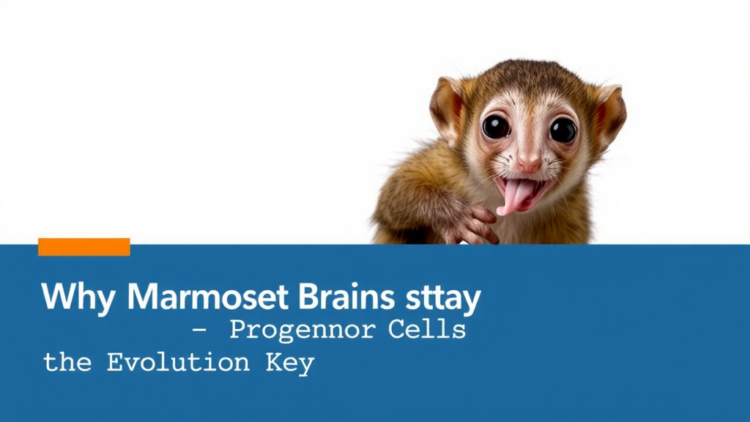
One of the most striking exceptions is the common marmoset (Callithrix jacchus), a small South American monkey that has become an increasingly important model organism in biomedical research. Despite being a genuine primate, the marmoset carries a brain that is smooth and virtually unfolded, a feature that sets it apart from the majority of its relatives. For developmental neuroscientists, this raises an obvious and compelling question: if marmosets and humans descend from a shared primate lineage, what cellular changes during embryonic development cause the marmoset brain to grow less, remain smaller, and never acquire the pronounced folds seen in other species?
A team at the German Primate Center (DPZ) — the Leibniz Institute for Primate Research in Göttingen — set out to answer exactly that question. In a study published in Science Advances, the researchers traced the developmental divergence between smooth and folded primate brains back to specific differences in neural progenitor cells, the self-renewing precursors from which all neurons arise. Their central finding is that the marmoset brain does not start out different. In early embryogenesis it displays the typical structure and composition of a large, folded primate brain, and only later do particular processes intervene to slow the production of nerve cells.
“We wanted to understand which changes at the cellular level cause the marmoset brain to grow less and form fewer folds,” explains Lidiia Tynianskaia, one of the study’s two first authors and a PhD student in the Junior Research Group Brain Development and Evolution at the DPZ. “At the beginning of development, the common marmoset brain exhibits the typical structure and composition of a large, folded primate brain. As development progresses, processes must therefore occur that effectively slow down the production of nerve cells.” That framing matters, because it reframes the smooth marmoset brain not as a primitive starting point but as the outcome of active developmental regulation imposed partway through embryogenesis.
To investigate those processes, the researchers turned to brain organoids — small, three-dimensional cell cultures grown from stem cells that recapitulate key aspects of early brain development. Comparative organoid experiments using marmoset and human cells allowed the team to focus on the brain’s progenitor cells, the population whose behavior largely determines how many neurons the cortex will ultimately contain. Since neuron number is one of the decisive factors governing both the size of a brain and the degree to which its surface folds, differences in progenitor behavior are a natural place to look for the roots of anatomical divergence.
The comparisons revealed that several distinct mechanisms, operating at different levels and in different progenitor cell types, converge to reduce the size and folding of the marmoset cerebral cortex. “Our investigations have shown that certain progenitor cells in the common marmoset divide significantly more slowly than in humans,” says César Mateo Bastidas Betancourt, the study’s other first author and also a PhD student in the Junior Research Group. “Other progenitor cells have a simpler structure than their human counterparts, with fewer processes, and are therefore less proliferative. Both of these factors ultimately result in fewer nerve cells, which contributes to a smaller size and less folding of the cerebral cortex in marmosets.”
These two mechanisms are complementary rather than redundant. Slower cell division directly limits how quickly the progenitor pool expands, while a simpler morphology — fewer of the cellular processes that in more proliferative progenitors help sustain repeated rounds of division — appears to constrain the cells’ proliferative capacity itself. In folded primate brains, progenitor cells in the developing neocortex typically undergo many rounds of division, amplifying the pool of neurons that will populate the expanding cortical sheet. When that amplification is dialed down, as it is in marmosets, the downstream consequence is a thinner, smaller cortex with less surface area to fold.
Timing emerged as a third, crucial dimension of the story. The scientists showed that certain characteristics and behaviors of marmoset progenitor cells appear at altered time points compared with their human counterparts, with the net effect that marmoset progenitors have a shorter overall window during which they can proliferate rapidly. In developmental biology, such shifts in timing are a well-known engine of evolutionary change: modest adjustments to when developmental programs switch on or off can produce large differences in final organ size without requiring wholesale redesign of the underlying machinery. The marmoset data suggest that a compressed proliferative window is one such adjustment, quietly capping the neuron output of the developing cortex.
Because most of the experiments relied on organoids, establishing that the cultures faithfully mirrored real development was essential. “The study combines the advantages of in vivo and in vitro methods,” says Michael Heide, head of the Junior Research Group Brain Development and Evolution. “Organoids are well-suited for obtaining statistically robust results because such sample sizes are not feasible in primates. We subsequently repeated some key experiments in fetal brain tissue to confirm the results from the organoids.” The team found that 50-day-old marmoset organoids closely resemble natural brain development at day 90, a correspondence that allowed them to align the developmental clock of the organoids with that of the actual marmoset embryo and interpret their results with confidence. That validation step is what elevates the findings from an interesting culture phenomenon to a credible account of what happens inside a developing primate.
The broader significance of the work runs in two directions. Evolutionarily, it offers a concrete, mechanistic scenario for how the striking diversity of primate brain sizes and shapes could have arisen: not through the appearance of entirely new cell types, but through coordinated changes in how existing progenitor cells divide, mature, and keep to their developmental schedule. Medically, the same cellular programs that scale a brain up or down are the ones that can go awry in developmental disorders, and the study provides an important framework for understanding both the processes themselves and the consequences of their disruption in the human brain. For a small monkey with a smooth brain, the common marmoset is now teaching scientists a great deal about what it took to build a folded one.
Subject of Research: Cellular mechanisms of neural progenitor development underlying smooth versus folded primate brains
Article Title: Smooth instead of folded—brain development in primates
Article References: Smooth instead of folded—brain development in primates. (n.d.). Original publication
Image Credits: AI Generated
DOI: Not provided
Keywords: marmoset, brain development, neural progenitor cells, brain organoids, cortical folding, primate evolution, cerebral cortex, neurogenesis, German Primate Center, Science Advances, developmental neuroscience, brain size
Cite Scienmag News
APA MLA Chicago
Gavin Prescott. (September 24, 2026). Why Marmoset Brains Stay Smooth: Progenitor Cells Hold the Evolutionary Key. Scienmag. https://scienmag.com/why-marmoset-brains-stay-smooth-progenitor-cells-hold-the-evolutionary-key/
Gavin Prescott. “Why Marmoset Brains Stay Smooth: Progenitor Cells Hold the Evolutionary Key.” Scienmag, 24 September 2026, https://scienmag.com/why-marmoset-brains-stay-smooth-progenitor-cells-hold-the-evolutionary-key/. Accessed 24 September 2026.
Gavin Prescott. “Why Marmoset Brains Stay Smooth: Progenitor Cells Hold the Evolutionary Key.” Scienmag. September 24, 2026. https://scienmag.com/why-marmoset-brains-stay-smooth-progenitor-cells-hold-the-evolutionary-key/
Copy citation Download RIS
Tags: brain developmentbrain morphology in primatesbrain organoidsbrain sizecerebral cortexcomparative primate neuroanatomycortical foldingcortical folding in primatescortical surface area expansiondevelopmental neuroscienceevolutionary neuroscienceGerman Primate Centermarmosetmarmoset brain structureneural progenitor cellsneurodevelopmental research modelsneurogenesisprimate brain developmentprimate common ancestorprimate evolutionprimates brain evolutionScience Advancessmooth brain in marmosets