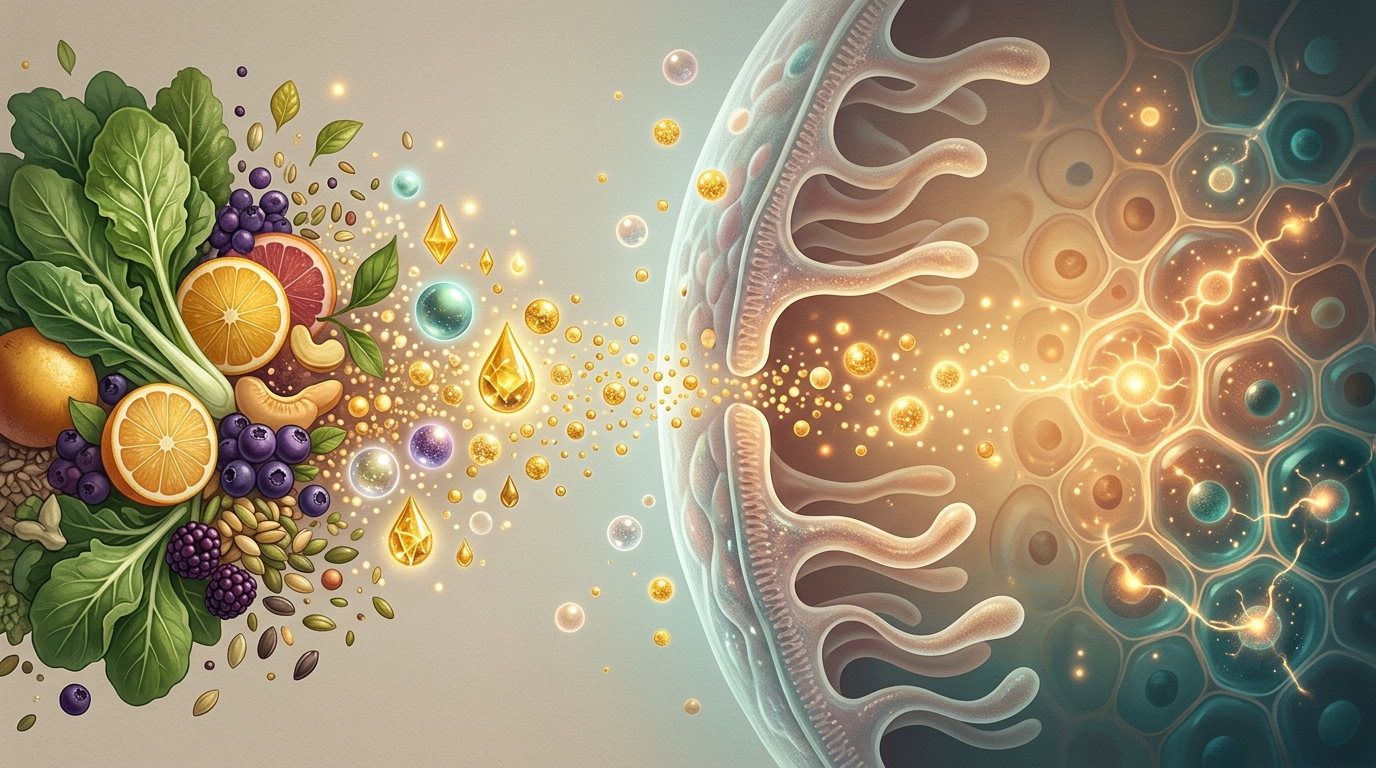
A new narrative review argues that the world’s persistent undernutrition problem cannot be solved by counting the vitamins and minerals in food alone. Writing in Food Science & Nutrition, the author contends that low nutrient supply is an outcome of interacting food, host, and food-system processes, not simply a synonym for low nutrient content. A food may contain substantial quantities of a nutrient while providing little of it in a form that is released from the matrix, absorbed, transported, or used physiologically, the review explains, and processing can simultaneously destroy heat-sensitive vitamins while improving digestibility and safety.
The review, informed by the Scale for the Assessment of Narrative Review Articles, draws on literature from PubMed/MEDLINE, Scopus, Web of Science, Embase, the Cochrane Library, and guidance from the World Health Organization, the Food and Agriculture Organization, and the European Food Safety Authority. Its central analytical move is a conceptual chain that separates nutrient content, the amount present in a food, from nutrient density, bioaccessibility, bioavailability, absorption, utilization, and finally dietary adequacy. Bioaccessibility describes the fraction released from the food matrix during digestion; bioavailability concerns the fraction absorbed and available for physiological use; utilization covers metabolism and incorporation into functional processes. These stages are related but not interchangeable, the author stresses, because an intervention may increase content without improving absorption, or improve bioaccessibility without changing clinical status.
The scale of the problem the review addresses is considerable. The World Health Organization reported that 149.2 million children below five were stunted, 45.4 million were wasted, and 462 million were underweight. Around 795 million people, roughly one tenth of the world population, had undernutrition in 2015, a figure worsened by the COVID-19 pandemic and associated lockdowns. The Global Nutrition Report released in early 2022 stated that 820 million people were hungry worldwide in 2021, about one in nine people, and that of 194 countries only 49 were on course to meet stunting and wasting targets. Anemia prevalence was showing no progress or worsening in more than 161 countries, and in the Africa region no country was on course to meet any diet-related noncommunicable disease targets. The review notes that undernutrition is most common in developing countries, with prevalence highest among children below five, and that vitamin A deficiency affects one out of three children below age five globally.
Among the food-side culprits, antinutritional factors receive detailed attention. Phytic acid, found in the hulls of nuts, grains, and seeds, strongly binds minerals such as calcium, copper, zinc, magnesium, and iron, forming precipitates that make them unavailable for intestinal absorption. Oxalates, concentrated in rhubarb, parsley, purslane, spinach, and tea, prevent calcium absorption by binding it. Glucosinolates in Brussels sprouts, broccoli, cabbage, and radishes interfere with iodine uptake and thyroid function, earning them the label goitrogens. Protease inhibitors, including the Bowman-Birk trypsin inhibitor in soybeans, block trypsin and pepsin in the gut and prevent protein digestion and absorption. Tannins and other polyphenols chelate zinc and iron, inhibit digestive enzymes, and can precipitate proteins, while lectins and trypsin inhibitors in legumes further interfere with nutrient digestion. Even excess dietary fiber can shorten intestinal transit enough to interfere with mineral absorption, and avidin in raw egg whites tightly binds vitamin B7, although such deficiency is rare.
Food processing cuts both ways, and the review is careful to avoid classifying it as inherently good or bad. Heat destroys vitamin C, so canned and other heat-processed fruits and vegetables contain less of it than fresh produce. Water-soluble B-group vitamins and vitamin C are more unstable during storage and processing than fat-soluble vitamins A, D, E, and K, with vitamin C, folate, and thiamine among the most vulnerable. Refining and milling grains strips away fiber, minerals, and vitamins compared with whole grains, and milling can distribute microorganisms throughout the food, reducing nutrient density. Boiling potatoes can leach water-soluble vitamins into the cooking water, though the nutrients can still be recovered if the liquid is consumed. The author argues that processing should instead be evaluated against a defined nutrient-specific endpoint, since heating may improve plant protein digestibility by inactivating antinutritional factors while severe thermal treatment promotes aggregation or reactions that reduce amino acid availability.
Postharvest storage emerges as another critical bottleneck. The review reports that around 50 to 60 percent of cereal grains are lost during storage in developing countries, mainly due to lack of technical know-how, and that in India roughly the same share of grains are traditionally stored in local structures such as Sanduka, earthen pots, Kanaja, Kothi, Kacheri, and Gummi. Cereal grains and tubers, the major staples in developing countries, account for the largest postharvest losses on a calorific basis. Scientific storage methods such as atmospheric storage and silos, combined with preservative measures, can reduce these losses to 1 to 2 percent or less. The review cautions, however, that food loss estimates are not identical to nutrient-loss estimates, and that the FAO Food Loss Index shows substantial variation across commodity groups and regions, with fruits and vegetables generally more perishable than cereals and pulses, so a single universal percentage should not be generalized.
Human and genetic factors add a further layer of complexity. Vitamin A deficiency and iron deficiency frequently co-occur, and a meta-analysis by da Cunha and colleagues, together with work by Htet and colleagues, found that improved iron status is connected with higher serum retinol, suggesting that using vitamin A and iron supplements simultaneously is more effective for preventing iron deficiency than using either micronutrient alone. Iron deficiency appears to impair mobilization of vitamin A stores in the liver, resulting in low serum retinol. Iron and zinc share similar absorption pathways, so combined supplementation can be less effective than either alone. Genetic variation matters too: polymorphisms in the BCMO1 enzyme, which converts beta-carotene into retinal, can reduce its catalytic activity by 48 to 59 percent, and Borel and colleagues reported that 25 SNPs across 12 genes explained 69 percent of the variation in post-prandial chylomicron beta-carotene response. Disease conditions from celiac disease to cystic fibrosis and lactose intolerance also impair nutrient uptake.
The review’s most consequential contribution is a limiting-step framework for choosing interventions. If the main limitation is low nutrient content, crop diversification, biofortification, or fortification may be appropriate. If the nutrient is present but bound within the matrix, fermentation, germination, milling choices, or meal composition may be more relevant. If intestinal absorption is impaired by disease or medication, food-level interventions alone may be insufficient, and where the principal constraint is affordability or seasonal access, income support, school meals, market infrastructure, and social protection are more directly relevant. The framework draws on a 2024 study of maize in which combining soaking, germination, and fermentation with Lactiplantibacillus plantarum reduced phytate by up to 85.6 percent and substantially lowered phytate-to-mineral molar ratios, yet the author emphasizes that these results establish improved compositional and estimated bioavailability indicators rather than demonstrating equivalent improvements in human mineral status.
That translational gap is illustrated most starkly by recent evidence on fermented bread. A 2026 systematic review of human intervention studies found that sourdough fermentation and phytate reduction could improve acute iron absorption under particular experimental conditions, yet the longer-term evidence did not consistently demonstrate improvements in iron stores. Some favorable outcomes appeared when phytate reduction was combined with iron fortification, suggesting that removing an inhibitor may be insufficient when the absolute nutrient supply remains inadequate. Similarly, a systematic review and meta-analysis of zinc-fortified foods found improvements in plasma zinc concentrations and a lower prevalence of zinc deficiency, but several functional outcomes could not be attributed specifically to zinc because some interventions included multiple micronutrients. Evidence on zinc-biofortified crops suggests increasing crop zinc concentration can raise total zinc absorption, but uncertainty remains about the dose and duration needed to improve population-level zinc status.
The review closes with a practical decision rule: diagnose the dominant limiting step, select an intervention with a mechanism capable of addressing it, and measure outcomes at several levels, from nutrient content and retention through in vitro bioaccessibility, human absorption, status biomarkers, and functional or clinical endpoints. Fortification can improve intake efficiently where suitable vehicles reach the target population, but it cannot replace dietary diversity or disease treatment and must be monitored for coverage, nutrient stability, excessive intake, and inequitable reach. Nanotechnology and biotechnology remain promising in selected applications, but scale-up should depend on demonstrated human benefit, safety, regulatory clarity, affordability, environmental consequences, and public acceptance. The strongest intervention, the author concludes, is not the one that maximizes nutrient concentration or produces the largest immediate change in a laboratory marker, but the one that addresses the dominant constraint while preserving food quality, affordability, safety, acceptability, and sustained consumption.
Subject of Research: A narrative review of how food properties, bioactive components, processing, and human factors determine nutrient supply from foods and which nutritional strategies address them.
Article Title: Food Properties, Bioactive Components, and Human Factors as Determinants of Low Nutrient Supply From Foods Can Be Improved With Adequate Nutritional Strategies
Article References: Awuchi, C. G. (2026). Food Properties, Bioactive Components, and Human Factors as Determinants of Low Nutrient Supply From Foods Can Be Improved With Adequate Nutritional Strategies. Food Science & Nutrition, 14(11), Article e72528. https://doi.org/10.1002/fsn3.72528
Image Credits: AI Generated
DOI: 10.1002/fsn3.72528
Keywords: nutrient bioavailability, antinutrients, phytate, food fortification, biofortification, fermentation, postharvest loss, food matrix, undernutrition, zinc, iron deficiency, limiting-step framework
News Source: Daisy Hatcher. (November 4, 2026). Why Eating Enough Nutrients Is Not the Same as Absorbing Them. Scienmag.