

• HOME
  • NEWS
  • EXPLORE
    • CAREER
      • Companies
      • Jobs
    • EVENTS
    • iGEM
      • News
      • Team
    • PHOTOS
    • VIDEO
    • WIKI
  • BLOG
  • COMMUNITY
    • FACEBOOK
    • INSTAGRAM
    • TWITTER
Wednesday, June 24, 2026
BIOENGINEER.ORG
No Result
View All Result
  • Login
  • HOME
  • NEWS
  • EXPLORE
    • CAREER
      • Companies
      • Jobs
        • Lecturer
        • PhD Studentship
        • Postdoc
        • Research Assistant
    • EVENTS
    • iGEM
      • News
      • Team
    • PHOTOS
    • VIDEO
    • WIKI
  • BLOG
  • COMMUNITY
    • FACEBOOK
    • INSTAGRAM
    • TWITTER
  • HOME
  • NEWS
  • EXPLORE
    • CAREER
      • Companies
      • Jobs
        • Lecturer
        • PhD Studentship
        • Postdoc
        • Research Assistant
    • EVENTS
    • iGEM
      • News
      • Team
    • PHOTOS
    • VIDEO
    • WIKI
  • BLOG
  • COMMUNITY
    • FACEBOOK
    • INSTAGRAM
    • TWITTER
No Result
View All Result
Bioengineer.org
No Result
View All Result
Home NEWS Science News Biology

Why doesn’t fire kill some bacteria and fungi?

Bioengineer by Bioengineer
March 30, 2022
in Biology
Reading Time: 2 mins read
0
Soil sampling
Share on FacebookShare on TwitterShare on LinkedinShare on RedditShare on Telegram

Scientists have found microbes living in the charred soil that wildfires leave behind. They don’t know how some fungi and bacteria manage to thrive when everything else has died, but a new project aims to change that. 
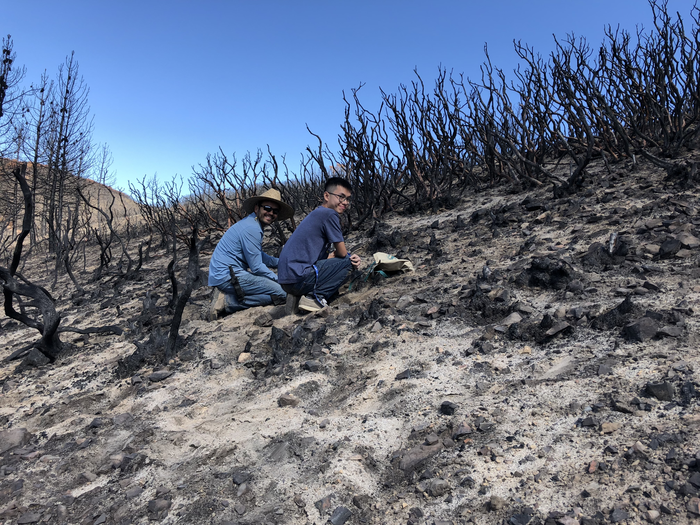
Soil sampling

Credit: Sydney Glassman/UCR

Scientists have found microbes living in the charred soil that wildfires leave behind. They don’t know how some fungi and bacteria manage to thrive when everything else has died, but a new project aims to change that. 

UC Riverside scientists will spend the next three years studying the traits that allow soil microbes to respond to fire, as well as the role those microbes play in storing or emitting powerful greenhouse gases like carbon dioxide or nitrous oxide.  

The work is funded by an $849,000 grant from the U.S. Department of Agriculture’s National Institute of Food and Agriculture. 

“There’s very little known about which microbes respond to fires, or why, or what effect they have on the rest of the environment,” said UCR mycologist Sydney Glassman. “We want to know how the fungi and bacteria that remain impact greenhouse gas emissions from post-fire soils.”

To answer their questions, Glassman and UCR environmental scientist Pete Homyak are sampling soil from two major, nearby burn scars— 2018’s Holy Fire in Orange and Riverside counties, and 2020’s El Dorado Fire, also known as the “Gender Reveal Fire” in San Bernardino County.

They’ll test whether remaining microbes have traits resembling ones found in plants that can flourish after fires. 

One such trait is the ability to reproduce quickly. “After a burn, there’s a lot of space that opens up. If they reproduce asexually, they can multiply at a particularly rapid speed and colonize that space,” Glassman said. 

A second quality is the ability to ‘feed’ on burnt things. Fire turns trees into charcoal, leaf matter into waxes, and releases large amounts of nitrogen. Most microbes don’t prefer high levels of nitrogen. However, the researchers believe it’s possible a select few do feast on a diet of charcoal or nitrogen, or wax.

Additionally, there are some plants that can simply tolerate high heat. Microbes could be the same. “There is some evidence of spores that are thermotolerant, or even require heat to reproduce,” Glassman said. 

Future projects will look not only at the characteristics of post-fire microbes, but at whether adding pre-fire fungi and bacteria back into soils could help with recovery. 

In a separate but related study, members of the group are trying to characterize the effects of flame retardants that are regularly added to vast tracts of forest land. Some of these chemicals deposit phosphorus and nitrogen that lasts for decades. The impact of that on naturally occurring microbes is also still unclear. 

“Fires have really strong impacts on soil chemistry, and the main things mediating those impacts are the microbes,” Glassman said. “The ones that survive transform the carbon and nitrogen left behind, setting the stage for regeneration. That’s why we think they’re so important to understand.”


Share12Tweet8Share2ShareShareShare2

Related Posts

Reevaluating the Impact of ‘Yo-Yo Dieting’: Is It Less Harmful Than Commonly Thought? — Biology

Reevaluating the Impact of ‘Yo-Yo Dieting’: Is It Less Harmful Than Commonly Thought?

June 24, 2026
Family Dogs: Science’s Unexpected Ally in Autism Research — Biology

Family Dogs: Science’s Unexpected Ally in Autism Research

June 24, 2026

Enhanced Riboflavin Production Achieved in Bacillus subtilis through Transporter Engineering

June 24, 2026

Scientists Discover Evolving Sperm Whale Dialects in the Mediterranean Sea

June 24, 2026

POPULAR NEWS

  • Saying Goodbye to PGY-6: Pediatric Fellowship Realities

    103 shares
    Share 41 Tweet 26
  • Multi-Hospital Study Reveals Long Covid Burden Is Twice as High as Current Estimates

    92 shares
    Share 36 Tweet 23
  • Detection of EDCs in Breast Milk and Infant Urine Up to Six Months Highlights Early Exposure Risks

    77 shares
    Share 31 Tweet 19
  • New Drug Candidate Developed at McMaster Shows Potential for Treating Brain Cancer

    58 shares
    Share 23 Tweet 15

About

We bring you the latest biotechnology news from best research centers and universities around the world. Check our website.

Follow us

Recent News

10 Months Exercise Boosts Kids’ Ketone Levels

Reevaluating the Impact of ‘Yo-Yo Dieting’: Is It Less Harmful Than Commonly Thought?

Could Daytime Light Exposure Offer Protection Against Dementia?

Subscribe to Blog via Email

Enter your email address to subscribe to this blog and receive notifications of new posts by email.

Join 82 other subscribers
  • Contact Us

Bioengineer.org © Copyright 2023 All Rights Reserved.

Welcome Back!

Login to your account below

Forgotten Password?

Retrieve your password

Please enter your username or email address to reset your password.

Log In
No Result
View All Result
  • Homepages
    • Home Page 1
    • Home Page 2
  • News
  • National
  • Business
  • Health
  • Lifestyle
  • Science

Bioengineer.org © Copyright 2023 All Rights Reserved.