Credit: UT Health San Antonio
The human body holds many mysteries, and function of the BRCA1 gene is among them. Women who inherit a faulty copy of BRCA1 have up to a 65 percent chance to develop breast cancer by age 70. They also have up to a 39 percent chance to develop ovarian cancer.
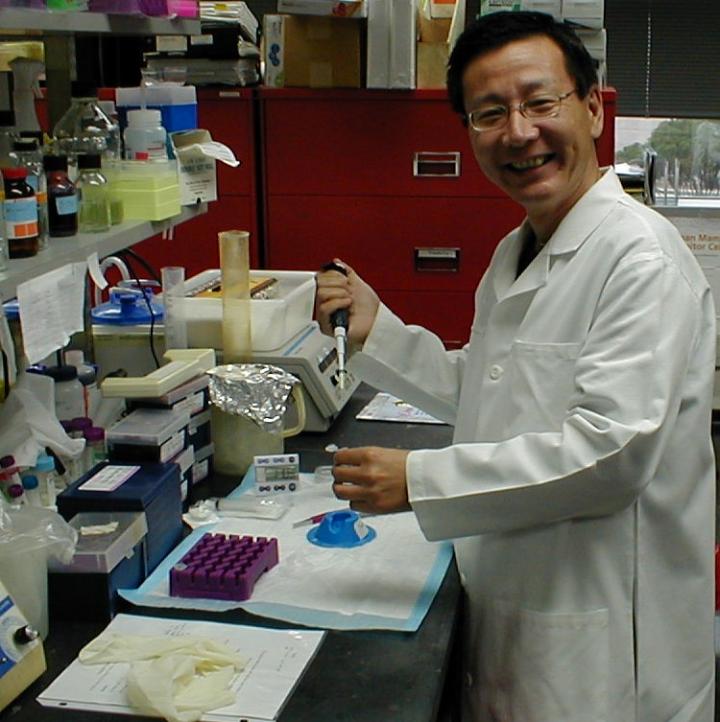
Rong Li, Ph.D., and colleagues at The University of Texas Health Science Center, now called UT Health San Antonio, are building on 15 years of BRCA1 studies. Their latest discovery, reported June 26 in Nature Communications, is of a new, previously unrecognized function of BRCA1.
Explaining tissue specificity
"BRCA1 plays a very important role in DNA repair in almost any cell type you choose to study," said Dr. Li, professor of molecular medicine at UT Health San Antonio and a holder/manager of the Tom C. and Patricia H. Frost Endowment to Advance Cancer Research and Education. "This is a function of BRCA1 that presumably is important for every cell type in the body. But we also know there is a tissue-specific cancer predisposition associated with BRCA1. If a woman loses BRCA1 function, breast and ovary are the two places that preferentially develop tumors. Is there something else BRCA1 does that could contribute to this tissue specificity?"
The answer, fleshed out in this latest Nature Communications paper, is yes.
Study of human tissues yields insights
Dr. Li and his team obtained human breast tissue specimens from breast oncologists including those led by Ismail Jatoi, M.D., Ph.D., FACS, and Richard Elledge, M.D., at the UT Health Cancer Center of UT Health San Antonio, as well as Oscar Ochoa, M.D., FACS, at PRMA Plastic Surgery. The team compared tissues of BRCA1 mutation carriers versus non-carriers and found interesting differences:
- Gene expression-related stress is higher in BRCA1 mutation carriers;
- This stress is only higher in luminal epithelial cells, where BRCA1-related breast tumors originate;
- Within the luminal epithelial cells, the stress is higher in estrogen-responsive genes.
Gene expression-related stress is a result of cells expressing (or switching on) genes to carry out functions. This process sometimes damages the genetic blueprint, DNA, resulting in abnormal structures that scientists label as stress.
"The breasts and ovaries are two major estrogen-responsive sites in a woman's body," Dr. Li said. "This zooming in on the stress location is the connection we sought to make between BRCA1 dysfunction and breast and ovarian cancer predisposition. This is a very attractive model to further test, and points to an interesting direction for drug development."
The study reported in Nature Communications focused on breast tissue. Similar studies of ovarian tissue will be conducted.
###
Dr. Li is co-leader of the Cancer Development and Progression Program at the UT Health Cancer Center. His academic appointment is in the Department of Molecular Medicine in the Joe R. & Teresa Lozano Long School of Medicine at UT Health San Antonio.
This research was funded by an award from the National Cancer Institute of the National Institutes of Health. The Alamo Breast Cancer Foundation also provided support for this study.
Read more cancer research news from UT Health San Antonio: Study compares radiation, surgery for bladder cancer
For current news from the UT Health Science Center San Antonio, now called UT Health San Antonio™, please visit our online newsroom, like us on Facebook or follow us on Twitter.
The University of Texas Health Science Center at San Antonio, with missions of teaching, research and healing, is one of the country's leading health sciences universities and is now called UT Health San Antonio™. UT Health's schools of medicine, nursing, dentistry, health professions and graduate biomedical sciences have produced more than 33,000 alumni who are advancing their fields throughout the world. With seven campuses in San Antonio and Laredo, UT Health has a FY 2017 revenue operating budget of $806.6 million and is the primary driver of its community's $37 billion biomedical and health care industry. For more information on the many ways "We make lives better®," visit http://www.uthscsa.edu.
Media Contact
Will Sansom
[email protected]
210-567-2579
@UTHealthSA
http://www.uthscsa.edu/hscnews
Original Source
https://news.uthscsa.edu/brca1-mutations-breast-cancer/ http://dx.doi.org/10.1038/ncomms15908