• HOME
  • NEWS
  • EXPLORE
    • CAREER
      • Companies
      • Jobs
    • EVENTS
    • iGEM
      • News
      • Team
    • PHOTOS
    • VIDEO
    • WIKI
  • BLOG
  • COMMUNITY
    • FACEBOOK
    • INSTAGRAM
    • TWITTER
Friday, June 26, 2026
BIOENGINEER.ORG
No Result
View All Result
  • Login
  • HOME
  • NEWS
  • EXPLORE
    • CAREER
      • Companies
      • Jobs
        • Lecturer
        • PhD Studentship
        • Postdoc
        • Research Assistant
    • EVENTS
    • iGEM
      • News
      • Team
    • PHOTOS
    • VIDEO
    • WIKI
  • BLOG
  • COMMUNITY
    • FACEBOOK
    • INSTAGRAM
    • TWITTER
  • HOME
  • NEWS
  • EXPLORE
    • CAREER
      • Companies
      • Jobs
        • Lecturer
        • PhD Studentship
        • Postdoc
        • Research Assistant
    • EVENTS
    • iGEM
      • News
      • Team
    • PHOTOS
    • VIDEO
    • WIKI
  • BLOG
  • COMMUNITY
    • FACEBOOK
    • INSTAGRAM
    • TWITTER
No Result
View All Result
Bioengineer.org
No Result
View All Result
Home NEWS Science News Chemistry

Why are alloy metal nanoparticles better than monometallic ones for CNT growth?

Bioengineer by Bioengineer
December 20, 2019
in Chemistry
Reading Time: 2 mins read
0
IMAGE
Share on FacebookShare on TwitterShare on LinkedinShare on RedditShare on Telegram

Revealing a long-term mystery of why certain nanoparticles are more efficient in incorporating carbon atoms and achieving a faster carbon nanotube growth
IMAGE

Credit: IBS


Researchers of the Center for Multidimensional Carbon Materials, within the Institute of Basic Science (IBS, South Korea), have presented a theoretical solution to a long-lasting mystery of carbon nanotubes (CNTs) growth. Published in Physical Review Letters, this study explains why nanoparticles made with an alloy of metals help to synthetize longer CNTs compared with conventional monometallic catalysts.

CNTs are tubular nanostructures made of carbon atoms with exciting potential properties that have kept researchers on the lookout for new advances. One of the most common methods to produce CNTs involves catalyst nanoparticles, which have the function of facilitating the addition of carbon atoms from precursor molecules to the walls of the cylinders. It is common knowledge in the field that alloy catalysts, like Ni-Y, Fe-Mo, Cu-Ni, and Co-Mo, outperform other single metal catalysts, but the reason has been unclear.

IBS researchers performed a systematic molecular dynamics simulation to explore the role of alloy catalysts in CNT growth. “In a molecular dynamics simulation, the motion of every atom can be clearly seen and, therefore, the variation of the shape and structure of the catalyst particle during the carbon nanotube growth can be recorded precisely. This allows us to go beyond the capacity of the best experimental methods.” explains Feng Ding, a group leader of the Center and corresponding author of the study.

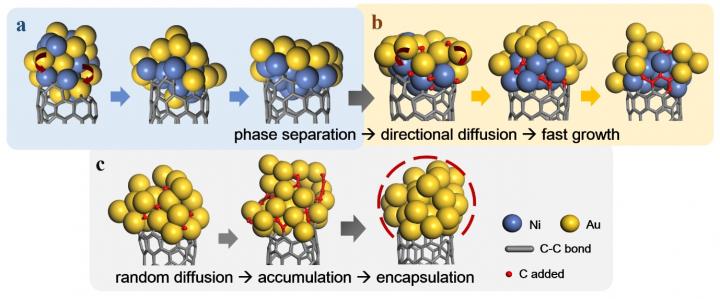
Through the molecular dynamic simulations, the authors have found that the two metals of the alloy are spatially separated at the rim of the tubes: CNTs tend to attract the more active metal atoms to the open end of the cylinders (growth front), where carbon atoms are inserted into the CNT wall during growth, while the less active metal atoms are pushed above. More simulations show that this is a general phenomenon and can be applied to many types of alloy catalysts.

IBS researchers have also demonstrated that alloy catalysts win over monometallic nanoparticles because the active metal atoms near the rim of the CNT catch the carbon atoms more easily than the less active ones. This will lead to a larger carbon concentration at the vicinal of CNT growth front and a quick addition of the carbon atoms, which contribute to the fast growth of the CNT.

Since the carbon atoms are continuously incorporated to the growing CNTs, the carbon precursors do not accumulate around the alloy nanoparticles. This prevents the formation of a cap made of carbon atoms engulfing the entire nanoparticle.

“This theoretical study addresses a long-term puzzle of the role of the alloy catalysts in carbon nanotube growth. It reveals the advantage of using alloy catalysts in carbon nanotube growth, and the contact-induced phase separation of the alloy catalyst can be considered as a general rule to guide catalyst design for controllable carbon nanotube growth,” says Lu Qiu, the first author of the study.

###

Media Contact
Dahee Carol Kim
[email protected]
82-428-788-133

Related Journal Article

http://dx.doi.org/10.1103/PhysRevLett.123.256101

Tags: Chemistry/Physics/Materials Sciences
Share12Tweet8Share2ShareShareShare2

Related Posts

AI and Physics Collaborate to Design Advanced Hydrogen Storage Materials

June 25, 2026

International Team Including Dresden Scientists Develops Novel Designer Proteins for Advanced Study of Living Tissue

June 25, 2026

New Study Uncovers Key Factors Driving Water Chemistry in Nanoscale Environments

June 25, 2026

Plasma Technology Extends Catalyst Lifespan in Hydrogen Production

June 24, 2026
Please login to join discussion

POPULAR NEWS

  • Saying Goodbye to PGY-6: Pediatric Fellowship Realities

    103 shares
    Share 41 Tweet 26
  • Multi-Hospital Study Reveals Long Covid Burden Is Twice as High as Current Estimates

    92 shares
    Share 36 Tweet 23
  • Detection of EDCs in Breast Milk and Infant Urine Up to Six Months Highlights Early Exposure Risks

    77 shares
    Share 31 Tweet 19
  • New Drug Candidate Developed at McMaster Shows Potential for Treating Brain Cancer

    58 shares
    Share 23 Tweet 15

About

We bring you the latest biotechnology news from best research centers and universities around the world. Check our website.

Follow us

Recent News

Tracking Lanthanide-Labeled Microplastics in Plants

POSTECH Researchers Slash Cost of Reconstituted Cell-Free Systems by 95%

AI and Physics Collaborate to Design Advanced Hydrogen Storage Materials

Subscribe to Blog via Email

Success! An email was just sent to confirm your subscription. Please find the email now and click 'Confirm' to start subscribing.

Join 82 other subscribers
  • Contact Us

Bioengineer.org © Copyright 2023 All Rights Reserved.

Welcome Back!

Login to your account below

Forgotten Password?

Retrieve your password

Please enter your username or email address to reset your password.

Log In
No Result
View All Result
  • Homepages
    • Home Page 1
    • Home Page 2
  • News
  • National
  • Business
  • Health
  • Lifestyle
  • Science

Bioengineer.org © Copyright 2023 All Rights Reserved.