Credit: Public domain
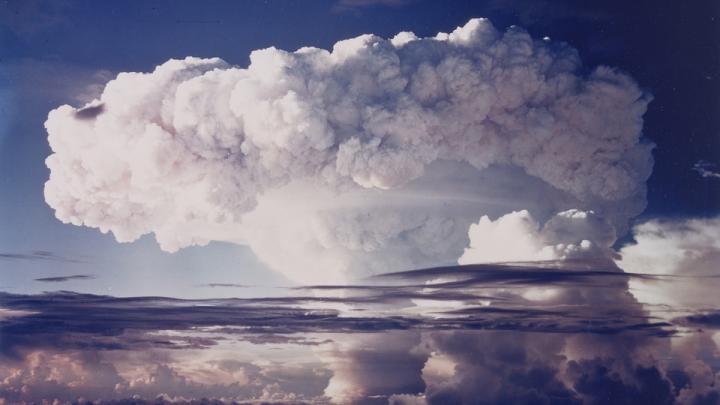
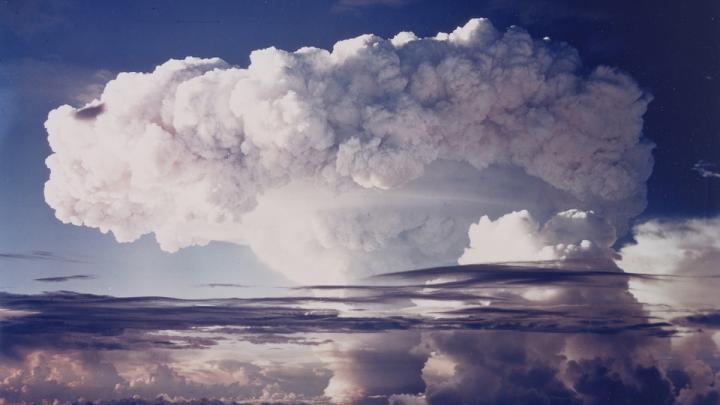
As the notion of nuclear hostilities leaps from its old, Cold War perch into modern debate, new calculations by University of Nebraska-Lincoln researchers show that even a limited nuclear strike could have disastrous global consequences.
In a new report, a group of experts led by Adam Liska, a biological systems engineer at Nebraska, has determined that a single nuclear warhead could cause devastating climate change resulting in widespread drought and famine that could cost a billion lives.
During the five decades of the Cold War, the doctrine of mutually assured destruction kept the Soviet Union and the United States in counterbalance, each nation recognizing that both would be annihilated if either attacked.
But the old rules may no longer apply as more nations, including North Korea, have gained nuclear weapons.
"We're losing our memory of the Cold War and we're losing our memory of how important it is to get this right," said co-author Tyler White, a political scientist who specializes in international security and nuclear policy. "Even a conflict that doesn't involve the United States can impact us and people around the world."
Even though North Korea does not yet have a warhead capable of delivering the damage described in the article, the nuclear stakes were raised recently when it successfully launched an intercontinental ballistic missile with the capability to deliver a nuclear payload to Alaska as well as cities in Asia and the Middle East.
Additionally, policy analysts say some nuclear powers have adopted doctrines that allow for limited strikes and for first use of nuclear weapons. Russian defense strategy, for example, contemplates limited nuclear strikes to deter or end conventional wars. Military strategists in the United States might consider limited use of nuclear weapons if the nation or an ally is in serious military jeopardy; in retaliation for a chemical or biological weapons attack; or to bring rogue nuclear states under control.
Along with White, Liska enlisted experts in climate modeling and climate change to assemble the report, which appeared July 6 in Environment Magazine. Robert Oglesby, a professor of Earth and atmospheric sciences, specializes in climate modeling and climate change; and Eric Holley, a doctoral student in natural resources, has studied how insurance and financial incentives might be used to adapt to climate change.
Using publicly available data on 19 types of weapons now held by five major nuclear powers — the United States, Russia, China, the United Kingdom and France — Liska and his colleagues calculated how many nuclear bombs in each category could be used before triggering conditions they describe as "nuclear autumn" or "nuclear drought." Not as severe as the nuclear winter predicted by scientists in the 1980s, a nuclear autumn nonetheless would significantly impact Earth's climate.
"The question is not if a nuclear drought can occur, but what factors increase its probability of occurring and what actions can be taken to mitigate the potentially devastating global impacts?" said Liska, who specializes in life-cycle analysis to assess the environmental impacts of products and services.
Other scientists previously have found nuclear blasts sufficient to ignite a developed area roughly the size of Los Angeles — 500 square miles — would throw 5.5 million tons of ash and soot into the stratosphere. Sunlight, temperatures and rainfall would decrease around the world, growing seasons would be significantly reduced for at least five years and global temperatures would be their lowest in 1,000 years. Rainfall could decrease by as much as 80 percent in some areas of the world.
The black ash created by a nuclear blast would cool temperatures at the Earth's surface, Oglesby said. Because there would be less temperature difference between the lower and upper atmosphere, rainfall would dwindle and cast large areas of the planet into drought.
"If the ash reaches the stratosphere, many months could pass before it dissipates," Oglesby said.
Physicist Stephen Hawking and former Defense Secretary William Perry are among those who have recently warned about the growing danger of nuclear weapons use.
Liska and colleagues found that the United States, Russia and China each have weapons, including air-dropped, intercontinental ballistic missiles and land-based missiles, that could trigger a nuclear drought with the detonation of fewer than five bombs. Each weapon represents only a fraction of their arsenals. China could cause a nuclear drought with the launch of a single land-based missile. It holds 20 of that type in its arsenal.
The potential climate destruction posed by nuclear weapons is further compounded by climate change related to fossil fuel consumption, Liska added. More nations are turning to nuclear energy to reduce fossil fuel usage, which also creates opportunities for more nations to obtain nuclear weapons. Political instability as a result of people fleeing higher sea levels in the long term could exacerbate global conflict and increase the chance of limited nuclear confrontations.
"We pulled together what is known about nuclear weapons today, to make a case about the magnitude of these impacts," Liska said. "With that understanding, we can make better choices going forward."
###
Media Contact
Adam Liska
aliska2@unl.edu
402-472-8744
@UNLNews
http://www.unl.edu
Original Source
http://news.unl.edu/newsrooms/today/article/why-a-single-nukes-impact-shouldnt-only-be-measured-in-megatons/ http://dx.doi.org/10.1080/00139157.2017.1325300