WASHINGTON, September 21, 2021 — Consciousness remains one of the brain’s biggest mysteries. We know very little about how it emerges from activity within the brain, but most neuroscientists agree consciousness is dynamic in nature.
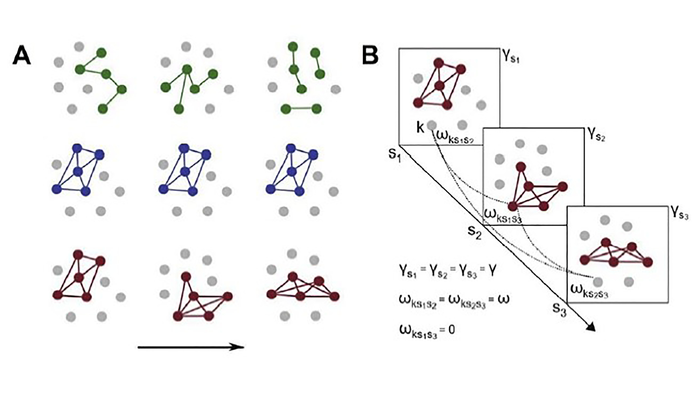
Credit: Sofía Morena del Pozo, Helmut Laufs, Vincent Bonhomme, Steven Laureys, Pablo Balenzuala, and Enzo Tagliazucchi
WASHINGTON, September 21, 2021 — Consciousness remains one of the brain’s biggest mysteries. We know very little about how it emerges from activity within the brain, but most neuroscientists agree consciousness is dynamic in nature.
Our subjective experience doesn’t appear to us like a sequence of disjointed snapshots. Instead, we feel the world as a continuous stream of information. This information is integrated, since we don’t perceive a different stream per sensory modality — one for vision, one for hearing, and so forth — but as a single one where all percepts merge.
In Chaos, from AIP Publishing, researchers explore the question: Which characteristics should brain activity have to support this type of conscious experiences?
“We conclude that brain activity should be integrated, with multiple regions ‘talking to each other’ frequently,” said Enzo Tagliazucchi, a co-author from Universidad Adolfo Ibañez and the Latin American Brain Health Institute in Santiago, Chile. “At the same time, the regions involved should change continuously, accounting for the multiplicity of contents that appear in our conscious experience.”
The group searched for integrated structures that encompass most of the brain but change configuration from time to time. Their hypothesis was these structures should vanish during states of deep unconsciousness, such as deep sleep or while under general anesthetics.
“In the case of the brain, nodes are specific anatomical regions and links indicate brain activity measured at those regions is significantly synchronized,” said Tagliazucchi. “At a given time, we have a network describing how brain regions are synchronized, and this network changes in time as brainwide communication patterns also change.”
The group wanted to zero in on groups of nodes tightly coupled together (modules) that maintain their identity over time, yet the involved nodes change as time progresses.
“We hypothesize that the largest of these modules is important for consciousness, since it is both dynamic and integrates a large proportion of brain regions,” Tagliazucchi said.
To put it to the test, they developed a way to detect these structures within temporal networks by using current algorithms within certain parameters. The researchers built artificial time-evolving networks to test and benchmark these algorithms and find the optimal parameters.
They applied algorithms using these parameters to brain imaging data and confirmed several hypotheses.
Brain activity during conscious wakefulness presents large integrated and dynamic network modules. These modules tend to vanish or fragment during sleep or under general anesthesia. These changes are similar between both conditions, suggesting unconsciousness occurs in both situations following the same mechanism.
“We expect our methodological advances will help other scientists detect integrated structures within other temporal networks by means of hypothesis-driven parameter optimization,” said Tagliazucchi. “Concerning the neurobiological significance of our findings, I would like to see our results replicated in other unconscious brain states and different modal organisms and be validated using metrics that do not come from neuroimaging, such as behavioral observations.”
###
The article “Unconsciousness reconfigures modular brain network dynamics” is authored by Sofía Morena del Pozo, Helmut Laufs, Vincent Bonhomme, Steven Laureys, Pablo Balenzuala, and Enzo Tagliazucchi. It will appear in Chaos on Sept. 21, 2021 (DOI: 10.1063/5.0046047). After that date, it can be accessed at https://aip.scitation.org/doi/10.1063/5.0046047.
ABOUT THE JOURNAL
Chaos is devoted to increasing the understanding of nonlinear phenomena in all areas of science and engineering and describing their manifestations in a manner comprehensible to researchers from a broad spectrum of disciplines. See https://aip.scitation.org/journal/cha.
###
Journal
Chaos An Interdisciplinary Journal of Nonlinear Science
DOI
10.1063/5.0046047
Article Title
Unconsciousness reconfigures modular brain network dynamics
Article Publication Date
21-Sep-2021