Credit: ©Science China Press
Ultrafast non-equilibrium magnetization in correlated spin systems is extensively studied in recent years. At both fundamental and application levels, ultrafast laser pulse excitation and dynamics measurement provide an effective path to the fast optical detection, as well as for the control of the magnetic order. Measuring the time-resolved magneto-optical Kerr effect (TR-MOKE), ultrafast magnetic relaxation phenomenon such as ultrafast demagnetization and uniform precession are observed in magnetic media. The optically excited magnetization precession in magnetic media exhibits the temporal response of magnetization when the effective magnetic field is instantaneously changed by ultrafast laser pulse excitation and provides information about the spin dynamics microscopically.
Recently, extensive attentions have been paid to the BiFeO3 (BFO) and Sr-doped LaMnO3 heterostructure, for a series of novel physical properties that originate from the antiferromagnetic (AFM) and ferromagnetic (FM) exchange interaction across the heterointerface. In an article recently published in SCIENCE CHINA Physics, Mechanics & Astronomy, researchers at the Institute of Physics, Chinese Academy of Sciences, reported their investigation on the ultrafast laser-excited magnetization dynamics of ferromagnetic (FM) La0.67Sr0.33MnO3 (LSMO) thin films with epitaxial grown BiFeO3 (BFO) coating layers.
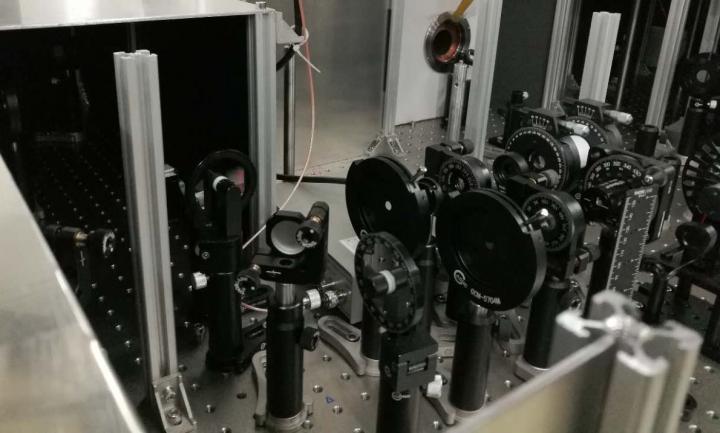
These researchers fabricated the BFO/LSMO heterostructure using the laser molecular beam epitaxy system. As they designed, 10-nm-thick LSMO thin films were deposited on (001) SrTiO3 (STO) single crystal substrates, and 3- or 20-nm-thick BFO films were coated onto the LSMO films. X-ray diffraction was carried out for structural characterization. With the ultrafast time-resolved magneto-optical Kerr effect (TR-MOKE) measurement system they built, the researchers measured the temporal response of the samples they prepared within the time scale of ~500 ps by pump-probe technique.
Two distinct types of oscillations were launched after the pump pulse excited the sample. The high-frequency oscillation at ~103 GHz was independent of the external magnetic field, which was ascribed to the coherent acoustic phonons generated in the STO substrates by the pump-pulse irradiation. The other oscillation mode occurred at a lower frequency (10-30 GHz), exhibiting a positive dependence on the external magnetic field. This relation confirmed the oscillation behavior to be the optically triggered magnetization precession, which has been extensively observed in magnetic media previously in ultrafast TR-MOKE measurements.
Intriguingly, by comparing the optically excited precession behavior of the different samples under the same external magnetic fields, the oscillation period of the precession appeared to be expanded for the BFO-coated LSMO films, and the sample coated with 20-nm-thick BFO exhibited a longer oscillation period than that coated with 3-nm-thick BFO. Fourier transforms show distinct shifts of the precession frequency peak position in each case for the same external magnetic field, thus confirmed the frequency modulation of the magnetization precession.
The researchers analyzed the effective magnetic field in the LSMO film and attributed the reduction of the precession frequency to the suppression of the anisotropy by BFO coating layers. Moreover, they suppose such behavior was induced by the exchange interaction across the BFO/LSMO interface.
"Investigating the optically excited magnetization precession in magnetic oxides may shed light on potential application in spintronics devices" wrote the researchers, "Our findings may provide an effective approach for controlling the spin behavior in magnetic oxide films through structural design".
###
This research was funded by the National Key Basic Research Program of China (Grant Nos. 2014CB921001, and 2013CB328706).
See the article:
Q. Wan, K. J. Jin, J. S. Wang, H. B. Yao, J. X. Gu, H. Z. Guo, X. L. Xu, and G. Z. Yang, Modulation of ultrafast laser-induced magnetization precession in BiFeO3-coated La0.67Sr0.33MnO3 thin films, Sci. China-Phys. Mech. Astron. 60, 047511 (2017)
http://engine.scichina.com/publisher/scp/journal/SCPMA/60/4/10.1007/s11433-017-9006-8?slug=full%20text http://link.springer.com/article/10.1007%2Fs11433-017-9006-8
Science China Press
http://www.scichina.com/
Media Contact
Kuijuan Jin
[email protected]
http://zh.scichina.com/english/
############
Story Source: Materials provided by Scienmag