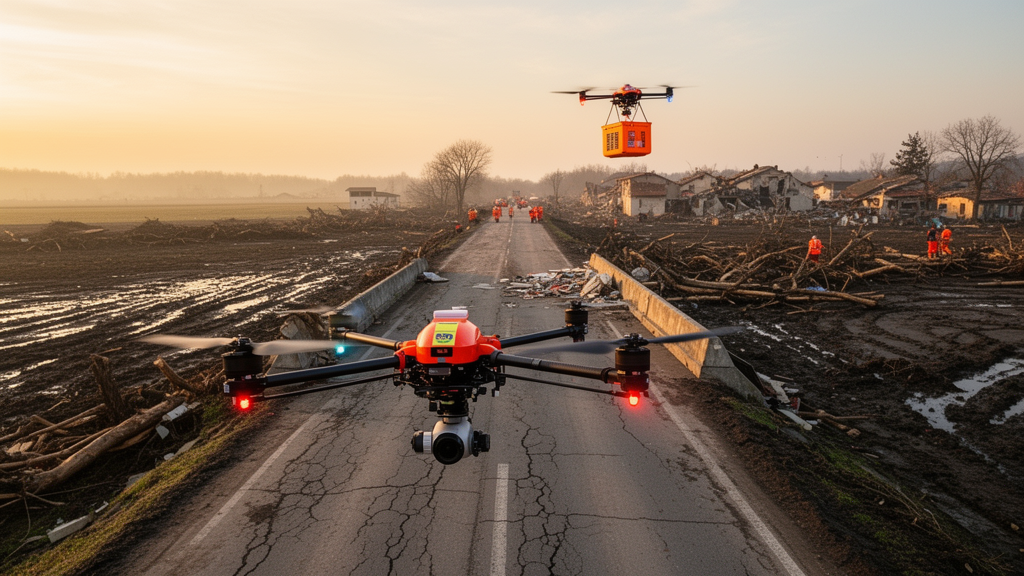
When floods or earthquakes knock out roads, the first hours of relief delivery run on guesswork. Trucks must be routed around bridges that may or may not still stand, and the reports guiding them are often stale or missing. A study published in Discover Artificial Intelligence reframes this chaos as a precise decision problem: every drone sortie spent photographing a damaged road is a sortie not spent delivering supplies, so each inspection must earn its place. The researchers built a Bayesian controller that decides, stage by stage, whether scarce drone capacity should buy information about a lifeline road or commit that capacity to service — and their results reveal a sharp, measurable boundary where smart, targeted scouting stops being the best strategy.
The core idea is called routing-aware value of information, or RA-VoI. Classical sensor-placement methods rank observations by entropy or mutual information, essentially asking how uncertain a road’s status is. But an uncertain road that no relief route uses is worthless to inspect, while a moderately uncertain bottleneck can decide whether an entire community receives aid. RA-VoI instead scores each candidate inspection by the expected reduction it produces in downstream delivery cost, estimated by running the routing plan on sampled scenarios of how damaged roads might recover. An inspection that resolves a high-uncertainty but route-irrelevant road segment scores near zero; an inspection that could flip a critical route from impassable to open scores high.
The model treats the whole operation as a partially observable Markov decision process over a six-stage horizon. Roads recover monotonically — once passable, they stay passable — but recovery times are clustered geographically, so learning the state of one bridge tells the controller something about neighboring segments. The controller maintains a cluster-coupled Beta-hazard belief over latent recovery trajectories, updated by three information streams: field observations from roads trucks actually drive, an initial bulletin revealing a quarter of the network’s status, and purchased drone inspections that return noisy reports with 85 percent sensor sensitivity and specificity. Each stage, an adaptive large-neighborhood search computes delivery plans across sampled scenarios while the sensing layer decides whether any inspection clears its cost.
That cost is genuinely two-sided. Beyond an accounting charge per probe, the controller subtracts an opportunity cost representing the delivery the same drone slot could have performed — a lightweight proxy based on the priority and reachability of unserved demand. An inspection is committed only when its value-of-information score exceeds this opportunity cost, against a no-probe baseline of zero. The authors are careful about what this term does: in their ablations it changed zero realized decisions, so they present it as structural accounting of the drone resource coupling rather than an empirically decisive mechanism.
The headline result comes from synthetic flooded-road networks with twenty demand nodes. Across eighty matched simulation seeds, the route-aware selector was the only active policy with a positive mean adjusted gain over passive routing — about 4,021 in reduced-model units, compared with negative values for entropy, coverage, and mutual-information probing at the reference probe cost. More striking is the tail: route-aware verification cut the catastrophic-failure rate from 2.53 percent under maximum-entropy probing to 1.25 percent, and its worst-5 percent conditional loss was roughly a third of the entropy baseline’s. The median paired difference was zero, meaning most scenarios were similar — the advantage came from a few avoided disasters, which is exactly the profile that matters in emergency response.
But the story inverts when the network doubles to forty demand nodes under the same fixed two-probe budget. There, the route-aware rule became the weakest policy tested, with a 10 percent catastrophic-failure rate against 41,374 mean gain for maximum-entropy probing, and a paired statistical test actually favored the entropy approach. The researchers diagnose this with a sensing-pressure metric: unresolved road-access entropy divided by available inspection slots. This pressure roughly doubled from 3.85 to 9.08 between the two settings. When each probe must cover far more unknown terrain, spreading observations broadly beats concentrating them on the few bottlenecks visible in current samples — a capacity–coverage boundary, not a failure of the underlying logic.
The second major contribution pushes risk aversion upstream into the information-purchase decision itself. Building on the standard mean–conditional-value-at-risk framework, the RA-CVaR-VoI rule blends the average sampled inspection gain with the average of its worst outcomes, controlled by a dial from pure mean valuation to pure tail protection. In a focused ablation across four boundary configurations, the pure-tail endpoint achieved the lowest severe-loss rate, 0.105, while executing the fewest inspections, 2.66 on average — it simply declines to buy information whose bad-case consequences look dangerous. In the compact twenty-node setting, the balanced midpoint recorded zero catastrophic outcomes, though it sacrificed some average gain that the full route-aware selector captured on a handful of lucky scenarios.
The authors stress that no single operating point wins everywhere. In one boundary cell with a single probe available, the route-aware selector remained superior and the pure-tail rule over-protected, while in cells with two or three probes the tail endpoint dominated on severe losses. A global sensitivity analysis over nine factors — spanning sensor accuracy, recovery correlation, budget, probe cost, and horizon — found the value-of-information family best in 87.5 percent of sampled settings, with rankings shifting toward broad uncertainty probing chiefly when information availability or sensing budget ran low. Probe cost, horizon, budget, bulletin coverage, recovery correlation, and sensor quality were the influential factors; the unserved-demand penalty and risk weight mattered less.
To ground the synthetic evidence, the team built a partially real-world case from the July 2021 Zhengzhou extreme rainstorm, using the actual road geography and the documented disruption locations from the official investigation, including the Jingguang North Road expressway tunnel and several flooded underpasses. Within this controlled setting, the value-of-information policies won the majority of paired comparisons against entropy probing at a zero severe-loss rate while using fewer inspections. The authors are explicit about the limits: recovery dynamics, emergency demand quantities, and drone observations were all modeled, so this is a stress test on real geography, not a field-validated response system.
The practical upshot is a set of planning rules rather than one recommended algorithm. Treat drone scouting as a priced dispatch decision, not a routine. Watch the sensing-pressure ratio and switch from targeted bottleneck inspection to broad probing when unknowns outgrow your capacity. Scale inspection budgets with the network rather than fixing a constant sortie count. And set the mean–tail dial according to your mandate — cost efficiency when expected performance dominates, pure tail protection when rare catastrophic failures to high-priority demand are intolerable. The evidence remains primarily synthetic, the one-step controller showed gaps up to 39.5 percent against exact solutions on tiny instances, and the authors caution that none of these thresholds are field-validated deployment rules. But the central finding stands: the question of whether to scout a road before driving it has a computable answer, and that answer changes with the terrain of uncertainty itself.
Subject of Research: Bayesian route- and tail-risk-aware value-of-information rules for deciding when drones should inspect flood-damaged lifeline roads versus deliver emergency supplies
Article Title: Bayesian active verification of lifeline roads for risk aware emergency logistics with trucks and drones
Article References: Li, H., Song, X., & Li, Y. (2026). Bayesian active verification of lifeline roads for risk aware emergency logistics with trucks and drones. Discover Artificial Intelligence, 6(1), Article 962. https://doi.org/10.1007/s44163-026-02033-1
Image Credits: AI Generated
DOI: 10.1007/s44163-026-02033-1
Keywords: drone logistics, disaster response, value of information, Bayesian belief updating, CVaR, truck-drone routing, POMDP, flooded roads, emergency supply delivery, Zhengzhou flood, active sensing, risk-aware optimization
News Source: Denise Maddox. (October 28, 2026). When Should Disaster Drones Scout Roads Instead of Delivering Aid? A New Algorithm Decides. Scienmag.