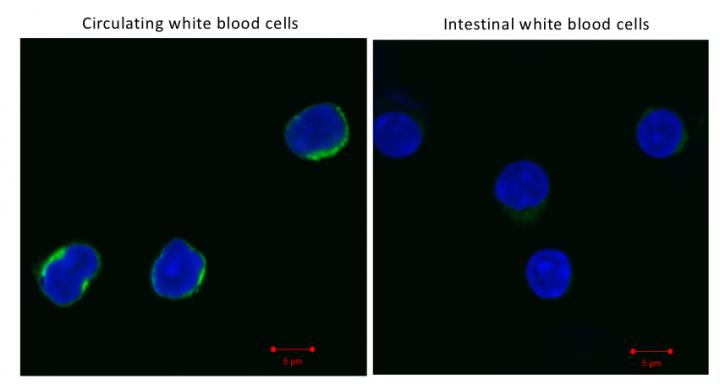
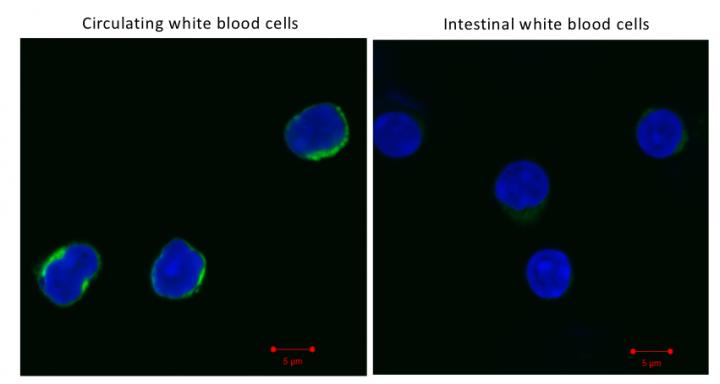
Credit: Špela Konjar, iMM.
Every day the human gut works on a fine-tuned balance that ensures the retention of essential nutrients while it prevents the entrance of potential armful microbes. Contributing to this surveillance system is a specialised group of immune cells that are held back due to unknown reasons although they have many characteristics of activated cells. Now, a new study led by Marc Veldhoen, group leader at Instituto de Medicina Molecular João Lobo Antunes (iMM; Portugal) shows how these cells are kept under control. The work published now in Science Immunology, reveals that the "batteries" of these cells have a different composition that reduces their capacity of producing energy, keeping them in a controlled activated mode. This knowledge can give rise to new diagnostics and treatments for conditions affecting the digestive track such as gut inflammations or infections.
The outer layer of our bodies, the skin and intestine, contains a special population of white blood cells, called intraepithelial lymphocytes. It is largely unknown how the activity of these cells is controlled, not fully activated nor at rest. Using imaging and biochemical experiments, the research group led by Marc Veldhoen has now shown this is, at least in part, due to differences in the cells' "batteries" – the mitochondria. These energy-producing structures are present inside our cells regulate the cell's power. "We hypothesised that these gut-resident white blood cells may use energy in a different way. It was surprising to see that the detection of mitochondria gave a very different picture than seen in other white blood cells, forming the basis of a new hypothesis that the mitochondria themselves are different in these cells", explains Marc Veldhoen.
Using high magnification electron microscopy, the researchers observed that the mitochondria were present in abundance but seem to be different upon staining for light microscopy. Next, they studied the functionality of these batteries. "When we analysed in detail these structures, we found changes in the lipids that form a layer separating the mitochondria from the rest of the cell", says S?pela Konjar, joint first author of the study, adding that "these changes make the "batteries" work differently, as if they are in a "low energy mode".
When the lipid landscape was purposely altered, the researchers confirmed a change in the activation potential of the cells. "Our results showed that lipids in the mitochondria of these cells could alter their metabolic state and change their activity. When the mitochondrial lipids could not be arranged similar to those found in other white blood cells, the cells could not be properly activated when needed", explains Marc Veldhoen. The researcher further explains: "This knowledge allows us to investigate how we can inhibit these cells when they are too active and cause damage, such as in gut inflammations, or how we can activate them more in cases of gut infections. Furthermore, the detection of mitochondria could be a diagnostic marker for the activation state of intestinal white blood cells".
###
This work was performed at the iMM (Portugal) and at the Babraham Institute (UK) with collaborations at Chicago University (USA). It was funded by the European Research Council, the Biotechnology and Biological Sciences Research Council, Horizon 2020 "EXCELLtoINNOV", National Institutes of Health, FEDER through POR Lisboa 2020-Programa Operacional Regional de Lisboa, PORTUGAL 2020, and Fundacao para a Ciencia e a Tecnologia.
*Konjar, S., Frising, U.C., Ferreira, C., Hinterleitner, R., Mayassi, T., Zhang, Q., Blankenhaus, B., Haberman, N., Loo, Y., Guedes, J., Baptista, M., Innocentin, S., Stange, J., Strathdee, D., Jabri, B., Veldhoen, M. (2018) Mitochondria maintain controlled activation state of epithelial-resident T lymphocytes. Sci. Immunol. 3, eaan2543. doi – 10.1126/sciimmunol.aan2543.
Media Contact
Inês Domingues
[email protected]
351-964-128-275
https://imm.medicina.ulisboa.pt/en/
Related Journal Article
http://dx.doi.org/10.1126/sciimmunol.aan2543