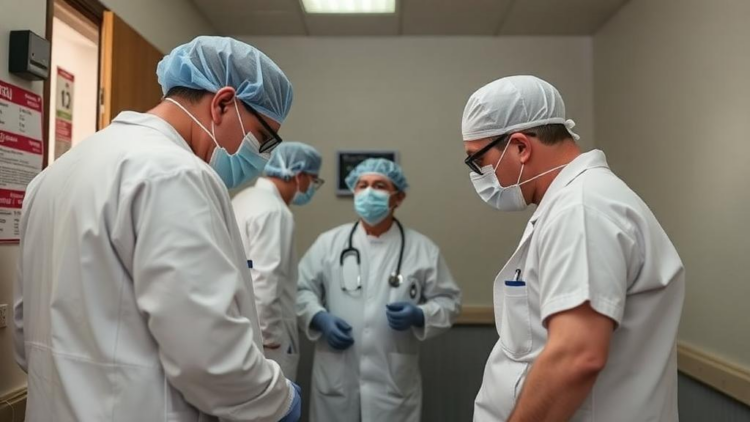
In the early hours of 6 February 2023, a sequence of powerful earthquakes struck southern Türkiye, killing tens of thousands of people and shattering the infrastructure of an entire region. Hospitals were damaged, supply chains collapsed, and healthcare workers were thrust into roles that no curriculum had fully prepared them for. Among those on the front lines were family medicine resident physicians, young doctors still in training who suddenly found themselves caring for the injured while simultaneously worrying about their own families, their own homes, and their own survival. A new qualitative study published in BMC Health Services Research offers an unusually intimate window into what those weeks and months actually felt like from the inside, and its findings challenge long-held assumptions about what disaster preparedness really means.
The research, led by Zeliha Yelda Özer of Çukurova University Faculty of Medicine in Adana, together with colleagues from medical education, public health, and biostatistics, took a deliberately interpretive approach. Rather than measuring outcomes with surveys or checklists, the team conducted semi-structured, in-depth interviews with twenty family medicine resident physicians at a university hospital in Adana, a city close enough to the epicenters to feel the full force of the disaster yet far enough to serve as a major receiving center for the wounded. Interviews began on 19 January 2024 and continued until 7 January 2025, a timeline that allowed residents to reflect on their experiences after the most acute phase of the crisis had passed.
Methodologically, the study is grounded in hermeneutic phenomenology, a tradition that asks not simply what happened to people, but how they made sense of what happened. Each interview was audio-recorded and transcribed verbatim, then examined using thematic analysis within that interpretive orientation. The authors were careful about rigor in ways that matter for qualitative work: they practiced investigator reflexivity, meaning they explicitly examined how their own backgrounds and assumptions might shape interpretation; they kept field notes; they discussed emerging interpretations as a team; they returned findings to participants for validation; and they used bilingual checking to ensure that nuances survived the translation between Turkish and English. Reporting followed the Consolidated Criteria for Reporting Qualitative Research, the international standard for transparency in interview-based studies. Ethical approval came from the Çukurova University Faculty of Medicine Ethics Committee, and all participants gave written informed consent.
From this material, the researchers developed two main themes. The first they describe as existential disruption and contested professional duty. The second traces a movement from clinical unpreparedness toward systemic reappraisal. Together, these themes capture a psychological arc that is rarely acknowledged in disaster medicine literature: the collapse of the assumed boundary between the person who helps and the person who needs help. Residents described how threats to their own safety and to the safety of their families destabilized the very foundations of what they believed professional duty required. The implicit contract of medicine, that the clinician stands steady while the patient suffers, broke down when the clinician was also shaking, grieving, and uncertain whether loved ones had survived.
This dual identity, survivor and provider at once, is the conceptual heart of the study. Disaster planning in most health systems treats staff as resources to be deployed, not as members of the affected population. The residents’ accounts suggest that this framing is not only incomplete but potentially harmful. A physician who cannot reach their family, who does not know whether their apartment building will stand, and who is simultaneously asked to triage earthquake victims is navigating an ethical and emotional terrain for which no lecture hall prepares them. The study found that these competing demands did not merely cause stress; they forced residents to question what duty even means when the duty-holder is himself a casualty of the same event.
The second theme documents a more constructive transformation. Confronted with unfamiliar clinical assignments and disrupted organizational systems, residents began to redefine what competent disaster practice actually looks like. Instead of picturing competence as a body of theoretical knowledge memorized in training, they came to see it as something embodied, distributed across teams, and dependent on ethical support from the institution. In other words, the disaster taught them that resilience in medicine is less about individual heroism and more about collective function: knowing how to work with strangers, how to improvise within broken systems, and how to sustain each other morally when standard protocols no longer apply.
For readers outside medicine, the technical significance of this reframing is worth unpacking. Traditional disaster preparedness curricula emphasize knowledge transfer: mass casualty triage categories, incident command structures, infection control in field conditions. These remain necessary, but the Adana findings indicate they are not sufficient. Competence under catastrophe, as the residents experienced it, involves tacit, embodied skills, the ability to keep working while exhausted and frightened, to communicate across professional hierarchies that have themselves been disrupted, and to make ethically fraught decisions, such as allocating scarce resources, without clear guidance. Those skills are relational and contextual, which means they cannot be assessed by written examination alone.
The study’s conclusions translate directly into policy recommendations. The authors argue that disaster preparedness for resident physicians should combine practical training with psychological support and, crucially, with workforce policies that explicitly recognize clinicians may also be disaster survivors. That recognition has concrete implications: hospitals might plan for staff who need to locate family members before reporting for duty, provide childcare and shelter for personnel, rotate staff to prevent burnout, and embed mental health professionals within disaster response teams rather than offering counseling only after the fact. The findings also suggest that debriefing and peer support should be treated as core components of disaster response infrastructure, not optional extras.
It is equally important to note the boundaries of what this study can claim. As an interpretive phenomenological investigation conducted at a single university hospital, its purpose is depth of understanding rather than statistical generalization. Twenty residents in Adana cannot represent every clinician in every disaster. The authors themselves state that transferability to other settings should be judged in light of local health-system and disaster contexts. Still, the mechanisms they describe, the destabilization of professional identity when the helper becomes the victim, and the shift from individual to team-based conceptions of competence, are likely to resonate wherever disasters strike populated areas with functioning hospitals, from seismic zones to flood plains to regions affected by conflict.
The 2023 Türkiye earthquake was one of the deadliest seismic events of the modern era, and the international response, acknowledged by the study’s authors with gratitude to volunteer responders and medical teams from around the world, demonstrated both the power and the fragility of collective humanitarian action. What this research adds is a quieter, more personal layer to that story: the testimony of young physicians who stood at the intersection of catastrophe and care. Their experiences suggest that the next generation of disaster preparedness must be designed for whole human beings, professionals who grieve, fear, and doubt even as they work. If health systems take that lesson seriously, the residents of Adana may have contributed not only to the survival of their patients, but to a fundamental redesign of how medicine trains and protects its own.
Subject of Research: Experiences of family medicine resident physicians providing care during the 2023 Türkiye earthquake
Article Title: Experiences of family medicine resident physicians at a university hospital during the 2023 Türkiye earthquake: a qualitative study
Article References: Özer, Z. Y., Okyar, Ç., Yüce, S., Boz, A., & Arslan, Y. K. (2026). Experiences of family medicine resident physicians at a university hospital during the 2023 Türkiye earthquake: a qualitative study. BMC Health Services Research. https://doi.org/10.1186/s12913-026-15755-w
Image Credits: AI Generated
DOI: 10.1186/s12913-026-15755-w
Keywords: disaster medicine, family medicine, resident physicians, Türkiye earthquake, qualitative research, interpretive phenomenology, professional identity, disaster preparedness, health services research, psychological support, primary care, medical education
Cite Scienmag News
APA MLA Chicago
Violet Maxwell. (October 4, 2026). When Doctors Are Also Survivors: Inside the Minds of Residents During the 2023 Türkiye Earthquake. Scienmag. https://scienmag.com/when-doctors-are-also-survivors-inside-the-minds-of-residents-during-the-2023-turkiye-earthquake/
Violet Maxwell. “When Doctors Are Also Survivors: Inside the Minds of Residents During the 2023 Türkiye Earthquake.” Scienmag, 4 October 2026, https://scienmag.com/when-doctors-are-also-survivors-inside-the-minds-of-residents-during-the-2023-turkiye-earthquake/. Accessed 4 October 2026.
Violet Maxwell. “When Doctors Are Also Survivors: Inside the Minds of Residents During the 2023 Türkiye Earthquake.” Scienmag. October 4, 2026. https://scienmag.com/when-doctors-are-also-survivors-inside-the-minds-of-residents-during-the-2023-turkiye-earthquake/
Copy citation Download RIS
Tags: disaster medicinedisaster preparednessdisaster response in healthcarefamily medicinefamily medicine residents earthquake preparednesshealth services researchhealthcare system resilience in Türkiye earthquakehealthcare workers mental health during earthquakeshospital infrastructure damage in Türkiye earthquakeimpact of earthquakes on medical traininginterpretive phenomenologyMedical Educationmedical education in crisis zonesmental health support for doctors after disastersphysician experiences during natural disastersphysicians’ personal and professional challenges during earthquakesprimary careprofessional identityPsychological Supportqualitative insights into disaster healthcare experiencesqualitative researchqualitative research on disaster medicineresident physiciansTürkiye earthquake