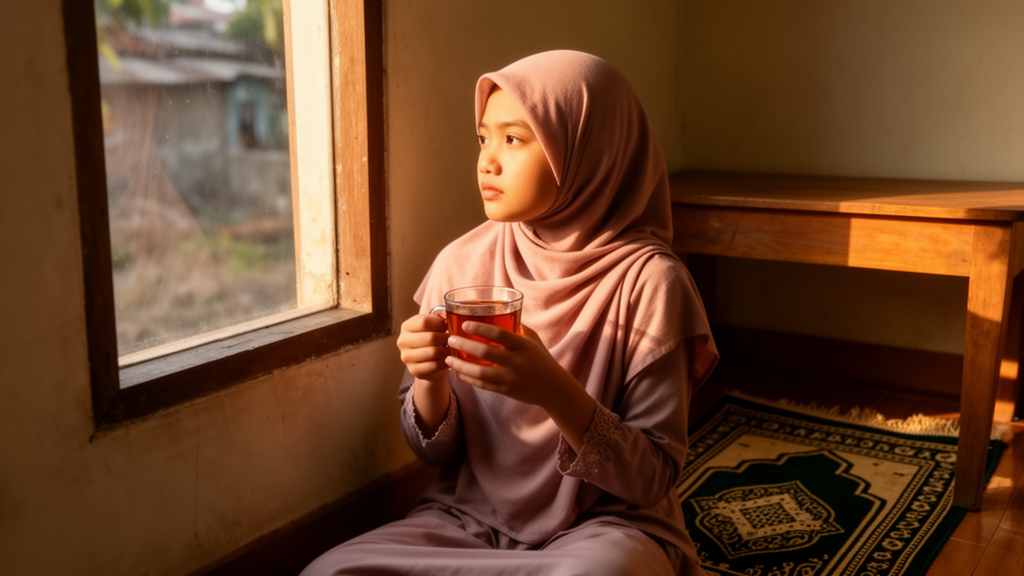
Parental divorce is usually studied as a psychological event, measured in symptom questionnaires and adjustment scores. A new qualitative study from Indonesia suggests that for adolescent girls in the world’s largest Muslim-majority country, it is something far more layered: a private loss that becomes a public, moral experience, filtered through religious language, family reputation, and the sting of a label classmates use as an insult. The research, published in Frontiers in Child and Adolescent Psychiatry, offers one of the most detailed phenomenological accounts to date of how faith, stigma, and family obligation intertwine in the aftermath of a parents’ separation.
The study was led by Slametiningsih, a doctoral researcher at the Faculty of Nursing, Universitas Indonesia, together with colleagues Achir Yani S. Hamid, Mustikasari Mustikasari, and Raden Irawati Ismail. The team interviewed fifteen Muslim girls aged fourteen and fifteen, all enrolled in a junior high school in Bekasi City, part of the Greater Jakarta metropolitan area. Each participant had experienced parental divorce at least one year before the interview, ensuring that the initial shock had settled into lived, ongoing experience. The girls lived in varied post-divorce arrangements: eight lived with their mothers, three with grandmothers, two with fathers, and two with extended family.
The methodological approach was Interpretative Phenomenological Analysis, or IPA, a qualitative framework designed to capture how people make sense of significant life events rather than how frequently outcomes occur across a population. Semi-structured, face-to-face interviews lasting forty-five to sixty minutes were conducted in Bahasa Indonesia by a trained female researcher with no teaching role at the school, in a private room to protect confidentiality. Interviews were audio-recorded, transcribed verbatim, and analyzed case by case before cross-case themes were developed. Two researchers independently reviewed transcripts and negotiated consensus, reflexive journals documented the researchers’ own assumptions about divorce, Islam, and gender, and member checking with three participants confirmed the resonance of the final themes. The study was reported against the COREQ checklist and approved by an ethics committee, with parental consent and adolescent assent obtained for every participant.
The analysis produced four superordinate themes. The first concerned the internal work of negotiating loss and self-acceptance after family rupture. The girls did not describe divorce as an event that ended when the household changed. It resurfaced in birthdays, school ceremonies, and quiet evenings. One participant recalled waiting months for her father to return after he left. Another described how school events made the absence visible: she pretended not to care about assemblies, she said, but she noticed which classmates had both parents there. Self-blame emerged even among girls who intellectually understood the divorce was an adult decision. One girl stopped playing basketball because she felt she no longer deserved to have fun, reasoning that if she suffered enough, her parents would see how much the separation hurt. Another captured the gap between understanding and healing with striking precision: she had, she said, two brains, one that understands and one that still hurts.
School itself became a double-edged space. For some girls, academic performance declined when grief became overwhelming. For others, achievement functioned as emotional refuge and a way of reclaiming dignity. One participant explained that getting top marks was her way of saying she was not part of her parents’ battle. The authors argue that schoolwork in these accounts was not merely educational activity but a site where distress appeared and where control and self-worth could be rebuilt, a nuance they suggest counselors should recognize before interpreting either falling grades or perfectionism in simplistic terms.
The second theme, relational ecosystems as both protection and vulnerability, showed that relationships rarely protected or harmed in isolation; they often did both at once. Reliable adults helped stabilize girls whose home lives felt uncertain. One participant described an adult who helped her with schoolwork and told her that whether her parents were together would not change what she could achieve. But parental remarriage could intensify feelings of displacement. One girl said a new baby seemed to receive all the love, as if her mother were starting over with a better family. Peers with divorced parents offered powerful validation through shared experience, while other peers weaponized the situation. When older students learned one participant’s father had left, they taunted that it was no wonder he did not want her. The phrase broken home, the authors note, functioned not as description but as stigma, deepening shame and social withdrawal.
The third theme traced a developmental arc from reactive survival toward purposeful autonomy. Early coping often took the form of escape: one girl locked herself in her room scrolling for hours because, online, nobody knew her family was damaged. Over time, some participants developed more deliberate strategies, learning to distinguish harmful conversations from safe ones. One said she no longer avoided family time completely, only the conversations that felt like picking scabs. Future orientation, meanwhile, depended heavily on family stability. Girls with reliable adult support could imagine university and future work; those living with unresolved arrangements found planning suspended. One participant wanted to attend university but could not think about next year when she did not know which parent she would be living with. The authors suggest that withdrawal in such adolescents should not automatically be read as indifference; it may be an attempt to maintain psychological safety.
The fourth and most culturally distinctive theme concerned Islamic meaning-making. Religious values appeared less as formal doctrine than as everyday expectations: respecting parents, avoiding harsh speech, protecting family dignity, being patient, and praying. These expectations shaped both how the girls interpreted divorce and how freely they could speak about pain. Calls to be patient, or sabr, could comfort, but when offered without listening they could silence distress. One girl said people simply told her to be patient, as though that solved anything. Filial respect constrained the expression of anger: one participant said she was angry but could not say it openly, because her father was still her father and she had been taught children must respect parents even when hurt. Yet faith also supplied endurance and hope. One girl described praying at night, asking God to make her heart stronger and trying to be patient because the divorce might be a test. The authors emphasize that religion in these accounts was ambivalent rather than uniformly protective or harmful, consistent with religious coping theory, which holds that faith can provide meaning and hope while also contributing to struggle when adversity is interpreted through guilt or moral failure.
The findings arrive against a backdrop of substantial family transition in Indonesia. Official statistics recorded 291,677 divorce cases in 2020, rising to 447,743 in 2021 and 516,344 in 2022, before declining to 463,654 in 2023 and 394,608 in 2024. West Java, where Bekasi is located, recorded 88,842 divorce cases in 2024, with 6,398 records in Kota Bekasi alone. The authors caution that these figures do not mean every adolescent in a divorced family experiences psychological difficulty, but they underline the scale on which family change intersects with adolescent development. Longitudinal evidence from the Netherlands and other contexts indicates that internalizing and externalizing problems can increase after parental divorce and persist into adulthood for some young people, while Indonesian studies have documented loss, confusion, self-blame, and resilience.
The practical implications are deliberately context-specific. The authors do not argue that secular, Western-derived counseling models are unsuitable for Indonesian Muslim adolescents; rather, they suggest such approaches may feel culturally distant when they ignore filial respect, family dignity, and religious language. They advocate an integrative option: retain evidence-based psychological counseling skills while adapting communication and, where the adolescent wishes, incorporating culturally and religiously meaningful resources, always voluntarily and non-coercively. School counselors, they propose, should provide confidential pathways for disclosure that avoid stigmatizing labels, watch for subtle signals such as withdrawal, irritability, or achievement used to regain control, and begin by asking what meanings each student attaches to family, religion, and divorce. Parents, meanwhile, are encouraged to listen before advising, to frame patience as an active capacity to endure difficulty while seeking support rather than an instruction to stop talking, and to reassure children that the separation is not their responsibility. The study’s limitations are clear: a single school, a homogeneous sample of Muslim girls, self-reported experiences, and a cross-sectional design that cannot track change over time. But its central message travels beyond Bekasi. Adolescent well-being after divorce is not only an emotional process; it is relational, cultural, and religious, and support that fails to see all three dimensions may miss the girls who need it most.
Subject of Research: Psychological well-being and Islamic cultural meaning-making among Indonesian Muslim adolescent girls after parental divorce
Article Title: Faith, family, and stigma after parental divorce: psychological well-being among Indonesian Muslim adolescent girls
Article References: Slametiningsih, S. Hamid, A. Y., Mustikasari, M., & Ismail, R. I. (2026). Faith, family, and stigma after parental divorce: psychological well-being among Indonesian Muslim adolescent girls. Frontiers in Child and Adolescent Psychiatry, 5, Article 1928639. https://doi.org/10.3389/frcha.2026.1928639
Image Credits: AI Generated
DOI: 10.3389/frcha.2026.1928639
Keywords: parental divorce, adolescent mental health, Indonesia, Muslim adolescents, interpretative phenomenological analysis, religious coping, stigma, psychological well-being, school counseling, qualitative research, family relationships, cultural adaptation
News Source: Ophelia Keating. (October 16, 2026). When Divorce Becomes a Moral Label: Indonesian Muslim Teenage Girls Describe Life After Parents Split. Scienmag.