Some animals release chemical pheromones which can trigger behavioral or hormonal changes in other animals. It is known that calm rats can reduce the fear of nearby rats, but the exact mechanism was unknown. Researchers, including those from the University of Tokyo, have found the pheromone responsible and demonstrated its effect both on lab rats and rats in the human environment. Their findings could lead to a new kind of humane pest control.
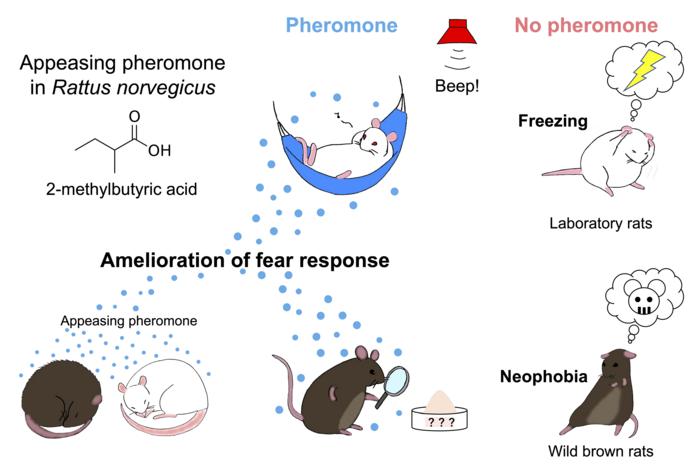
Credit: ©2023 Kiyokawa et al. CC-BY-ND
Some animals release chemical pheromones which can trigger behavioral or hormonal changes in other animals. It is known that calm rats can reduce the fear of nearby rats, but the exact mechanism was unknown. Researchers, including those from the University of Tokyo, have found the pheromone responsible and demonstrated its effect both on lab rats and rats in the human environment. Their findings could lead to a new kind of humane pest control.
Associate Professor Yasushi Kiyokawa from the University of Tokyo’s Laboratory of Veterinary Ethology and his colleagues are big fans of rats. They find them fascinating to study, partly due to their relatively high intelligence which, in some ways, even allows them to stand in for humans in certain studies on social interactions.
“I believe that by studying the social lives of rats, we might actually uncover something about human social interactions as well,” said Kiyokawa. “That is one of the motivations behind our latest research topic, which explores in more details than ever before, an observed phenomenon where rats can affect the emotional state of others around them.”
It has been known for some time that, within the same species, rats which are in a relaxed state can imbue a similar state in nearby rats. Essentially, they can calm each other down without any direct interaction. This is due to pheromones, biological compounds in the air, released from the relaxed rat and received by the scared rat, altering their state. But the nature of the pheromones involved was unknown until now.
“To isolate the pheromones involved in this intra-species calming phenomenon, we needed to be careful about how we tried to collect them,” said Kiyokawa. “If we stressed out the rat too much, it would likely affect what pheromones it released. So, we had to be creative and come up with a way to collect pheromones from a relaxed rat. We did this by putting a calm rat to sleep and used water to absorb pheromones from its neck.”
The main pheromone the team found released by relaxed rats was 2-methylbutyric acid (2-MB), which is incidentally found in the aromas of cheese and wine. They first determined this was what they were seeking by making sure it did indeed reduce the fear in other lab rats. Then they laced one of two identical small chambers with 2-MB to see if the rats would show any preference toward either, which they did. This directly showed that rats felt comfortable to sniff the pheromone. Given the striking effect it seemed to have, the team also wanted to see if it would work on wild rats in urban environments.
“We tested at two different locations to see if wild rats would respond to 2-MB,” said Kiyokawa. “They responded similarly to our lab rats. Synthetic 2-MB reduced their fear of novel things, or neophobia. This is important because it’s neophobia in urban rats that makes producing effective traps so difficult.”
Based on their results, the team believe that 2-MB could be used to create a form of humane pest control. It could be used to lure urban rats into nonlethal traps and also keep them calm while they’re being transported out of the urban environment.
###
Journal article: Yasushi Kiyokawa, Shigeyuki Tamogami, Masato Ootaki, Evelyn Kahl, Dana Mayer, Markus Fendt, Satoru Nagaoka, Tsutomu Tanikawa, and Yukari Takeuchi. “An appeasing pheromone ameliorates fear responses in the brown rat (Rattus norvegicus)”, iScience. DOI: https://doi.org/10.1016/j.isci.2023.107081
Funding:
This study was supported by JSPS KAKENHI Grant Numbers JP20H03160 and JP19H00967.
Useful links:
Graduate School of Agricultural and Life Sciences – https://www.a.u-tokyo.ac.jp/english/
Research contact:
Associate Professor Yasushi Kiyokawa
Laboratory of Veterinary Ethology, Graduate School of Agricultural and Life Sciences,
The University of Tokyo, 1-1-1 Yayoi, Bunkyo-ku, Tokyo 113-8657, Japan
[email protected]
Press contact:
Mr. Rohan Mehra
Public Relations Group, The University of Tokyo,
7-3-1 Hongo, Bunkyo-ku, Tokyo, 113-8656, Japan
[email protected]
About The University of Tokyo: The University of Tokyo is Japan’s leading university and one of the world’s top research universities. The vast research output of some 6,000 researchers is published in the world’s top journals across the arts and sciences. Our vibrant student body of around 15,000 undergraduate and 15,000 graduate students includes over 4,000 international students. Find out more at www.u-tokyo.ac.jp/en/ or follow us on Twitter at @UTokyo_News_en.
Journal
iScience
DOI
10.1016/j.isci.2023.107081
Method of Research
Experimental study
Subject of Research
Animals
Article Title
An appeasing pheromone ameliorates fear responses in the brown rat (Rattus norvegicus)
Article Publication Date
21-Jun-2023