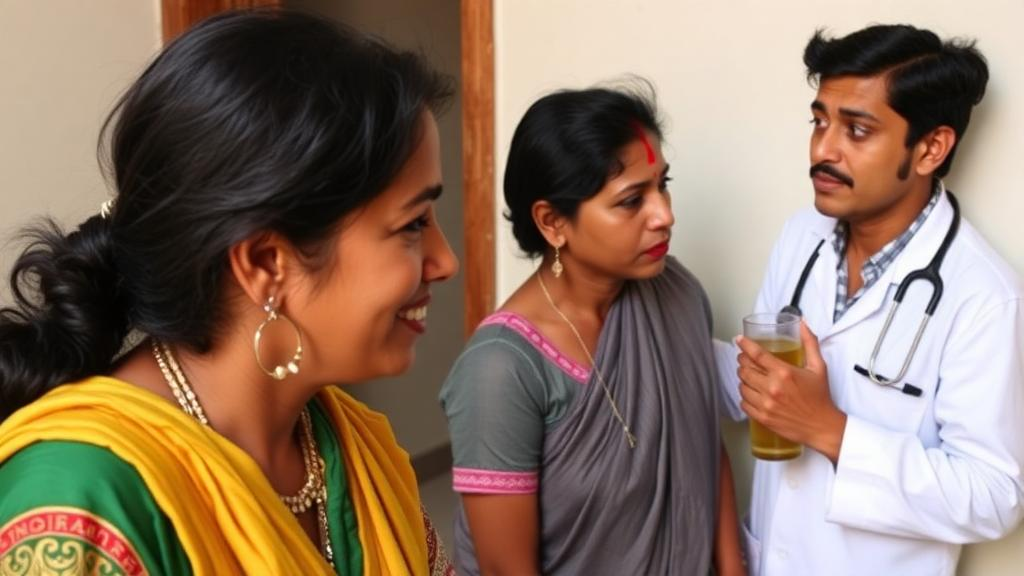
For millions of married women in India, the decision to see a doctor is not simply a matter of need, money, or distance. It can hinge on something far less obvious: whether the man they live with drinks alcohol. A new analysis of national survey data, published in BMC Health Services Research, suggests that a husband’s drinking is a measurable, statistically robust predictor of whether a woman reports barriers to healthcare access, and that state-level alcohol policies may soften, but not erase, that association.
The study, conducted by Deepak Kumar of the Indian Institute of Technology Roorkee and Manzoor Malik of the University of Liverpool’s Institute of Population Health, draws on the fifth round of India’s National Family Health Survey, known as NFHS-5. This large, nationally representative household survey is one of the most detailed portraits of Indian family life available to researchers, capturing information on fertility, nutrition, household economics, and health-seeking behaviour. From it, the authors assembled a sample of 46,154 currently married women, a figure large enough to detect even modest effects while adjusting for a wide range of individual, partner, and household characteristics.
The headline numbers are striking on their own. Roughly 42 percent of the women in the sample reported at least one barrier to accessing healthcare services, whether that barrier was permission to seek care, money for treatment, distance to a health facility, or the logistics of getting there. Meanwhile, about 27 percent of the women had partners who consumed alcohol. When the researchers cross-tabulated these two facts and then modelled them formally, the relationship held: women whose partners drank had significantly greater odds of reporting barriers to care than women whose partners did not.
The statistical machinery behind that conclusion is a logistic regression, a standard tool for modelling binary outcomes such as whether a woman did or did not report a barrier. In this framework, the effect of partner drinking is expressed as an odds ratio, a number that describes how the odds of the outcome change with the exposure. Here, the odds ratio was 1.53, with a 95 percent confidence interval running from 1.19 to 1.97. Because the entire interval sits above 1, the finding is conventionally regarded as statistically significant, and the magnitude implies that partner alcohol use is associated with roughly a fifty percent increase in the odds of a woman reporting an access barrier, once other measurable factors are held constant.
That last clause matters enormously. Alcohol use rarely travels alone; it clusters with poverty, lower education, and other disadvantages that independently shape health access. The authors therefore adjusted their models for a battery of covariates spanning the woman’s own characteristics, her partner’s characteristics, and household conditions. The persistence of the alcohol association after these adjustments is what elevates the finding from a simple correlation to a candidate behavioural determinant in its own right. It suggests that male partner drinking is not merely a proxy for household hardship but a distinct factor woven into the everyday negotiation of whether, when, and how a woman can reach care.
The study’s second major contribution is its attention to policy context. India is unusual in that several states have experimented with alcohol prohibition, and the researchers exploited this variation to ask whether the policy environment modifies the relationship between partner drinking and healthcare access. Their analysis found that women living in states with prohibition policies had lower odds of reporting barriers to care, with an odds ratio of 0.94 and a confidence interval of 0.88 to 0.99. The effect is modest, and the confidence interval sits close to the null value of 1, but it points in a consistent direction: environments that restrict alcohol availability appear to be associated with slightly fewer reported access barriers for women.
Interpreting that policy finding requires care. Prohibition policies are not randomly assigned across states; they emerge from particular political, religious, and social histories, and states that adopt them may differ in unmeasured ways from those that do not. The authors are appropriately measured in their language, describing the result as suggesting some policy effect rather than proving one. Still, the finding is provocative because it reframes alcohol control as a women’s health intervention. If restricting alcohol availability reduces problematic drinking in households, and if that in turn eases the constraints women face in seeking care, then alcohol policy becomes a lever for gender equity in health, not merely a public order measure.
The mechanisms connecting a partner’s drinking to a woman’s healthcare access are not directly observed in this dataset, but the plausible pathways are well recognised in the broader literature on gender and health. Alcohol misuse is associated with household financial strain, diverting resources that might otherwise pay for transport, fees, or medicines. It is also strongly linked to intimate partner violence, which the survey literature identifies as both a barrier to care in itself and a reason women avoid leaving home or disclosing health needs. Controlling behaviour by an intoxicated partner can restrict a woman’s autonomy to travel or to seek permission for care, a requirement that remains socially salient in many Indian households. Each of these channels is consistent with the pattern the authors report, even though the study design cannot isolate which one dominates.
What makes the research notable is its placement within the field of health services research. Barriers to healthcare access have traditionally been studied through structural lenses, such as the density of facilities, the cost of services, and the availability of transport, or through socio-cultural lenses, such as caste, class, and gender norms. Behavioural factors rooted in male partner characteristics have remained, as the authors put it, largely underexplored. By quantifying the contribution of one such factor using a survey of more than 46,000 women, the study adds a behavioural variable to a policy conversation that has often been dominated by infrastructure and financing. It implies that programmes aimed at improving women’s health in India may underperform if they ignore the household dynamics in which healthcare decisions are embedded.
The practical implications reach policymakers, public health planners, and community health programmes alike. The authors conclude that interventions targeting both partner behaviour and the policy environment may be critical to reducing barriers to healthcare access in India. That could mean alcohol harm-reduction programmes designed with household wellbeing in mind, screening and support services that recognise the spillover effects of male drinking on women’s health-seeking, and continued evaluation of state alcohol policies with women’s healthcare access as an explicit outcome. With 42 percent of married women in the sample reporting at least one barrier, the scale of the problem is far too large for any single intervention, but identifying partner alcohol use as a significant, modifiable correlate gives India’s health system a new and concrete target in its effort to bring care within reach of every woman.
Subject of Research: The association between male partner alcohol use and women's barriers to accessing healthcare services in India
Article Title: Partner alcohol use and women’s access to healthcare services in India
Article References: Kumar, D., & Malik, M. (2026). Partner alcohol use and women’s access to healthcare services in India. BMC Health Services Research. https://doi.org/10.1186/s12913-026-15364-7
Image Credits: AI Generated
DOI: 10.1186/s12913-026-15364-7
Keywords: healthcare access, partner alcohol use, India, NFHS-5, women's health, logistic regression, odds ratio, alcohol prohibition policy, intimate partner characteristics, health services research, gender equity, public health
News Source: Ophelia Keating. (October 8, 2026). When a Husband Drinks, Indian Women Struggle to Reach a Doctor, Massive Survey Finds. Scienmag.