Wheat feeds billions of people, but the hidden half of the plant—the root system that anchors it and draws water and nutrients from the soil—has long remained one of the most difficult traits for scientists to study and breeders to improve. Now, a team of Danish researchers has revealed that the deepest soil layers hold the strongest genetic signal for differences in wheat rooting, a finding that could reshape how plant scientists and breeders search for varieties capable of withstanding drought and capturing resources far below the surface.
The study, published in the journal Plant Methods, draws on five years of phenotypic data collected at the RadiMax semi-field facility, a unique experimental platform in Denmark designed specifically to observe deep root systems under controlled conditions. Across those years, researchers recorded root observations each June from 1,500 rows of plants, capturing root intensity throughout the soil profile from 0.6 meters down to 2.6 meters. In total, 513 winter wheat cultivars were grown in the facility during the experiment, and 409 of them were genotyped using SNP chips, allowing the team to connect visible differences in root growth with underlying genetic variation.
Root traits have long frustrated geneticists. Unlike simple plant characteristics governed by one or a few genes, root architecture is typically controlled by many genes, each contributing a small effect, and the resulting measurements often show low heritability—meaning that only a modest fraction of the observed variation between plants can be attributed to genetic differences rather than environmental noise. This makes breeding for deeper, more efficient roots a slow and uncertain process. Yet deep rooting matters enormously: varieties that push roots deeper into the soil profile can access water and nitrogen reserves that shallower-rooted plants never reach, a critical advantage in drought-prone environments and low-input farming systems.
To untangle this complexity, the researchers developed a statistical approach that analyzes root variation across soil depth rather than treating the root system as a single, uniform trait. The team employed depth-resolved regression models with random coefficients, a framework that allows genetic and non-genetic sources of variation to be quantified at each layer of the soil profile. The models also accounted for spatial variation between rows—differences in growing conditions across the experimental field that could otherwise masquerade as genetic effects. A key technical finding of the modeling work was that random variation within rows remained constant across depths, simplifying the statistical structure and lending confidence to the depth-specific estimates.
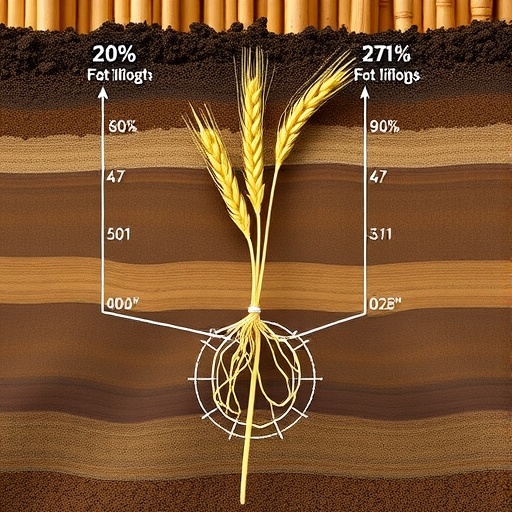
The results were striking. Genetic variance for cumulative root intensity increased substantially below 1.1 meters, and the deepest layers of the soil profile exhibited the largest differences between wheat lines. In other words, while the upper soil layers—where all varieties tend to invest heavily in roots—showed relatively little differentiation between genotypes, the deep zones revealed clear genetic distinctions. It is precisely in these hard-to-reach layers, where differences in rooting depth and intensity translate most directly into access to water and nutrients, that the strongest breeding-relevant variation was hiding.
The study also quantified heritability at each depth, providing breeders with a practical map of where measurements are most informative. Narrow-sense heritability of point measurements peaked at approximately 1.5 meters, reaching a value of about 0.13. While this remains a modest figure—consistent with the notoriously low heritability of root traits—it represents a meaningful signal, and its position at depth rather than near the surface offers a clear directive: phenotyping efforts aimed at identifying genetically superior root systems should focus their attention on the deeper soil horizons rather than on the topsoil, where environmental variation dominates the picture.
The technical achievement underlying these findings is considerable. Measuring roots in situ at depths beyond two meters is extraordinarily difficult; roots are invisible in soil, and conventional methods such as excavating or coring are labor-intensive and destructive. The RadiMax facility was built to overcome exactly these limitations, allowing researchers to observe root intensity across the full soil profile in a systematic, repeatable way. By combining this phenotyping capability with modern genomic tools—SNP chip genotyping of more than 400 cultivars—and sophisticated statistical modeling, the team has demonstrated a pipeline that can be applied to future studies of root variation in wheat and potentially other cereal crops.
The implications for breeding are significant. If the genetic differences that matter most for deep rooting are concentrated in the lower soil layers, then breeding programs that rely solely on shallow or aggregated root measurements risk discarding valuable genetic material. Selection strategies informed by depth-resolved phenotyping could identify varieties whose deep-rooting potential would otherwise go unnoticed. Moreover, the identification of a depth at which heritability peaks—around 1.5 meters in this study—gives breeders a concrete target for measurement protocols, potentially streamlining what has historically been one of the most expensive and unreliable components of crop improvement programs.
The work also speaks to a broader challenge in plant science: the genetics of complex traits. Because root traits are polygenic and low-heritability, they are prime candidates for genomic prediction approaches, in which genome-wide marker data are used to estimate the breeding value of plants that have not yet been phenotyped. The finding that genetic variance accumulates with depth suggests that genomic prediction models for root traits should explicitly incorporate the vertical dimension of root distribution, rather than treating the root system as a homogeneous entity. The depth-resolved statistical framework developed by the Danish team provides a template for how this might be done, modeling genetic and environmental effects as functions of depth rather than as single static values.
Climate change adds urgency to this line of research. Heat waves and erratic rainfall are increasingly common across the world’s wheat-growing regions, and crops with deeper, more resource-efficient root systems are widely seen as a key component of adaptation strategies. Wheat is one of the most important cereals worldwide, and even modest improvements in the efficiency with which varieties extract water and nitrogen from the soil profile could translate into meaningful gains in yield stability and reduced fertilizer dependence. The new study suggests that the genetic raw material for such improvements exists among existing wheat cultivars—but that finding it requires looking down, into the deep soil layers where conventional phenotyping rarely ventures.
The research was a collaborative effort involving the Center for Quantitative Genetics and Genomics at Aarhus University, the Department of Plant and Environmental Sciences at the University of Copenhagen, and Danish plant breeding companies including Nordic Seed A/S, Sejet Plant Breeding I/S, and DLF Seeds A/S, reflecting a partnership between academic quantitative genetics and commercial breeding expertise. The work was supported by Innovation Fund Denmark through the RadiBooster project. Bjarne Nielsen and Marta Malinowska, both of Aarhus University, share first authorship, with Just Jensen as senior author and corresponding author.
For a discipline in which the underground half of the plant has often been described as the “hidden” or “forgotten” frontier, the study offers both a methodological advance and a provocative biological conclusion: the deepest soil is not a genetic dead zone but the very place where wheat varieties reveal their most meaningful differences. As deep phenotyping facilities of this kind become more widely used, and as statistical methods like the ones developed here are adopted more broadly, the era in which roots remained invisible to breeding may finally be giving way to one in which the soil profile itself becomes a high-resolution map of genetic potential.
Subject of Research: Genetic variation in wheat root traits across soil depth, quantified using depth-resolved statistical modeling of phenotypic data from the RadiMax semi-field facility
Subject of Research: Agriculture
Article Title: Deep soil layers show the most pronounced genetic variation in wheat root length
Article References: Nielsen, B., Malinowska, M., Sarup, P., Füchtbauer, W. S., Fè, D., Odone, A., Thorup‑Kristensen, K., & Jensen, J. (2026). Deep soil layers show the most pronounced genetic variation in wheat root length. Plant Methods. https://doi.org/10.1186/s13007-026-01554-1
Image Credits: AI Generated
DOI: 10.1186/s13007-026-01554-1
Keywords: genomic prediction, wheat, root phenotyping, semi-field facility, high-throughput phenotyping, genetic variability, root intensity, soil depth, narrow-sense heritability, deep rooting
Cite Scienmag News
APA MLA Chicago
Alan Morgan. (September 9, 2026). Wheat root length shows strongest genetic variation in deepest soil layers. Scienmag. https://scienmag.com/wheat-root-length-shows-strongest-genetic-variation-in-deepest-soil-layers/
Alan Morgan. “Wheat root length shows strongest genetic variation in deepest soil layers.” Scienmag, 9 September 2026, https://scienmag.com/wheat-root-length-shows-strongest-genetic-variation-in-deepest-soil-layers/. Accessed 9 September 2026.
Alan Morgan. “Wheat root length shows strongest genetic variation in deepest soil layers.” Scienmag. September 9, 2026. https://scienmag.com/wheat-root-length-shows-strongest-genetic-variation-in-deepest-soil-layers/
Copy citation Download RIS
Tags: deep root length and plant breedingdeep soil layer root variationdeep soil root variation in wheatdrought resilience in wheatdrought-resilient wheat varietiesgenetic diversity in wheat cultivarsgenetic markers for root traitsgenetic signals in soil root layersgenotype-phenotype correlation in wheat rootsimproving wheat drought tolerance through root traitsphenotypic analysis of wheat rootsplant breeding for deep rooting traitsplant root phenotyping methodsresource capture and drought toleranceroot length genetic diversityroot system architecture in cerealssemi-field experimental platform for root studiesSNP genotyping in wheatSNP genotyping in wheat root researchsoil profile root distributionwheat root architecture under controlled conditionsWheat root system genetics