• HOME
  • NEWS
  • EXPLORE
    • CAREER
      • Companies
      • Jobs
    • EVENTS
    • iGEM
      • News
      • Team
    • PHOTOS
    • VIDEO
    • WIKI
  • BLOG
  • COMMUNITY
    • FACEBOOK
    • INSTAGRAM
    • TWITTER
Saturday, July 18, 2026
BIOENGINEER.ORG
No Result
View All Result
  • Login
  • HOME
  • NEWS
  • EXPLORE
    • CAREER
      • Companies
      • Jobs
        • Lecturer
        • PhD Studentship
        • Postdoc
        • Research Assistant
    • EVENTS
    • iGEM
      • News
      • Team
    • PHOTOS
    • VIDEO
    • WIKI
  • BLOG
  • COMMUNITY
    • FACEBOOK
    • INSTAGRAM
    • TWITTER
  • HOME
  • NEWS
  • EXPLORE
    • CAREER
      • Companies
      • Jobs
        • Lecturer
        • PhD Studentship
        • Postdoc
        • Research Assistant
    • EVENTS
    • iGEM
      • News
      • Team
    • PHOTOS
    • VIDEO
    • WIKI
  • BLOG
  • COMMUNITY
    • FACEBOOK
    • INSTAGRAM
    • TWITTER
No Result
View All Result
Bioengineer.org
No Result
View All Result
Home NEWS Science News Biology

What makes a reach movement effortful?

Bioengineer by Bioengineer
June 7, 2017
in Biology
Reading Time: 2 mins read
0
Share on FacebookShare on TwitterShare on LinkedinShare on RedditShare on Telegram
IMAGE

Credit: Thomas Steuer/ Pierre Morel

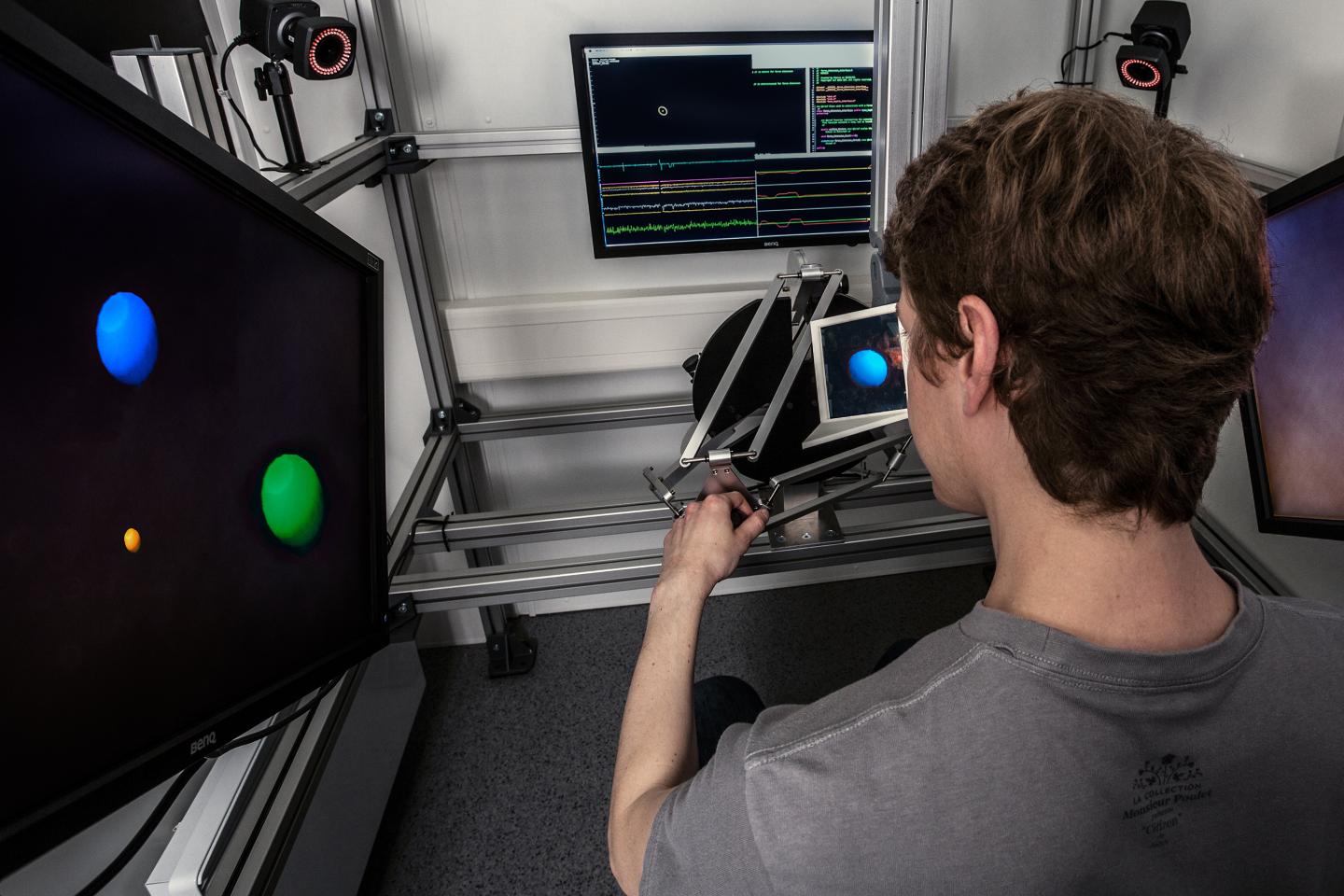
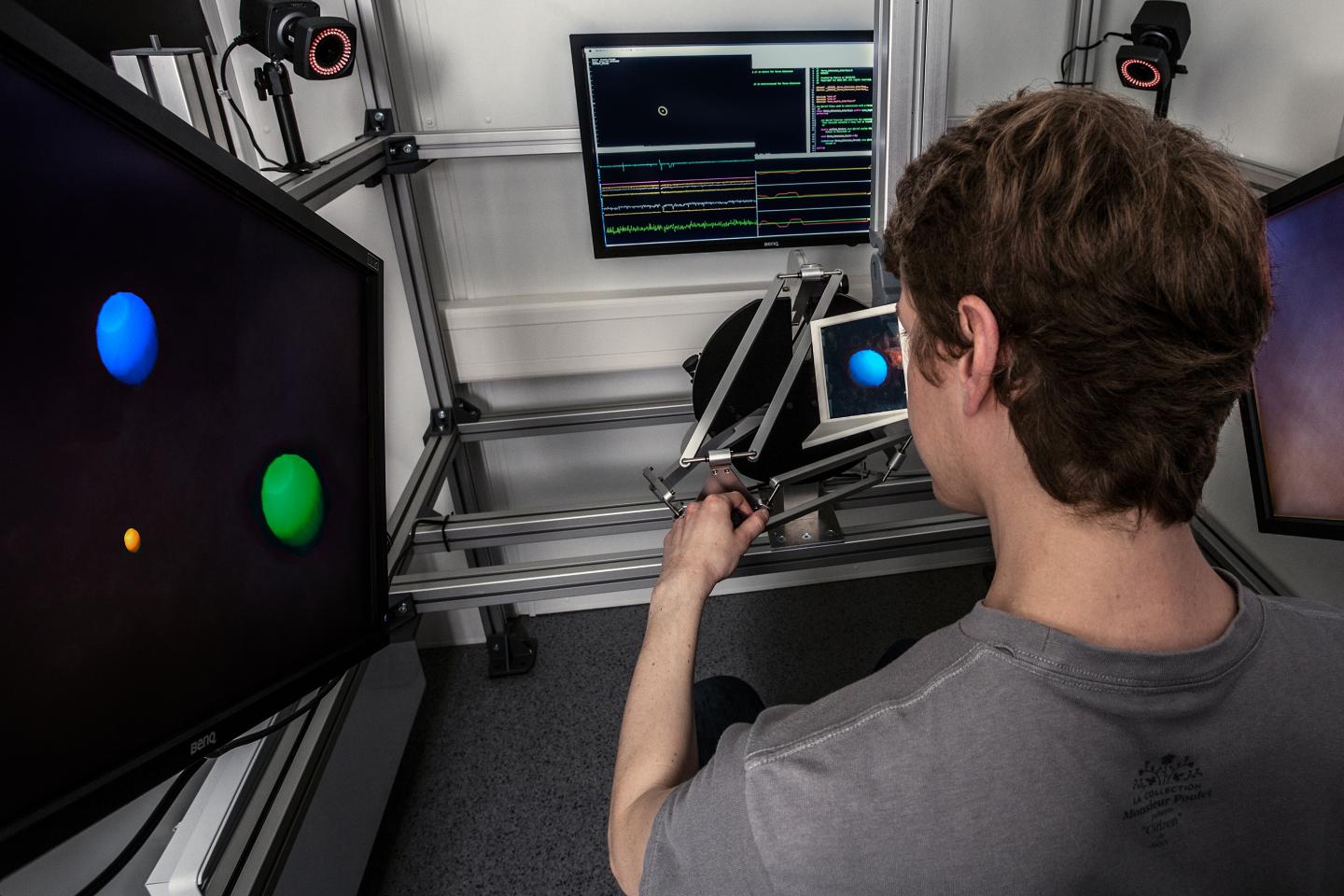
When choosing between alternative actions, we have to compare the positive outcomes of those actions and weigh them against their costs. Whether a predator hunting prey, a monkey picking fruits, or a human wavering between stairs and elevator, the physical effort associated with executing an action is a relevant cost and hence a decision factor. Understanding how we estimate movement effort is thus necessary to understand how we take decisions.

To study physical effort, human subjects were asked to repeatedly choose between arm movements which differed in amplitude or duration and in force. Not surprisingly, effort increased with the strength of a force resisting the movement. The researchers managed to quantify this dependency precisely, showing that effort was proportional to the square of that strength. Additionally, effort was higher when the movements involved weaker muscles, even for movements that necessitated only little strength. More surprisingly, Morel and colleagues showed that the distance covered by the movements did not determine effort. Instead, effort depended on the duration of the movements, with movements that lasted longer feeling more strenuous than brief movements.

"Our results allow us to estimate action-related costs in decision-making, showing they cannot easily be predicted from energetic expense", says Morel. "More than that, the results also give weight to the idea that action selection in decision-making and in movement execution have common properties and hence might be based on shared mechanisms." When a given action is executed, its goal can typically be achieved in many ways. For example, the multiple joints of the arm provide a large flexibility in how we could conduct reaches to a given target object. Nevertheless, when repeating reaches towards the same target, we tend to execute them in the same optimized way. "We conclude that previously described optimization principles during movement execution seem to also serve as guiding principles during economically motivated conscious choice before movement execution", says Alexander Gail, head of the research group. Understanding how we estimate movement effort is an important step towards understanding how we take decisions.

###

Original publication

Morel P, Ulbrich P, Gail A (2017) What makes a reach movement effortful? Physical effort discounting supports common minimization principles in decision making and motor control. PLoS Biol 15(6): e2001323. https://doi.org/10.1371/journal.pbio.2001323

Media Contact

Dr. Susanne Diederich
[email protected]
49-551-385-1359

http://dpz.eu

Related Journal Article

http://dx.doi.org/10.1371/journal.pbio.2001323

############

Story Source: Materials provided by Scienmag

Share12Tweet8Share2ShareShareShare2

Related Posts

The concealed geometry behind breeding constraints

The concealed geometry behind breeding constraints

July 18, 2026
Organic fertilizer helps biochar immobilize cadmium in contaminated soil

Organic fertilizer helps biochar immobilize cadmium in contaminated soil

July 18, 2026

Asteroid impact may have reshaped tuna evolution alongside dinosaur extinction

July 18, 2026

Wild snapdragons subtly change color to attract bees

July 17, 2026
Please login to join discussion

POPULAR NEWS

  • A painless adhesive

    49 shares
    Share 20 Tweet 12
  • Groundbreaking Discovery: New Shark Species Identified for the First Time

    34 shares
    Share 14 Tweet 9
  • 研究人员开发认知工具包,实现阿尔茨海默症早期检测

    50 shares
    Share 20 Tweet 13
  • A varied menu

    51 shares
    Share 22 Tweet 12

About

We bring you the latest biotechnology news from best research centers and universities around the world. Check our website.

Follow us

Recent News

Factors Influencing Elderly Preference for Dental Services

Frequency-Dependent Deep Brain Stimulation in Motor Thalamus Alters Speech and Swallowing

Neonatal Monocyte Iron Handling Drives Immunometabolic Responses in Sepsis

Subscribe to Blog via Email

Enter your email address to subscribe to this blog and receive notifications of new posts by email.

Join 85 other subscribers
  • Contact Us

Bioengineer.org © Copyright 2023 All Rights Reserved.

Welcome Back!

Login to your account below

Forgotten Password?

Retrieve your password

Please enter your username or email address to reset your password.

Log In
No Result
View All Result
  • Homepages
    • Home Page 1
    • Home Page 2
  • News
  • National
  • Business
  • Health
  • Lifestyle
  • Science

Bioengineer.org © Copyright 2023 All Rights Reserved.