• HOME
  • NEWS
  • EXPLORE
    • CAREER
      • Companies
      • Jobs
    • EVENTS
    • iGEM
      • News
      • Team
    • PHOTOS
    • VIDEO
    • WIKI
  • BLOG
  • COMMUNITY
    • FACEBOOK
    • INSTAGRAM
    • TWITTER
Saturday, June 27, 2026
BIOENGINEER.ORG
No Result
View All Result
  • Login
  • HOME
  • NEWS
  • EXPLORE
    • CAREER
      • Companies
      • Jobs
        • Lecturer
        • PhD Studentship
        • Postdoc
        • Research Assistant
    • EVENTS
    • iGEM
      • News
      • Team
    • PHOTOS
    • VIDEO
    • WIKI
  • BLOG
  • COMMUNITY
    • FACEBOOK
    • INSTAGRAM
    • TWITTER
  • HOME
  • NEWS
  • EXPLORE
    • CAREER
      • Companies
      • Jobs
        • Lecturer
        • PhD Studentship
        • Postdoc
        • Research Assistant
    • EVENTS
    • iGEM
      • News
      • Team
    • PHOTOS
    • VIDEO
    • WIKI
  • BLOG
  • COMMUNITY
    • FACEBOOK
    • INSTAGRAM
    • TWITTER
No Result
View All Result
Bioengineer.org
No Result
View All Result
Home NEWS Science News Health

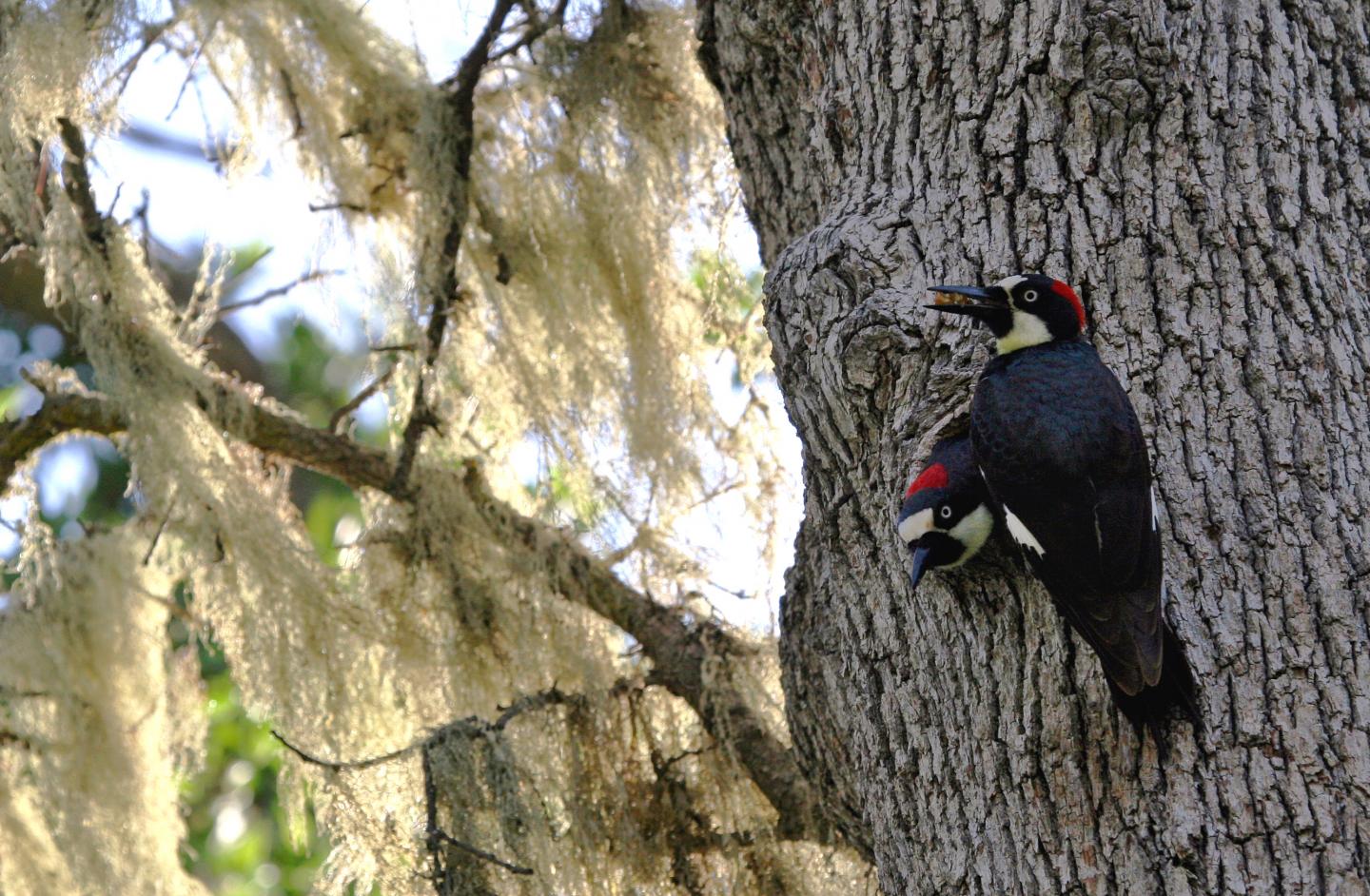
What drives multiple female acorn woodpeckers to share a nest?

Bioengineer by Bioengineer
May 2, 2019
in Health
Reading Time: 2 mins read
0
IMAGE
Share on FacebookShare on TwitterShare on LinkedinShare on RedditShare on Telegram

Study explores the possible benefits of rare behavior
IMAGE

Credit: Photo © Bruce Lyon.

Ithaca, NY–Acorn Woodpeckers live in close-knit family groups and have one of the most complex breeding systems of any bird in the world. In about 20 percent of family groups, up to 3 related females may lay eggs in the same nest. They raise the chicks cooperatively with one or more related males. This behavior is known as joint nesting or “cooperative polyandry.” Only five other species of birds worldwide are known to do this. The reasons that may be driving the behavior are outlined in a study recently published in The American Naturalist.

Lead authors Sahas Barve at Old Dominion University (Cornell Ph.D. ’17), and Cornell Lab of Ornithology scientist Walt Koenig, used demographic data collected during 35 years (1982-2016) at the Hastings Natural History Reservation in central coastal California. They analyzed the costs and benefits of joint nesting, hoping to explain why some woodpecker females exhibit this rare behavior.

They found that joint nesting was more common in years when Acorn Woodpecker population density was high, all the breeding territories were occupied, and opportunities for a female to nest on her own were very unlikely.

Although nesting with others reduces the number of offspring each female can produce compared to when she nests alone, Barve says such females make the “best of a bad situation” by nesting jointly with their mother or sister rather than not nesting at all because of the lack of real estate.

Females that decide to nest jointly do so in groups where there are two or more breeder males, thus increasing the number of caregivers and the total number of chicks that females can successfully raise. Years of population boom may have therefore been an important mechanism driving the evolution of such highly social behaviors like joint nesting among Acorn Woodpeckers.

###

Reference:
Sahas Barve, Walter D. Koenig, Joseph Haydock, and Eric L. Walters, Habitat Saturation Results in Joint-Nesting Female Coalitions in a Social Bird (2019) The American Naturalist.

Media Contact
Pat Leonard
[email protected]

Tags: BiologyDevelopmental/Reproductive BiologyPopulation Biology
Share13Tweet8Share2ShareShareShare2

Related Posts

Tracking Lanthanide-Labeled Microplastics in Plants

June 25, 2026

Neural Design Enables Zero-Shot Drug-Binding Proteins

June 25, 2026

Genomic Insights into Human Skin Fungi Diversity

June 25, 2026

Chiral Laser Gyroscopes Surpass Lock-In Limit

June 25, 2026
Please login to join discussion

POPULAR NEWS

  • Saying Goodbye to PGY-6: Pediatric Fellowship Realities

    103 shares
    Share 41 Tweet 26
  • Multi-Hospital Study Reveals Long Covid Burden Is Twice as High as Current Estimates

    92 shares
    Share 36 Tweet 23
  • Detection of EDCs in Breast Milk and Infant Urine Up to Six Months Highlights Early Exposure Risks

    77 shares
    Share 31 Tweet 19
  • New Drug Candidate Developed at McMaster Shows Potential for Treating Brain Cancer

    58 shares
    Share 23 Tweet 15

About

We bring you the latest biotechnology news from best research centers and universities around the world. Check our website.

Follow us

Recent News

Tracking Lanthanide-Labeled Microplastics in Plants

POSTECH Researchers Slash Cost of Reconstituted Cell-Free Systems by 95%

AI and Physics Collaborate to Design Advanced Hydrogen Storage Materials

Subscribe to Blog via Email

Success! An email was just sent to confirm your subscription. Please find the email now and click 'Confirm' to start subscribing.

Join 82 other subscribers
  • Contact Us

Bioengineer.org © Copyright 2023 All Rights Reserved.

Welcome Back!

Login to your account below

Forgotten Password?

Retrieve your password

Please enter your username or email address to reset your password.

Log In
No Result
View All Result
  • Homepages
    • Home Page 1
    • Home Page 2
  • News
  • National
  • Business
  • Health
  • Lifestyle
  • Science

Bioengineer.org © Copyright 2023 All Rights Reserved.