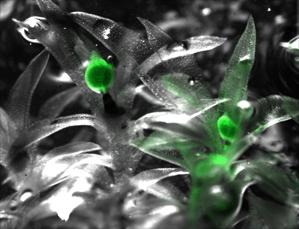

Credit: Carlos Ortiz-Ramírez.
For many years biologists have wondered why plants have so many genes coding for proteins that are known to be essential for the nervous system of animals, called glutamate receptors. Now, researchers from Instituto Gulbenkian de Ciencia (IGC, Portugal) and University of Maryland (UMD, USA) discovered a new function for those proteins, showing that moss sperm uses them to navigate its swimming towards the female organs and ensure offspring. This study will be published in Nature* on 24 July.
The team led by Jose Feijo, former group leader at the IGC and currently at UMD, has been studying the role played by glutamate receptors in plants. These proteins are key molecular players in how neurons talk inside our brain, playing a central role in memory and learning. However, plants have no neurons. Therefore why do some plants have even more genes for this kind of proteins than our own brain?
To understand how the functions of glutamate receptors (GLR) were conserved during evolution, Feijo's group focused on one of the early land plants, the moss Physcomitrella patens. Contrary to higher plants, this organism has swimming sperm and only two copies of GLR genes, which made it ideal to a genetics approach, by mutating these two genes and looking for defects.
Carlos Ortiz-Ramirez, first author of this study and graduate student at the IGC when this study began, observed that the moss had no offspring in the absence of GLRs. The research team then discovered that the moss sperm was on the basis of this sterility. While normal sperm twist and tumble and take sharp turns to find the entrance to the female organs, the sperm with mutated GLR could swim normally, but did not change direction.
The researchers further observed that, even when mutant sperm reached the female organs and fertilized the eggs, the resulting spores (the "babies" of mosses) were not of good quality, and mostly died. In collaboration with Jorg Becker's team, group leader at the IGC, the team further pinpointed the genetic mechanism involved in this process. They discovered that the absence of GLRs affected the expression of BELL1, a gene essential for normal development of the spores.
The research team further discovered that GLRs in the moss work mechanistically in a similar way to neurons, forming ion channels that allow the flow of calcium.
Jose Feijo says: "Even though they form ion channels both in mammals and in moss, we discovered that glutamate receptors play two completely new and distinct functions in the moss, both in sperm navigation and in control of gene expression, which is crucial for spore development. This was very surprising."
While not in their immediate scope Feijo also noted that like neurons, human sperm also has many glutamate receptors expressed. "Perhaps this is just a coincidence", Feijo adds, "but if it represents some conserved function for glutamate-receptors on swimming sperm during evolution, it would be ironic if we got there by studying moss sperm".
This study was conducted at the IGC and UMD, and was funded by Fundacao para a Ciencia e Tecnologia (FCT; Portugal), Marie Curie ITN-PlantOrigins, and NSF-US.
###
*Ortiz-Ramirez, C., Michard, E., Simon, A.a., Damineli, D.S.C., Hernandez-Coronado, M., Becker, J.D., Feijo, J.A. (2017) Glutamate Receptor-like channels are essential for chemotaxis and reproduction in mosses. Nature. DOI:10.1038/nature23478
Media Contact
Ana Mena
[email protected]
351-214-407-959
@IGCiencia
http://www.igc.gulbenkian.pt
Related Journal Article
http://dx.doi.org/10.1038/nature23478