Researchers use hybrid birds to narrow genetic region underlying difference in color between blue-winged and golden-winged warblers
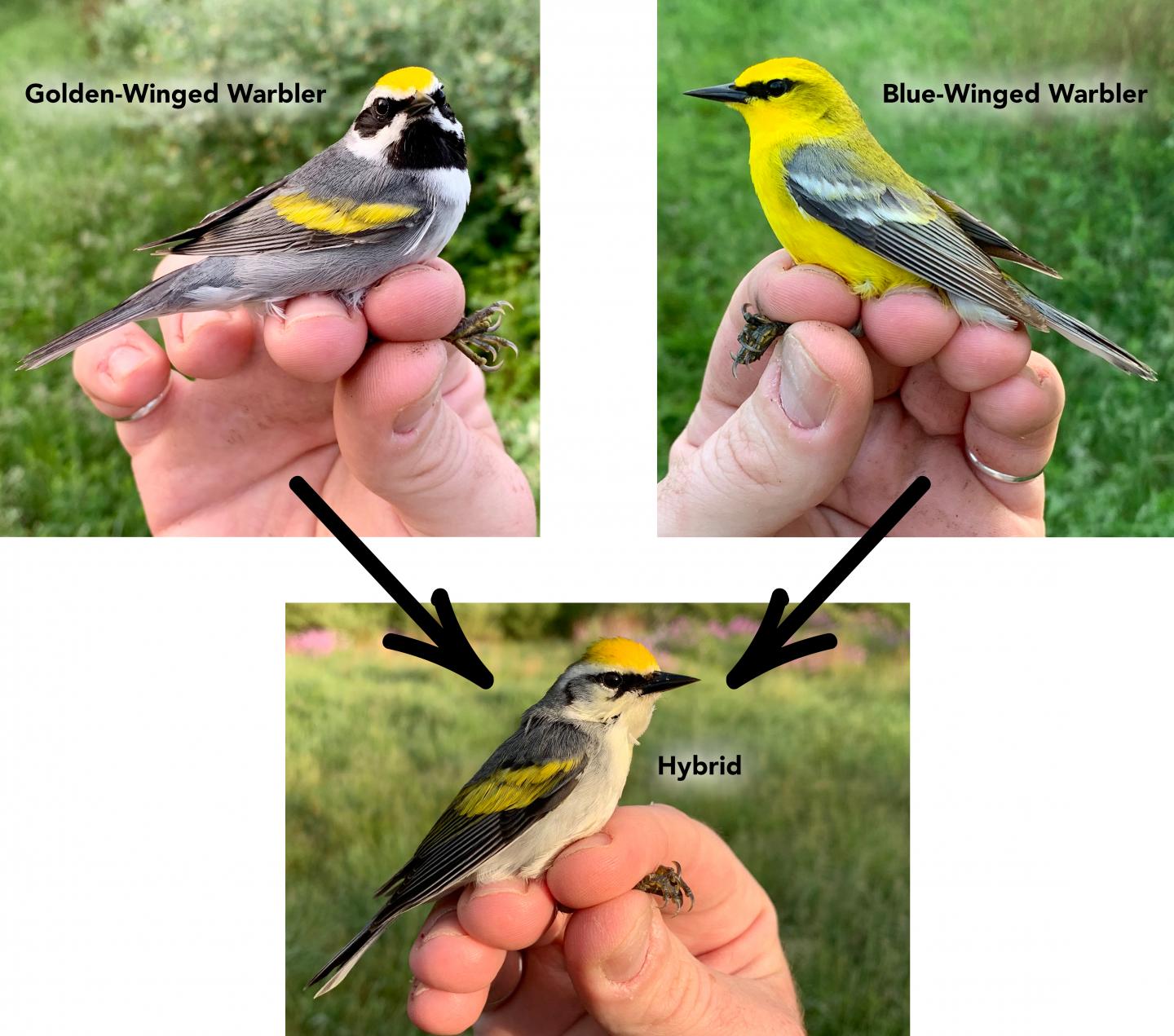
Credit: David Toews, Penn State
A new study has narrowed down the region of the genome that drives the black color in throat and face of warblers by studying the hybrid offspring produced when two species mate. The hybrids of golden-winged and blue-winged warblers have a mix of coloration from the parent species, which allows researchers to identify which regions of the genome are associated with which color patterns. The study, led by researchers at Penn State, also reveals a more complex basis for the amount of yellow in warbler bellies and raises concerns about how hybrids of these species are classified.
Their results appear online in the journal The Auk: Ornithological Advances.
“The distinct plumage of these otherwise very similar birds has perplexed ornithologists for more than a hundred years,” said Marcella Baiz, postdoctoral researcher at Penn State and first author of the paper. “Our research team previously compared the genomes of golden-winged and blue-winged warblers and identified 6 regions that differed between them, some of which may control color. In this study, we used hybrid birds of these species, which mix and match the features of their parent species, to help identify which regions of the genome are associated with which color patterns.”
Color is an important cue for warblers and is prominently displayed during mating and other behaviors. Blue-winged warblers have yellow throats and bellies, while golden-winged warblers have white bellies and a black throat patch and face mask. Hybrids of these species vary in amounts of yellow and whether they have a black face mask and throat, and these characteristics are commonly used to categorize birds into different classes of hybrids.
The research team rated hybrid birds based on their plumage color and genetic likeness to the two parental species. They found that the amount of yellow in hybrids, which is produced by pigments called carotenoids, is not directly related to a bird’s genetic likeness to the parent species–for example, hybrids with more yellow were not genetically closer to blue-winged warblers. Additionally, the extent of yellow in hybrids re-captured in subsequent years appeared to decline over time.
“Some researchers have hoped that the extent of yellow could indicate how many generations a hybrid is removed from the parent species,” said David Toews, assistant professor of biology at Penn State and leader of the research team. “Our results indicate that it isn’t quite so straightforward, and that classifying hybrids into groups based on the amount of yellow can be misleading.”
The inheritance of a black throat patch and face mask, however, appears to be much more straightforward. The research team previously identified a genetic region related to black coloration in warblers. In the current study, the team used a rarer type of hybrid to narrow that to a region about five times smaller.
“This one type of very rare hybrid looks almost entirely like a blue-winged warbler, with a yellow body but with a black throat patch and face mask, like a golden-winged warbler,” said Baiz. “By comparing its genome to that of blue-wing warblers, we were able to identify a much smaller genetic region where the birds differed, which we believe drives the black coloration.”
The genetic region is located near the Agouti-signaling protein (ASIP) gene, which is thought to regulate production of the pigment melanin in some birds. Next, the research team would like to confirm that this section of the genome affects expression of the ASIP protein in warblers and underlies differences in their black plumage patches.
“We plan to continue to study the evolution of color across the 110 species of warblers, which have incredibly diverse plumage,” said Toews. “Now that we have identified a starting point, this narrowed down genetic region, we won’t be stabbing in the dark.”
###
In addition to Baiz and Toews, the research team includes Gunnar Kramer and Henry Streby from the University of Toledo, Scott Taylor from the University of Colorado, Boulder, and Irby Lovette from the Cornell Lab of Ornithology. This research was supported by the Cornell Lab of Ornithology, the U.S. Geological Survey, and the National Science Foundation.
Media Contact
Gail McCormick
[email protected]
Original Source
https:/
Related Journal Article
http://dx.